
Japan reinforces male-only succession in Imperial House Law
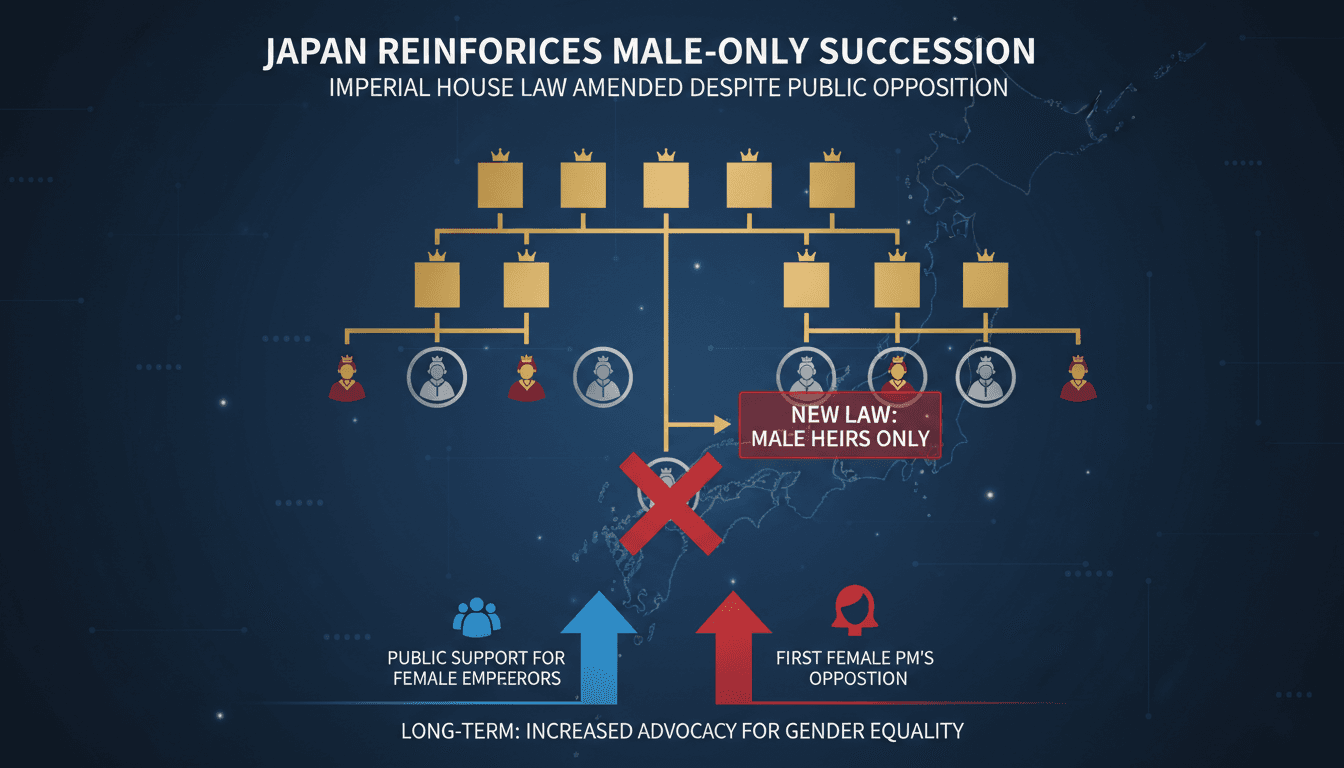
Here's what it means for you.
The recent changes to Japan's Imperial House Law underscore the ongoing tension between traditional values and modern societal expectations regarding gender roles. With public support for female emperors growing, this legislative move may catalyze further advocacy for gender equality in royal succession. The implications of this law could influence future discussions and potential amendments, reflecting a shift in public sentiment. The decision to maintain a male-only succession policy, despite significant public backing for female emperors, highlights the complexities of cultural heritage and contemporary values. As Japan navigates these challenges, the conversation around gender equality in the monarchy is likely to intensify.
What happened
Japan's Parliament has enacted revisions to the Imperial House Law, reinforcing a male-only succession policy. This legislative change prevents Princess Aiko from inheriting the throne, despite widespread public support for allowing female emperors. The new law permits the adoption of male relatives aged over 15 back into the imperial family, yet it maintains the ban on women ascending to the throne.
The changes were officially enacted on July 17, 2026, marking a significant moment in Japan's legislative history. While the law introduces some flexibility, it ultimately preserves the exclusion of women from the imperial lineage.
The Context
Public opinion polls indicate broad support for allowing female emperors, reflecting a shift in societal attitudes towards gender roles. However, the first female prime minister of Japan has expressed opposition to the idea of a female emperor, illustrating the divide between political leadership and public sentiment. The historical significance of Japan's imperial lineage, which spans over 1,500 years, adds weight to the ongoing debate.
The timing of this legislative change comes amid increasing discussions about gender equality in various sectors of Japanese society. As the nation grapples with its traditions, the implications of this law may resonate beyond the monarchy, influencing broader societal norms.
Takeaway
The ongoing debate surrounding female succession in Japan's imperial family highlights significant societal tensions regarding gender roles and tradition. As public support for female emperors continues to grow, future amendments to the Imperial House Law may become necessary to address evolving views on gender and succession.
The potential for public advocacy movements advocating for female emperors could reshape the landscape of royal succession in Japan. Observers should watch for shifts in public opinion and legislative responses in the coming years.
Conservative-leaning coverage of current events.
"Fox News is a highly influential conservative news outlet known for right-leaning political commentary and coverage."
— A47 Editor
Asian nation with 1,500-year-old imperial line insists only men can become emperor in policy revision
Japan's Parliament has revised the Imperial House Law to enforce a male-only succession policy, effectively preventing Princess Aiko from inheriting the throne despite public support for her candidacy. This decision underscores the longstanding tradi...
International stories from NPR’s global desk.
"NPR is an American public media organization known for thoughtful reporting and a slightly left-leaning editorial tone."
— A47 Editor
Japan revises law to ensure supply of (male) heirs to the imperial throne
Japan's parliament has revised its imperial succession laws to ensure a supply of male heirs to the throne, amidst a growing debate on the role of women in the imperial family. The changes allow distant male relatives to rejoin the imperial family an...
International stories from NPR’s global desk.
"NPR is an American public media organization known for thoughtful reporting and a slightly left-leaning editorial tone."
— A47 Editor
Japan revises law on royals, keeps blocking women from throne
Japan's parliament has revised its imperial succession laws to ensure a supply of male heirs to the throne, while maintaining the ban on female emperors, despite growing public support for a female emperor driven by a popular princess. The changes al...
International coverage of politics, culture, and current affairs.
"BBC News is widely regarded as a reputable international news organization, known for its impartial tone and public service mandate."
— A47 Editor
Japan relaxes royal succession rules - but ban on female emperors remains
Japan has enacted changes to its imperial succession laws, allowing the adoption of male distant relatives aged over 15 back into the imperial family, while maintaining the ban on female emperors. This legislative move aims to address the dwindling n...
Political, social, and economic news across Asia and the Pacific.
"France 24 is viewed as a globally focused outlet with balanced coverage and a European perspective."
— A47 Editor
Japan changes imperial succession law but keeps ban on female emperor
Japan's parliament has enacted changes to its imperial succession laws, allowing male distant relatives to rejoin the imperial family and enabling women to retain royal status after marrying commoners. However, the legislation maintains the ban on fe...