
Pentagon awards $3 billion in missile defense contracts to Northrop Grumman and Lockheed Martin
What happened
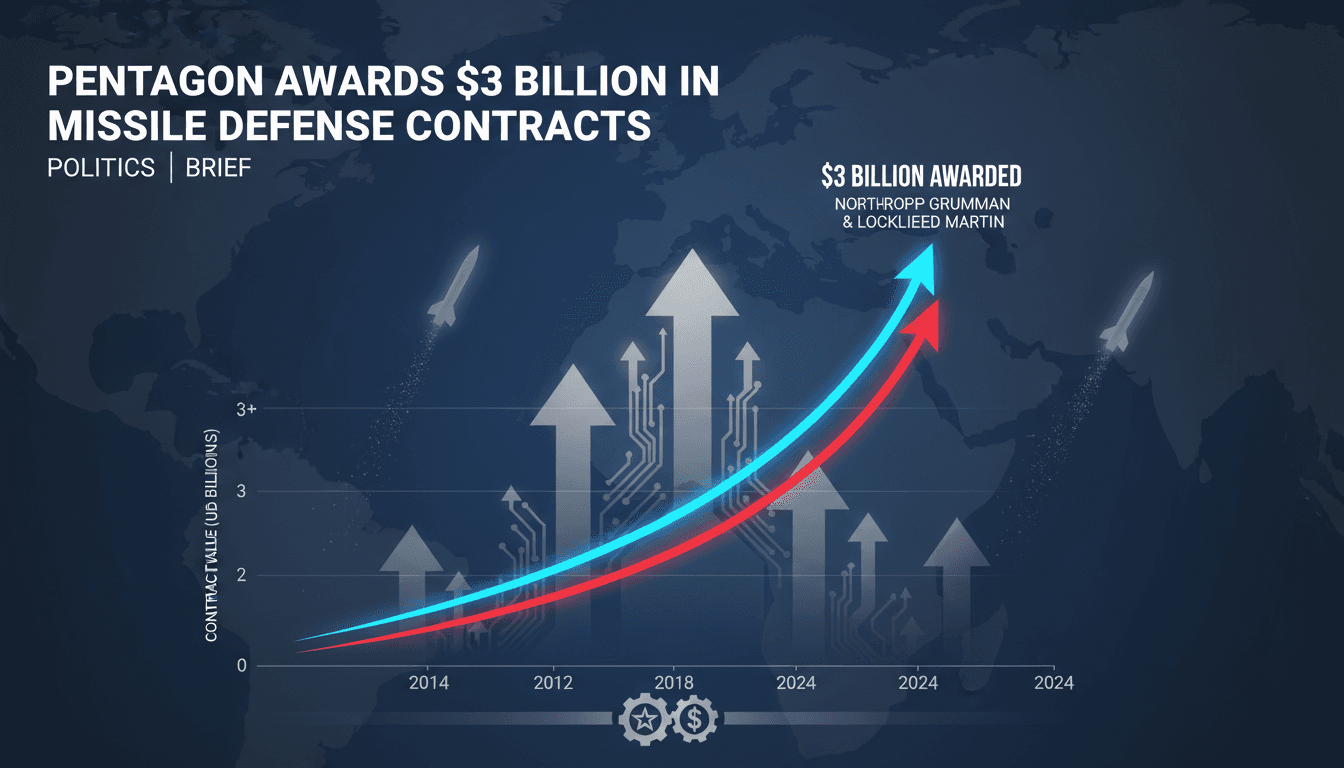
The U.S. Department of Defense has signed contracts exceeding $3 billion with Northrop Grumman and Lockheed Martin to boost the production of missile interceptor components. This decision comes as a direct response to heightened military needs driven by ongoing conflicts and the strain on existing stockpiles. The agreements specifically aim to enhance the production of critical missile defense systems, including Patriot and THAAD missile parts.
The contracts were officially signed on August 3, 2026, and publicly announced the following day. Northrop Grumman's share of the contracts totals $3 billion, underscoring a substantial investment in U.S. defense capabilities. This initiative reflects a strategic move to address stockpile shortages and improve military readiness.
The Context
The Pentagon's decision to increase missile defense production is influenced by the current geopolitical landscape, particularly the conflicts in Iran and Ukraine. As these situations evolve, the U.S. military faces increased pressure to maintain and enhance its defense capabilities. The involvement of major defense contractors like Northrop Grumman and Lockheed Martin highlights the critical role of the military-industrial complex in responding to national security needs.
This investment is not only a response to immediate military requirements but also a long-term strategy to bolster U.S. defense capabilities. The timing of these contracts suggests a proactive approach to potential future conflicts, ensuring that the U.S. remains prepared in an increasingly volatile global environment.
Takeaway
The expansion of missile interceptor production reflects the U.S.'s strategic response to ongoing global security challenges. As geopolitical tensions persist, it is likely that further investments in missile defense systems will follow, leading to additional contracts and collaborations within the defense sector. Stakeholders should monitor developments in U.S. defense contracts closely, as they may have significant implications for military readiness and international relations.
In the coming months, the focus will be on how these contracts impact the production capabilities of Northrop Grumman and Lockheed Martin, as well as the broader defense landscape. Observers should also watch for potential shifts in U.S. foreign policy, particularly concerning Iran and Ukraine.
Capitol Hill news, legislation, and policy insight.
"The Hill specializes in U.S. politics and policy, with a focus on Capitol Hill developments and a reputation for insider reporting."
— A47 Editor
Pentagon signs deal to expand missile interceptor systems production
The Pentagon has signed framework agreements with Northrop Grumman and Lockheed Martin to expand the production of missile interceptor components, a strategic move to enhance the U.S. missile defense capabilities. This agreement underscores the incre...
English-language news from Qatar covering domestic and regional affairs.
"Gulf Times reflects Qatari perspectives on regional developments."
— A47 Editor
US signs deal to boost production of Patriot, THAAD missile parts
The United States has finalized a deal exceeding $3 billion with Lockheed Martin and Northrop Grumman to enhance the production of Patriot and THAAD missile components, a move prompted by increasing tensions in Iran and ongoing conflicts in Ukraine t...
Global news coverage with extensive reporting on Middle Eastern conflicts and geopolitics.
"Al Jazeera is a Qatar-based broadcaster known for wide regional coverage and alternative perspectives."
— A47 Editor
Pentagon boosts Patriot, THAAD interceptor output amid stockpile strain
The Pentagon has announced an increase in the production of Patriot and THAAD missile interceptors to address the strain on its stockpile, with defense contractors Lockheed Martin and Northrop Grumman poised to benefit from billion-dollar contracts a...
Comprehensive coverage of Middle Eastern and global issues.
"Al Jazeera is a prominent voice from the Global South, especially the Middle East, with an emphasis on underreported stories."
— A47 Editor
Pentagon boosts Patriot, THAAD interceptor output amid stockpile strain
The Pentagon has announced an increase in the production of Patriot and THAAD missile interceptors to address the strain on its stockpile, with defense contractors Lockheed Martin and Northrop Grumman poised to benefit from billion-dollar contracts a...
Pan-Arab news coverage spanning politics, business, sports, and regional affairs.
"Asharq Al-Awsat reflects a broad Arab editorial perspective with strong attention to regional geopolitics."
— A47 Editor
أميركا توقِّع اتفاقية لزيادة إنتاج قطع غيار الصواريخ الاعتراضية
The U.S. Department of Defense has signed a framework agreement with Lockheed Martin and Northrop Grumman to increase the production capacity of components for defensive systems. This agreement aims to enhance the manufacturing capabilities of critic...
Insights and news on social issues, policy, and political movements across the United States.
"The Wall Street Journal is known for its deep political coverage, especially at the intersection of policy, regulation, and social dynamics."
— A47 Editor
Northrop Grumman Enters $3 Billion Contracts to Increase Missile Defense Production
Northrop Grumman has signed two contracts totaling $3 billion to accelerate the production of missile interceptors, a strategic move aimed at enhancing the company's missile defense capabilities.
Insights and news on social issues, policy, and political movements across the United States.
"The Wall Street Journal is known for its deep political coverage, especially at the intersection of policy, regulation, and social dynamics."
— A47 Editor
Northrop Grumman Enters $3 Billion Contracts to Increase Missile Defense Production
Northrop Grumman has signed two contracts worth a total of $3 billion aimed at accelerating the production of missile interceptors. This move is part of the company's strategy to enhance its capabilities in missile defense systems.