
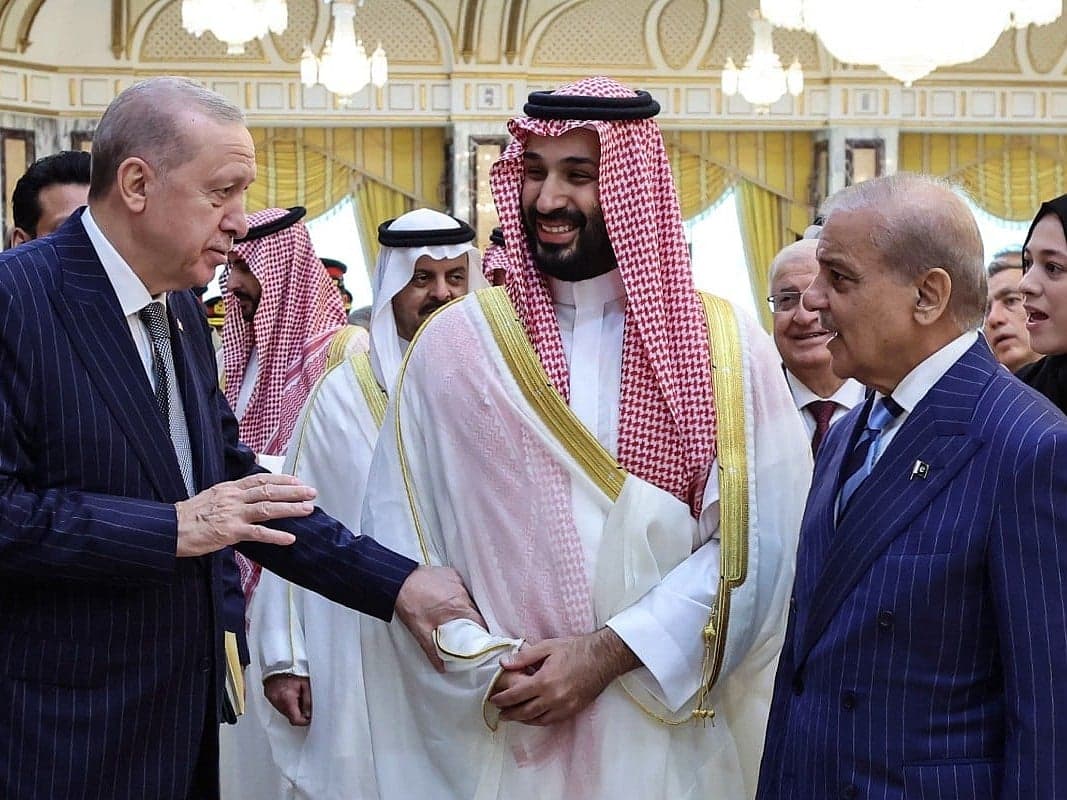
Saudi Arabia, Turkey, and Pakistan Sign Mecca Joint Defence Agreement
Why it matters
This agreement signals a shift towards regional self-reliance in defense, potentially altering the geopolitical landscape.
What happened (in 30 seconds)
- On August 7, 2026, Saudi Arabia, Turkey, and Pakistan signed the Mecca Joint Defence Agreement, establishing a collective defense framework.
- US President Donald Trump endorsed the pact on August 17, 2026, calling it a significant step for Middle East security.
- The agreement aims to enhance military coordination and defense industry collaboration among the three nations amid rising regional tensions.
The context you actually need
- Heightened security concerns in the Middle East have prompted nations to seek greater autonomy from traditional alliances, particularly with the US.
- The pact builds on existing bilateral ties, particularly a Saudi-Pakistani mutual defense agreement from September 2025, now incorporating Turkey's military capabilities.
- Regional actors are increasingly focused on collective security measures to address threats from Iran and other geopolitical tensions.
What's really happening
The Mecca Joint Defence Agreement represents a strategic pivot for Saudi Arabia, Turkey, and Pakistan, reflecting a broader trend of regional actors seeking to bolster their security frameworks independently of Western influence. This trilateral pact establishes a collective defense mechanism akin to NATO's Article 5, where an attack on one member is considered an attack on all.
The agreement is rooted in a context of escalating tensions in the Middle East, particularly concerning Iran's missile capabilities and its influence in the region. By formalizing military cooperation, the signatories aim to enhance their deterrent capabilities against potential aggressors. This move is not merely about military alignment; it also encompasses political coordination and defense industry collaboration, which could lead to increased arms production and joint military exercises.
The endorsement from President Trump adds a layer of political visibility and legitimacy to the agreement, suggesting that the US may view this pact as a stabilizing factor in a region where it has significant interests. However, the agreement is framed by its signatories as purely defensive, aimed at enhancing their collective security without targeting specific adversaries. This positioning is crucial for maintaining diplomatic relations with other regional powers and avoiding escalation into broader conflicts.
The implications of this agreement extend beyond military cooperation. It could lead to a reconfiguration of alliances in the Middle East, as countries like Egypt may seek to join or align with this new bloc. The focus on self-reliance in defense could also encourage other nations in the region to pursue similar agreements, potentially leading to a more fragmented security landscape.
As the implementation mechanisms are developed, the agreement's success will depend on the ability of these nations to coordinate effectively and manage their defense industries collaboratively. The potential for increased military spending and joint exercises could also have economic implications, influencing defense contractors and related sectors.
Who feels it first (and how)
- Defense contractors in Saudi Arabia, Turkey, and Pakistan may see increased demand for military equipment and technology.
- Government officials in the signatory countries will need to navigate the complexities of joint military operations and political coordination.
- Businesses operating in the Middle East may experience shifts in the security landscape, affecting risk assessments and operational strategies.
What to watch next
- Implementation mechanisms: Monitor how quickly and effectively the signatories establish operational frameworks for joint military exercises and coordination. This will indicate the pact's seriousness and potential impact.
- Regional reactions: Watch for responses from other Middle Eastern countries, particularly Egypt, which may seek to join or counterbalance this new alliance.
- Economic implications: Keep an eye on defense spending trends in the region, as increased military collaboration could lead to significant investments in defense industries.
The Mecca Joint Defence Agreement has been signed and publicly endorsed.
The agreement will lead to increased military cooperation and joint exercises among the signatories.
The long-term impact on US influence in the region and how other countries will respond to this new security bloc.
Frequently Asked Questions
- Why it matters?
- This agreement signals a shift towards regional self-reliance in defense, potentially altering the geopolitical landscape.
- What happened (in 30 seconds)?
- On August 7, 2026, Saudi Arabia, Turkey, and Pakistan signed the Mecca Joint Defence Agreement, establishing a collective defense framework. US President Donald Trump endorsed the pact on August 17, 2026, calling it a significant step for Middle East security. The agreement aims to enhance military coordination and defense industry collaboration among the three nations amid rising regional tensions.
- What's really happening?
- The Mecca Joint Defence Agreement represents a strategic pivot for Saudi Arabia, Turkey, and Pakistan, reflecting a broader trend of regional actors seeking to bolster their security frameworks independently of Western influence. This trilateral pact establishes a collective defense mechanism akin to NATO's Article 5, where an attack on one member is considered an attack on all. The agreement is rooted in a context of escalating tensions in the Middle East, particularly concerning Iran's missi
- Who feels it first (and how)?
- Defense contractors in Saudi Arabia, Turkey, and Pakistan may see increased demand for military equipment and technology. Government officials in the signatory countries will need to navigate the complexities of joint military operations and political coordination. Businesses operating in the Middle East may experience shifts in the security landscape, affecting risk assessments and operational strategies.
- What to watch next?
- Implementation mechanisms: Monitor how quickly and effectively the signatories establish operational frameworks for joint military exercises and coordination. This will indicate the pact's seriousness and potential impact. Regional reactions: Watch for responses from other Middle Eastern countries, particularly Egypt, which may seek to join or counterbalance this new alliance. Economic implications: Keep an eye on defense spending trends in the region, as increased military collaboration cou
Arabic-language reporting focused on domestic developments in Saudi Arabia.
"Okaz is a mainstream Saudi newspaper that often reflects domestic priorities and official-facing coverage."
— A47 Editor
الرئيس الأمريكي يرحب باتفاقية مكة للدفاع المشترك
U.S. President Donald Trump welcomed the signing of the 'Makkah Agreement for Joint Defense' by Saudi Arabia, Turkey, and Pakistan, describing it as a significant and bold step. In a post on his Truth Social account, Trump expressed happiness at the ...
Global news coverage with extensive reporting on Middle Eastern conflicts and geopolitics.
"Al Jazeera is a Qatar-based broadcaster known for wide regional coverage and alternative perspectives."
— A47 Editor
Trump hails Mecca pact: Can it replace the region’s US security umbrella?
Former President Donald Trump has praised a newly established security pact among Saudi Arabia, Turkiye, and Pakistan, formalized in Mecca, which asserts that an attack on one member will be viewed as an attack on all. This agreement emerges as the U...
Comprehensive coverage of Middle Eastern and global issues.
"Al Jazeera is a prominent voice from the Global South, especially the Middle East, with an emphasis on underreported stories."
— A47 Editor
Trump hails Mecca pact: Can it replace the region’s US security umbrella?
Former President Donald Trump has praised a newly established security pact among Saudi Arabia, Turkiye, and Pakistan, formalized in Mecca, which asserts that an attack on one member will be viewed as an attack on all. This agreement emerges as the U...
English-language reporting focused on Saudi Arabia and regional affairs.
"Saudi Gazette provides English-language coverage that often aligns with mainstream Saudi news priorities."
— A47 Editor
Trump hails Makkah Joint Defense Agreement as ‘big, bold and important first step’
US President Donald Trump praised the Makkah Joint Defense Agreement signed by Saudi Arabia, Türkiye, and Pakistan, calling it a significant step towards enhancing regional security. The agreement, established on August 7, creates a trilateral framew...
English-language reporting on Saudi politics, policy, and society.
"Saudi Gazette reflects mainstream Saudi institutional perspectives."
— A47 Editor
Trump hails Makkah Joint Defense Agreement as ‘big, bold and important first step’
US President Donald Trump praised the Makkah Joint Defense Agreement signed by Saudi Arabia, Türkiye, and Pakistan, calling it a significant step towards enhancing regional security. The agreement, established on August 7, creates a trilateral framew...
UAE-based newspaper covering Gulf politics, society, and international developments.
"Gulf News is one of the UAE’s most prominent English-language publications."
— A47 Editor
Trump hails ‘Big, Bold’ Mecca defence pact as Saudi Arabia, Turkey and Pakistan forge new security bloc
US President Donald Trump praised the newly formalized defense pact between Saudi Arabia, Turkey, and Pakistan, established in Mecca, which declares that an armed attack on one will be considered an attack on all three nations. This agreement aims to...
A curated Gulf News feed featuring major stories across news, business, opinion, and lifestyle.
"Gulf News is a major UAE newspaper whose featured stories feed reflects a broad editorial mix shaped for a Gulf audience."
— A47 Editor
Trump hails ‘Big, Bold’ Mecca defence pact as Saudi Arabia, Turkey and Pakistan forge new security bloc
US President Donald Trump praised the newly formalized defense pact between Saudi Arabia, Turkey, and Pakistan, established in Mecca, which declares that an armed attack on one will be considered an attack on all three nations. This agreement aims to...
English-language news from Qatar covering domestic and regional affairs.
"Gulf Times reflects Qatari perspectives on regional developments."
— A47 Editor
President Trump welcomes defence pact between Saudi Arabia, Turkiye and Pakistan
US President Donald Trump expressed his approval of the recently signed defense pact among Saudi Arabia, Turkiye, and Pakistan, which establishes a mutual defense framework during a trilateral summit in Makkah. This agreement treats an armed attack o...
Jordanian news and regional updates.
"Roya News is a Jordanian outlet focused on breaking news and local affairs."
— A47 Editor
ترمب: اتفاق مكة للدفاع المشترك يظهر كيف تتمكن الدول من الدفاع عن نفسها
Former President Trump stated that the Mecca Agreement for mutual defense illustrates how nations can protect themselves. This announcement highlights the importance of international cooperation in security matters.