
Lebanese Parliament Advocates for UNIFIL Extension Amid Security Concerns
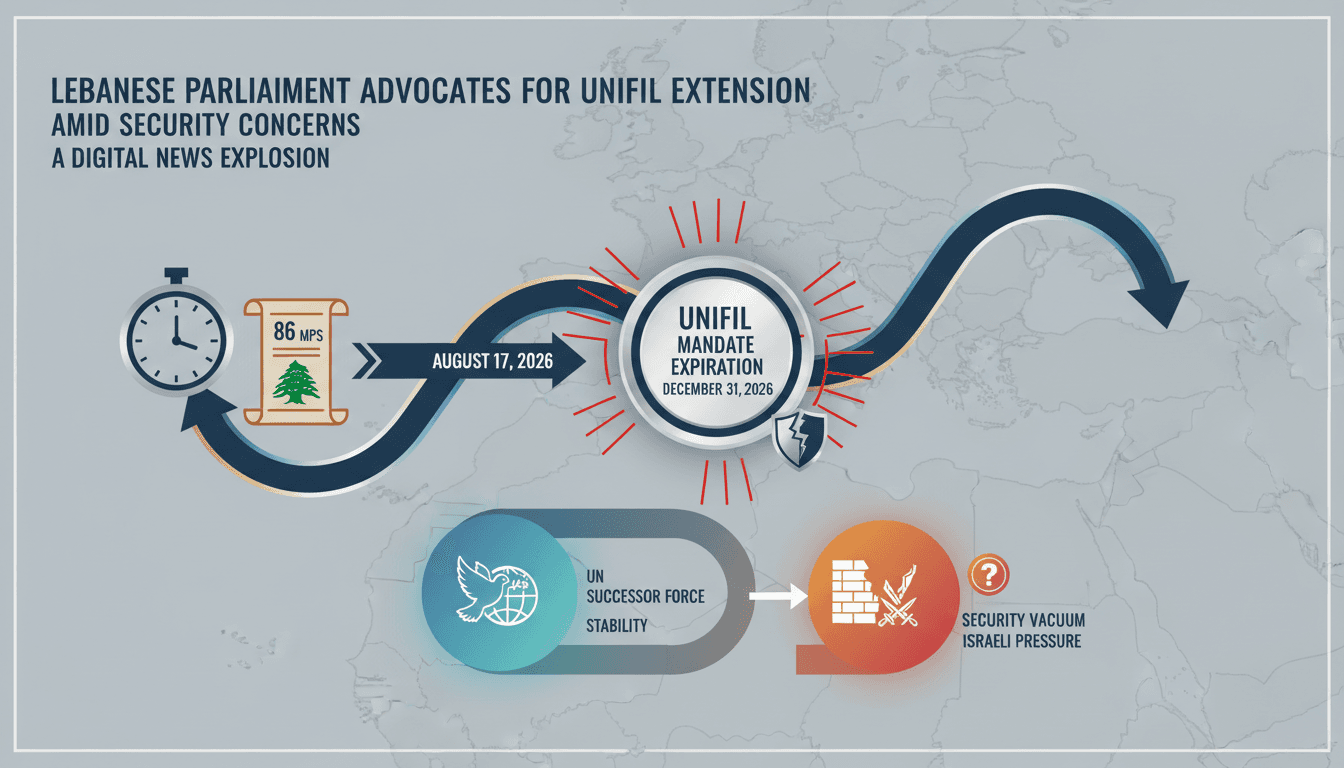
Here's what it means for you.
Stability in Lebanon could influence regional economic conditions, impacting Gulf investments and travel.
Why it matters
The extension of UNIFIL is crucial for maintaining security in southern Lebanon, which has broader implications for regional stability and economic interests.
What happened (in 30 seconds)
- On August 17, 2026, Lebanese President Joseph Aoun received a petition from 86 MPs advocating for the extension of UNIFIL.
- Lebanon's leadership emphasized the importance of UNIFIL for security and humanitarian efforts amid Israeli pressure to terminate the mission.
- Alternatives to UNIFIL, including a potential successor force, are being considered to prevent a security vacuum after the mandate expires on December 31, 2026.
The context you actually need
- UNIFIL was established in 1978 to oversee the withdrawal of Israeli forces and has been critical in maintaining peace in southern Lebanon.
- The mission's mandate was last extended in August 2025, with a planned drawdown in 2027, raising concerns about security in the region.
- Israeli objections to UNIFIL's effectiveness have prompted Lebanese officials to seek either an extension or a replacement to support local forces and prevent escalation.
What's really happening
The push for extending the United Nations Interim Force in Lebanon (UNIFIL) reflects a complex interplay of local and regional dynamics. On August 17, 2026, President Joseph Aoun met with a parliamentary delegation led by MP Melhem Khalaf, who presented a petition signed by 86 MPs—representing over two-thirds of the Lebanese parliament—calling for the continuation of UNIFIL. This overwhelming support underscores a unified stance among Lebanese leaders regarding the mission's significance for national security and humanitarian efforts.
Lebanon faces a precarious security situation, particularly in the south, where tensions with Israel and the presence of Hezbollah pose ongoing challenges. The Lebanese government has articulated that UNIFIL plays a vital role in stabilizing southern villages, providing humanitarian aid, and coordinating with the Lebanese Armed Forces. The mission's presence is seen as a buffer against potential escalations that could arise from Israeli military actions or Hezbollah's activities.
Israeli officials have increasingly criticized UNIFIL, arguing that it has failed to effectively curb Hezbollah's influence and activities. This pressure has prompted Lebanese leaders to advocate for either an extension of UNIFIL's mandate or the establishment of a successor force under UN auspices. The latter option aims to ensure that international support remains in place to prevent a security vacuum that could lead to increased violence or instability.
Ministerial sources indicate that discussions are ongoing regarding extending UNIFIL's mandate to 2030 or exploring a multinational coalition proposed by France and Italy. This reflects a strategic pivot towards securing a more robust international presence in the region, which is critical for Lebanon's post-conflict security needs. The parliamentary initiative is framed as a supportive measure for the presidency, emphasizing the need for coordination with the Lebanese Army and adherence to UN Security Council Resolution 1701.
The implications of this diplomatic effort extend beyond Lebanon. A stable southern Lebanon is essential for regional economic interests, particularly for Gulf nations that have vested interests in maintaining peace and stability in the area. The potential for reduced escalation risks could enhance Gulf economic and travel interests, making this issue relevant to a broader audience.
Who feels it first (and how)
- Lebanese citizens in southern regions who rely on UNIFIL for security and humanitarian support.
- Local businesses that depend on stability for economic activities and trade.
- Gulf investors who may be affected by regional stability and security conditions impacting their investments.
What to watch next
- UN Security Council discussions on the mandate extension will reveal international support dynamics and potential shifts in troop contributions.
- Responses from Israel regarding the extension or replacement of UNIFIL could indicate escalating tensions or a willingness to negotiate.
- Local security developments in southern Lebanon will provide insights into the effectiveness of UNIFIL and the potential for increased violence or stability.
The current mandate for UNIFIL expires on December 31, 2026.
Diplomatic efforts will continue to secure either an extension of UNIFIL or a successor force.
The extent of Israeli opposition and its impact on Lebanon's security landscape remains uncertain.
Frequently Asked Questions
- Why it matters?
- The extension of UNIFIL is crucial for maintaining security in southern Lebanon, which has broader implications for regional stability and economic interests.
- What happened (in 30 seconds)?
- On August 17, 2026, Lebanese President Joseph Aoun received a petition from 86 MPs advocating for the extension of UNIFIL. Lebanon's leadership emphasized the importance of UNIFIL for security and humanitarian efforts amid Israeli pressure to terminate the mission. Alternatives to UNIFIL, including a potential successor force, are being considered to prevent a security vacuum after the mandate expires on December 31, 2026.
- What's really happening?
- The push for extending the United Nations Interim Force in Lebanon (UNIFIL) reflects a complex interplay of local and regional dynamics. On August 17, 2026, President Joseph Aoun met with a parliamentary delegation led by MP Melhem Khalaf, who presented a petition signed by 86 MPs—representing over two-thirds of the Lebanese parliament—calling for the continuation of UNIFIL. This overwhelming support underscores a unified stance among Lebanese leaders regarding the mission's significance for nat
- Who feels it first (and how)?
- Lebanese citizens in southern regions who rely on UNIFIL for security and humanitarian support. Local businesses that depend on stability for economic activities and trade. Gulf investors who may be affected by regional stability and security conditions impacting their investments.
- What to watch next?
- UN Security Council discussions on the mandate extension will reveal international support dynamics and potential shifts in troop contributions. Responses from Israel regarding the extension or replacement of UNIFIL could indicate escalating tensions or a willingness to negotiate. Local security developments in southern Lebanon will provide insights into the effectiveness of UNIFIL and the potential for increased violence or stability.
Pan-Arab news coverage spanning politics, business, sports, and regional affairs.
"Asharq Al-Awsat reflects a broad Arab editorial perspective with strong attention to regional geopolitics."
— A47 Editor
التمديد لقوات «يونيفيل»... تحرك لبناني لمنع الفراغ جنوباً
Lebanese President Joseph Aoun emphasized the importance of the continued presence of UNIFIL forces in southern Lebanon, stating that Lebanon's primary option is to extend their mandate. This statement highlights the Lebanese government's commitment ...
Arabic-language coverage of international news and geopolitics.
"RT Arabic is a Russian state-funded outlet often criticized for promoting Kremlin-aligned narratives."
— A47 Editor
عون: الأولوية لتمديد "اليونيفيل" في الجنوب وإسرائيل تضغط لإخراجها منذ عام
Lebanese President Joseph Aoun emphasized that his primary focus is on extending the mandate of the United Nations Interim Force in Lebanon (UNIFIL) in southern Lebanon, amidst ongoing Israeli efforts to remove the force, which have been persistent f...
Jordanian news and regional updates.
"Roya News is a Jordanian outlet focused on breaking news and local affairs."
— A47 Editor
عون يتمسك ببقاء اليونيفيل في الجنوب.. وبديل دولي مطروح في حال تعذر التمديد
Lebanese President Joseph Aoun reiterated Beirut's commitment to the continued presence of the United Nations Interim Force in Lebanon (UNIFIL) in the southern region, emphasizing its importance for stability. He indicated that an international alter...