
Trump Orders Reduction in US-South Korea Military Drills Over Iran Stance
Here's what it means for you.
If you’re in the defense sector or involved in international relations, this shift could reshape strategic partnerships and military readiness in the Asia-Pacific region.
Why it matters
This development raises questions about the reliability of US alliances and could influence regional security dynamics.
What happened (in 30 seconds)
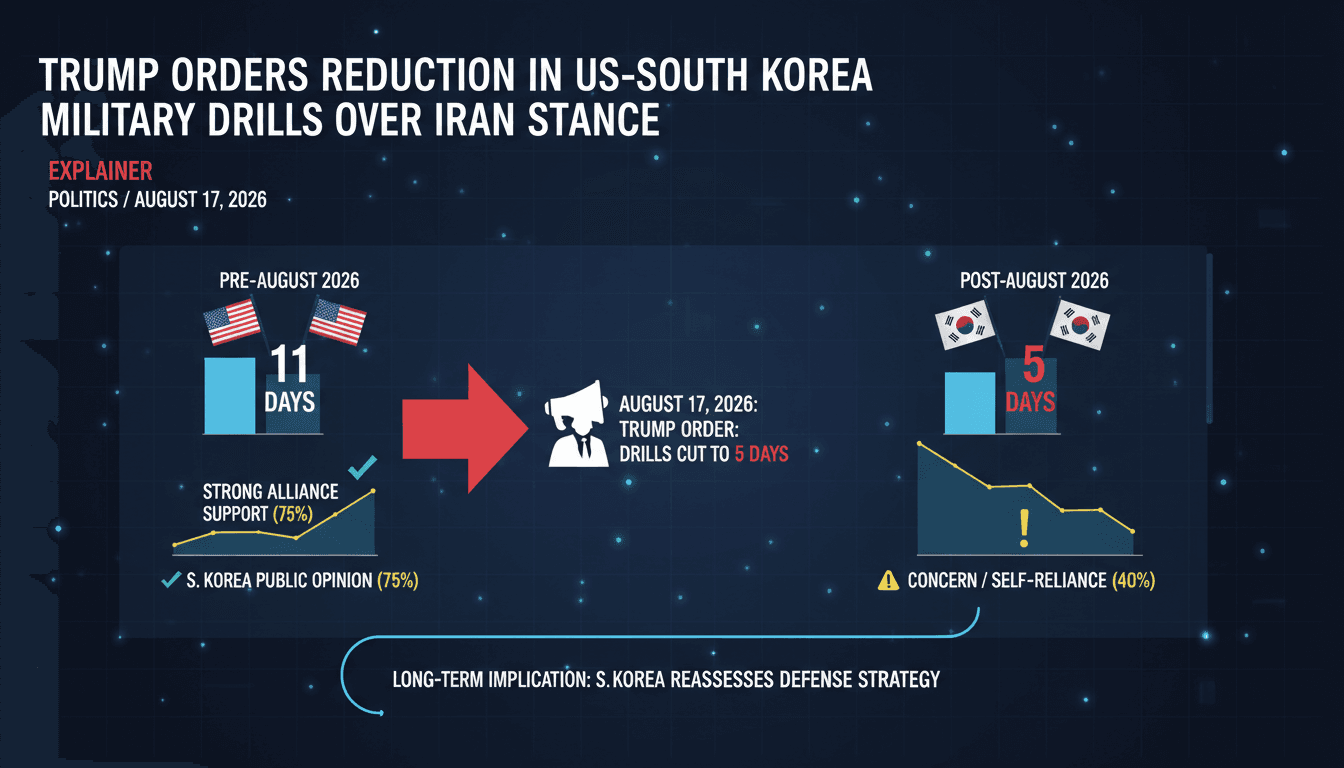
- Trump directed a reduction in US-South Korea military drills from 11 to 5 days, citing costs and South Korea's refusal to support US actions against Iran.
- South Korean officials were caught off guard, negotiating a scaled-back exercise just hours before it was set to begin, raising alarms about the alliance's reliability.
- Domestic debates intensified in South Korea regarding defense autonomy and the implications of US pressure on military cooperation.
The context you actually need
- The US-South Korea alliance has been a cornerstone of security in East Asia since the Korean War, with 28,500 US troops stationed in South Korea to deter North Korean threats.
- In 2026, the US and Israel were engaged in military operations against Iran, seeking support from allies like South Korea, which declined due to legal and strategic constraints.
- Trade tensions also complicate the relationship, with unresolved issues including a pledged $350 billion South Korean investment in the US.
What's really happening
On August 17, 2026, President Trump took to Truth Social to announce a significant reduction in the annual joint military exercises with South Korea, linking this decision to Seoul's refusal to participate in the US-Israel military campaign against Iran. This announcement came just hours before the drills were set to commence, catching South Korean officials off guard during a national holiday. The exercises were curtailed from 11 days to just 5, with a limited scope that raised concerns about the future of the alliance.
The underlying motivations for Trump's directive appear multifaceted. He cited the costs associated with the drills and described South Korea's refusal to support US actions against Iran as an "inappropriate and hostile" signal to North Korea. This framing suggests a strategic pivot where the US is willing to leverage military cooperation as a bargaining chip in broader geopolitical negotiations.
In South Korea, the reaction was immediate and intense. President Lee Jae Myung emphasized the importance of self-reliant defense capabilities while also advocating for continued coordination with the US. However, the lack of prior notice regarding the drill reduction sparked criticism from opposition figures, who viewed the refusal to support Iran as a diplomatic misstep. Media outlets highlighted the vulnerabilities in the alliance, prompting public discourse on the need for greater autonomy in defense matters.
Polling data from late March 2026 indicated that only 38% of South Koreans supported aiding the US in the Iran conflict, reflecting a growing sentiment for self-reliance. This shift in public opinion could lead to significant changes in South Korea's defense policy, including discussions around nuclear options and reduced dependence on US military support.
The episode has not only strained diplomatic relations but has also revived debates about the future of the US-South Korea alliance. As South Korea grapples with its security strategy, the implications of this reduced military cooperation could resonate throughout the Asia-Pacific region, affecting alliances and military readiness.
Who feels it first (and how)
- Defense contractors in South Korea may see shifts in contracts and funding due to reduced military exercises.
- Military personnel in both the US and South Korea could face changes in training and operational readiness.
- Political leaders in South Korea will need to navigate public sentiment and potential calls for increased defense autonomy.
What to watch next
- Public opinion trends in South Korea regarding military cooperation with the US, as shifts could influence future defense policies.
- Responses from North Korea, which may interpret the reduced drills as an opportunity to escalate its own military activities.
- Diplomatic negotiations between the US and South Korea, particularly regarding trade and military support, which could reshape the alliance's future.
The US-South Korea military drills have been reduced from 11 to 5 days.
Increased discussions in South Korea about defense autonomy and potential nuclear options.
The long-term impact on US-South Korea relations and regional security dynamics.
Frequently Asked Questions
- Why it matters?
- This development raises questions about the reliability of US alliances and could influence regional security dynamics.
- What happened (in 30 seconds)?
- Trump directed a reduction in US-South Korea military drills from 11 to 5 days, citing costs and South Korea's refusal to support US actions against Iran. South Korean officials were caught off guard, negotiating a scaled-back exercise just hours before it was set to begin, raising alarms about the alliance's reliability. Domestic debates intensified in South Korea regarding defense autonomy and the implications of US pressure on military cooperation.
- What's really happening?
- On August 17, 2026, President Trump took to Truth Social to announce a significant reduction in the annual joint military exercises with South Korea, linking this decision to Seoul's refusal to participate in the US-Israel military campaign against Iran. This announcement came just hours before the drills were set to commence, catching South Korean officials off guard during a national holiday. The exercises were curtailed from 11 days to just 5, with a limited scope that raised concerns about t
- Who feels it first (and how)?
- Defense contractors in South Korea may see shifts in contracts and funding due to reduced military exercises. Military personnel in both the US and South Korea could face changes in training and operational readiness. Political leaders in South Korea will need to navigate public sentiment and potential calls for increased defense autonomy.
- What to watch next?
- Public opinion trends in South Korea regarding military cooperation with the US, as shifts could influence future defense policies. Responses from North Korea, which may interpret the reduced drills as an opportunity to escalate its own military activities. Diplomatic negotiations between the US and South Korea, particularly regarding trade and military support, which could reshape the alliance's future.
Global news coverage with extensive reporting on Middle Eastern conflicts and geopolitics.
"Al Jazeera is a Qatar-based broadcaster known for wide regional coverage and alternative perspectives."
— A47 Editor
Alarm in South Korea as Iran dispute with Trump shakes a 72-year alliance
Tensions have escalated in South Korea following President Trump's directive to significantly reduce U.S. military drills with the country, a decision linked to South Korea's non-involvement in the ongoing conflict with Iran. This move has raised con...
Comprehensive coverage of Middle Eastern and global issues.
"Al Jazeera is a prominent voice from the Global South, especially the Middle East, with an emphasis on underreported stories."
— A47 Editor
Alarm in South Korea as Iran dispute with Trump shakes a 72-year alliance
Tensions have escalated in South Korea following President Trump's directive to significantly reduce U.S. military drills with the country, a decision linked to South Korea's non-involvement in the ongoing conflict with Iran. This move has raised con...
Regional coverage and analysis focused on politics, diplomacy, and business across the Middle East.
"Al-Monitor is known for analytical reporting on Middle East politics and policy developments."
— A47 Editor
South Korea minister says Trump appears to be pressuring Seoul over Iran, investment
South Korean Foreign Minister Cho Hyun stated that U.S. President Donald Trump's directive to reduce joint military exercises is perceived as a tactic to pressure Seoul into supporting U.S. actions regarding Iran, alongside other unresolved investmen...
Top international stories selected by The Guardian editors.
"The Guardian is known for its progressive editorial stance and in-depth analysis."
— A47 Editor
In cutting joint drills, Trump has given South Korea’s president what he wants. So why does Seoul look so uneasy?
President Donald Trump has ordered a significant reduction in joint military exercises with South Korea, a move that aligns with South Korean President Lee Jae Myung's long-standing push for stronger homegrown defenses and reduced military posturing ...