
Trump Administration Expands Third-Country Deportation Network to Haiti and Liberia
Why it matters
This expansion of deportation agreements reflects a significant shift in U.S. immigration policy, impacting global migration dynamics.
What happened (in 30 seconds)
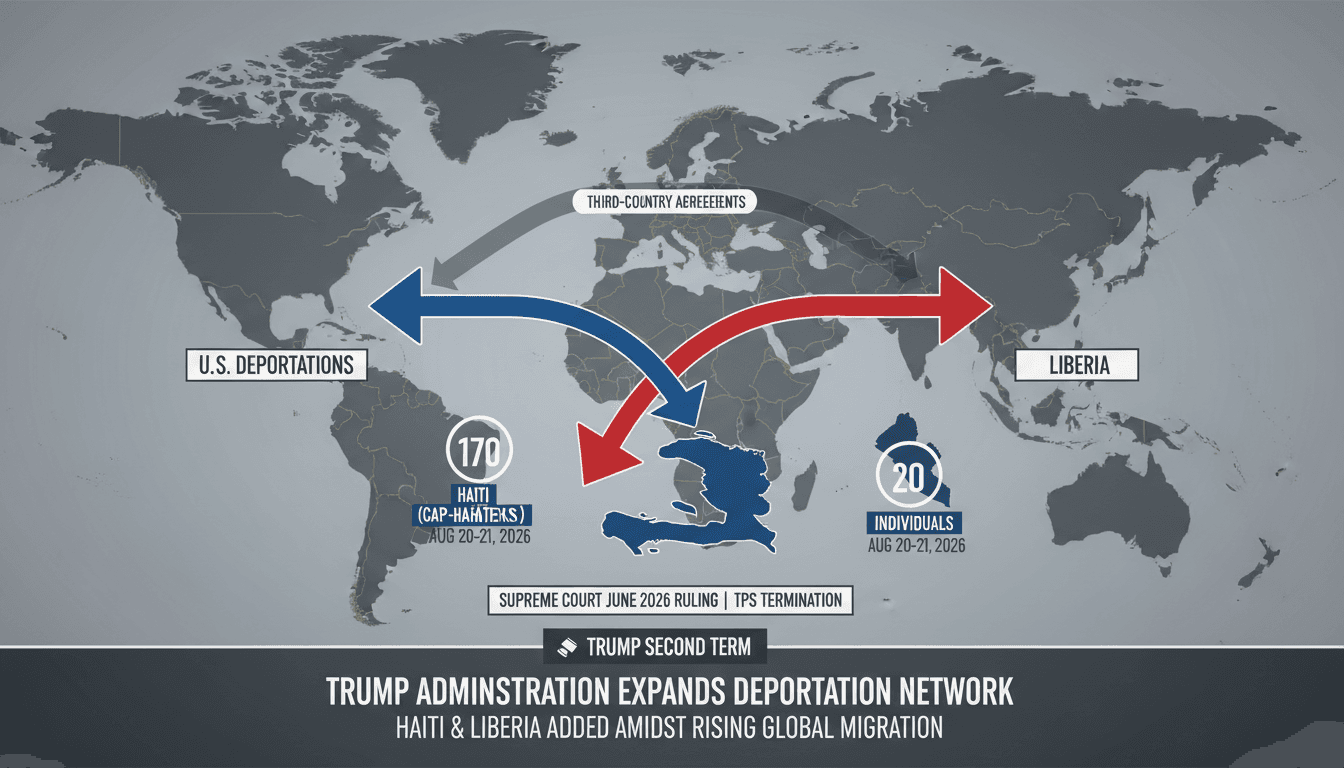
- On August 20-21, 2026, the Trump administration deported 170 Haitian nationals to Cap-Haïtien and 20 individuals to Liberia.
- This policy leverages bilateral agreements with Haiti, Liberia, Guatemala, and Honduras to expedite removals of migrants lacking direct ties to these countries.
- The move follows a Supreme Court ruling that ended Temporary Protected Status for approximately 350,000 Haitians, intensifying immigration enforcement.
The context you actually need
- The Trump administration's first term focused on strict border enforcement and mass deportations, a trend that continues into the second term.
- The geopolitical landscape is marked by increasing global migration pressures, prompting the U.S. to seek third-country agreements to facilitate deportations.
- Human rights organizations have raised alarms about the safety risks for deportees in unstable countries like Haiti and Liberia.
What's really happening
The recent expansion of the third-country deportation network is a strategic maneuver by the Trump administration to streamline immigration enforcement while navigating complex legal and diplomatic landscapes. By leveraging agreements with countries like Haiti, Liberia, Guatemala, and Honduras, the U.S. aims to bypass traditional repatriation barriers that have historically complicated deportation processes.
This policy shift is rooted in a broader context of heightened global migration pressures, where the U.S. is increasingly focused on controlling its borders amid rising numbers of migrants seeking asylum or better living conditions. The June 2026 Supreme Court ruling that allowed the termination of Temporary Protected Status (TPS) for Haitians has intensified the urgency of this enforcement strategy. With approximately 350,000 Haitians losing their TPS status, the administration is now faced with a growing population of individuals who lack legal protections and are subject to deportation.
The operational mechanics of this policy involve not just deportations but also the establishment of intermediary nations that can process and temporarily house deportees. The agreements with Liberia, for instance, allow for the deportation of up to 1,200 individuals over a year, reflecting a systematic approach to managing migrant flows. This is part of a larger trend where the U.S. has deported over 23,000 individuals to 26 countries under similar third-country arrangements, indicating a significant shift in how the U.S. handles immigration enforcement.
The implications of this policy are multifaceted. For one, it raises serious human rights concerns, particularly regarding the safety of deportees in countries with unstable political climates. Activists and human rights organizations have voiced their worries about the potential exposure of deportees to armed groups, kidnapping, and extortion in these regions. Furthermore, local communities, particularly those with strong ties to affected populations, are likely to experience increased tensions and protests, as seen in Ohio's Haitian communities following recent ICE arrests.
As the U.S. continues to expand its deportation network, the focus will likely remain on securing additional agreements with other nations, which could further complicate the global migration landscape. This strategy not only reflects the administration's commitment to strict immigration enforcement but also highlights the growing interdependence between U.S. immigration policy and international relations.
Who feels it first (and how)
- Migrants from Haiti, Liberia, Guatemala, and Honduras: Directly impacted by deportations and the loss of legal protections.
- Human rights organizations: Engaged in advocacy and response efforts to address safety concerns for deportees.
- Local communities in the U.S.: Particularly those with significant immigrant populations, facing potential unrest and community tensions.
- International labor markets: May experience shifts in labor mobility discussions as countries reassess their immigration policies in response to U.S. actions.
What to watch next
- Increased deportation flights: Monitor the frequency and scale of deportation operations to gauge the policy's impact on migrant populations.
- Legal challenges: Watch for potential court cases that may arise against the administration's deportation strategies, which could alter enforcement practices.
- International agreements: Keep an eye on new bilateral agreements that may emerge as the U.S. seeks to expand its deportation network further.
The Trump administration is actively expanding its third-country deportation network.
Increased tensions in local communities with significant immigrant populations as deportations continue.
The long-term effects on international labor mobility and how other nations will respond to U.S. deportation strategies.
Frequently Asked Questions
- Why it matters?
- This expansion of deportation agreements reflects a significant shift in U.S. immigration policy, impacting global migration dynamics.
- What happened (in 30 seconds)?
- On August 20-21, 2026, the Trump administration deported 170 Haitian nationals to Cap-Haïtien and 20 individuals to Liberia. This policy leverages bilateral agreements with Haiti, Liberia, Guatemala, and Honduras to expedite removals of migrants lacking direct ties to these countries. The move follows a Supreme Court ruling that ended Temporary Protected Status for approximately 350,000 Haitians, intensifying immigration enforcement.
- What's really happening?
- The recent expansion of the third-country deportation network is a strategic maneuver by the Trump administration to streamline immigration enforcement while navigating complex legal and diplomatic landscapes. By leveraging agreements with countries like Haiti, Liberia, Guatemala, and Honduras, the U.S. aims to bypass traditional repatriation barriers that have historically complicated deportation processes. This policy shift is rooted in a broader context of heightened global migration pressu
- Who feels it first (and how)?
- Migrants from Haiti, Liberia, Guatemala, and Honduras: Directly impacted by deportations and the loss of legal protections. Human rights organizations: Engaged in advocacy and response efforts to address safety concerns for deportees. Local communities in the U.S.: Particularly those with significant immigrant populations, facing potential unrest and community tensions. International labor markets: May experience shifts in labor mobility discussions as countries reassess their immigration
- What to watch next?
- Increased deportation flights: Monitor the frequency and scale of deportation operations to gauge the policy's impact on migrant populations. Legal challenges: Watch for potential court cases that may arise against the administration's deportation strategies, which could alter enforcement practices. International agreements: Keep an eye on new bilateral agreements that may emerge as the U.S. seeks to expand its deportation network further.
Pan-Arab news coverage spanning politics, business, sports, and regional affairs.
"Asharq Al-Awsat reflects a broad Arab editorial perspective with strong attention to regional geopolitics."
— A47 Editor
ترمب يُوسّع شبكة ترحيل المهاجرين نحو الأميركتين وأفريقيا
The Trump administration has intensified its efforts to deport migrants to their home countries and third countries, including Liberia, Honduras, and Guatemala. This expansion of deportation policies reflects a significant shift in immigration enforc...
Global news coverage with extensive reporting on Middle Eastern conflicts and geopolitics.
"Al Jazeera is a Qatar-based broadcaster known for wide regional coverage and alternative perspectives."
— A47 Editor
First group of US deportees, out of an expected 1,200, arrive in Liberia
The first group of 20 US deportees has arrived in Liberia, marking the beginning of a larger repatriation effort that will see a total of 1,200 individuals accepted by the country. This initiative is part of an agreement reached between the US and Li...
Comprehensive coverage of Middle Eastern and global issues.
"Al Jazeera is a prominent voice from the Global South, especially the Middle East, with an emphasis on underreported stories."
— A47 Editor
First group of US deportees, out of an expected 1,200, arrive in Liberia
The first group of 20 US deportees has arrived in Liberia, marking the beginning of a larger repatriation effort that will see a total of 1,200 individuals accepted by the country. This initiative is part of an agreement reached between the US and Li...
Regional and international reporting focused on Middle Eastern politics, diplomacy, and economics.
"Asharq Al-Awsat is a Saudi-owned international newspaper reflecting mainstream Gulf political perspectives."
— A47 Editor
Liberia Says Taking up to 1,200 US Deportees
Liberia has announced its agreement to accept up to 1,200 deportees from the United States, with the first group of 20 expected to arrive soon. This decision follows discussions between the two nations regarding the repatriation of individuals who ha...
Pan-Arab news coverage spanning politics, business, sports, and regional affairs.
"Asharq Al-Awsat reflects a broad Arab editorial perspective with strong attention to regional geopolitics."
— A47 Editor
ليبيريا تعلن استقبال نحو 1200 شخص سترحّلهم الولايات المتحدة
Liberia announced on Tuesday that it will host up to 1,200 foreign nationals whom the United States intends to deport. This decision reflects Liberia's willingness to assist in the resettlement of individuals facing removal from the U.S. immigration ...
International stories from NPR’s global desk.
"NPR is an American public media organization known for thoughtful reporting and a slightly left-leaning editorial tone."
— A47 Editor
Liberia agrees to take 1,200 third-country deportees from the U.S.
Liberia has agreed to accept 1,200 third-country deportees from the United States, with the first group of 20 expected to arrive shortly. This decision follows ongoing discussions between the two nations regarding the repatriation of individuals who ...