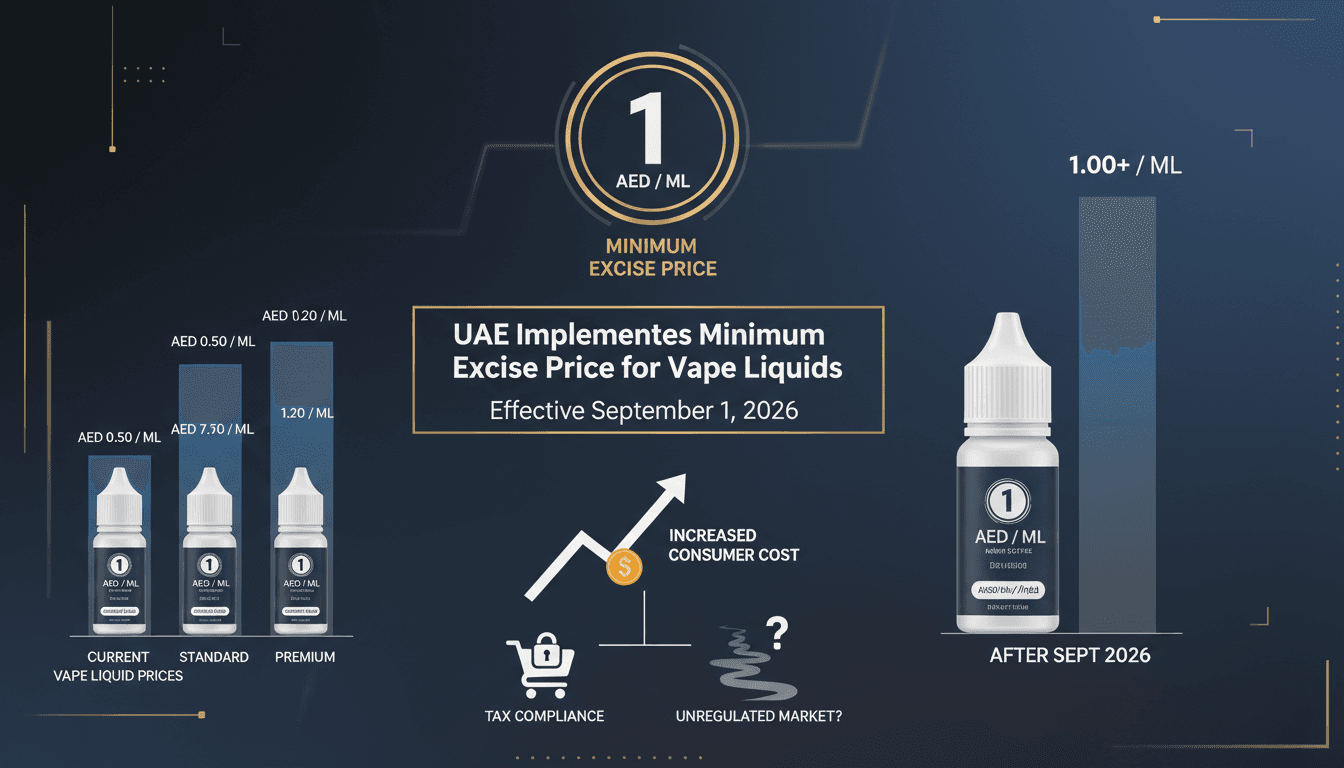
UAE Implements Minimum Excise Price for E-Liquids Starting September 2026

Here's what it means for you.
If you vape in the UAE, expect to pay more for your e-liquids starting September 2026.
Why it matters
This policy aims to curb vaping consumption while ensuring tax compliance, impacting both consumers and retailers.
What happened (in 30 seconds)
- The UAE Ministry of Finance announced a minimum excise price of AED 1 per millilitre for e-liquids, effective September 1, 2026.
- Existing excise tax rates of 100% will apply to the higher of the actual retail price or the new minimum price.
- Retailers and consumers are preparing for potential shifts in purchasing behavior due to increased costs.
The context you actually need
- The UAE introduced a 100% excise tax on vaping products in December 2019 as part of a broader sin tax strategy to reduce harmful consumption.
- The new minimum price addresses market developments and prevents underpricing that could undermine tax effectiveness.
- Traditional tobacco products like cigarettes will not see any changes in their minimum pricing, maintaining a consistent tax structure across categories.
What's really happening
The UAE's decision to implement a minimum excise price for electronic smoking device liquids is a strategic move aimed at enhancing tax compliance and reducing consumption of vaping products. By setting a threshold of AED 1 per millilitre, the Ministry of Finance is effectively ensuring that all e-liquids sold in the market will be taxed at a level that reflects their retail price or the minimum price, whichever is higher. This means that if a 60 ml bottle of e-liquid retails for AED 40, it will be taxed as if it were priced at AED 60 before applying the 100% excise tax, resulting in a significant increase in the effective price for consumers.
The rationale behind this policy is multifaceted. First, it aligns with the UAE's broader public health goals by discouraging vaping, particularly among youth. Doctors and health advocates have expressed optimism that higher prices may deter young people from taking up vaping and encourage existing users to reduce consumption or quit altogether. This aligns with global trends where increased taxation on tobacco and related products has been shown to reduce usage rates.
However, the policy also raises concerns among retailers. Many fear that the increased price floor could drive consumers towards unregulated sellers, undermining the government's efforts to control the market and ensure safety standards. The Ministry of Finance has emphasized that the goal is to create a consistent regulatory environment across both vaping and traditional tobacco products, but the potential for a black market remains a significant risk.
Moreover, the decision comes at a time when the vaping market is evolving rapidly, with new products and flavors constantly emerging. The minimum price policy aims to stabilize the market and prevent a race to the bottom in pricing, which could compromise tax revenues and public health objectives. As the implementation date approaches, both consumers and retailers will need to adapt to the new pricing landscape, which could lead to shifts in purchasing behavior and product offerings.
Who feels it first (and how)
- Vapers: Expect to pay more for e-liquids, particularly those who purchase lower-cost products.
- Retailers: May face reduced sales and increased competition from unregulated sellers.
- Health Advocates: Likely to see positive impacts on public health as consumption decreases.
What to watch next
- Consumer Behavior: Monitor changes in purchasing patterns as prices rise, particularly among youth.
- Market Response: Watch for potential shifts towards unregulated sellers and how retailers adapt their pricing strategies.
- Health Outcomes: Keep an eye on public health data to assess the impact of the policy on vaping rates.
The minimum excise price will be AED 1 per ml, effective September 1, 2026.
Increased prices will lead to reduced consumption among existing users and deter youth uptake.
The extent to which consumers will turn to unregulated sellers in response to higher prices.
Frequently Asked Questions
- Why it matters?
- This policy aims to curb vaping consumption while ensuring tax compliance, impacting both consumers and retailers.
- What happened (in 30 seconds)?
- The UAE Ministry of Finance announced a minimum excise price of AED 1 per millilitre for e-liquids, effective September 1, 2026. Existing excise tax rates of 100% will apply to the higher of the actual retail price or the new minimum price. Retailers and consumers are preparing for potential shifts in purchasing behavior due to increased costs.
- What's really happening?
- The UAE's decision to implement a minimum excise price for electronic smoking device liquids is a strategic move aimed at enhancing tax compliance and reducing consumption of vaping products. By setting a threshold of AED 1 per millilitre, the Ministry of Finance is effectively ensuring that all e-liquids sold in the market will be taxed at a level that reflects their retail price or the minimum price, whichever is higher. This means that if a 60 ml bottle of e-liquid retails for AED 40, it will
- Who feels it first (and how)?
- Vapers: Expect to pay more for e-liquids, particularly those who purchase lower-cost products. Retailers: May face reduced sales and increased competition from unregulated sellers. Health Advocates: Likely to see positive impacts on public health as consumption decreases.
- What to watch next?
- Consumer Behavior: Monitor changes in purchasing patterns as prices rise, particularly among youth. Market Response: Watch for potential shifts towards unregulated sellers and how retailers adapt their pricing strategies. Health Outcomes: Keep an eye on public health data to assess the impact of the policy on vaping rates.
Business and economy coverage focused on Dubai, the UAE, Saudi Arabia, and the wider Middle East.
"Arabian Business is a well-known regional business outlet with strong focus on Gulf markets, leadership, and investment stories."
— A47 Editor
UAE to introduce new tax from September 1
The UAE Ministry of Finance has announced the introduction of a new tax on vaping products, set to take effect on September 1. This tax is part of the country's efforts to regulate the vaping industry and address public health concerns associated wit...
UAE-based English-language newspaper covering regional politics, economics, and global affairs.
"The National reflects Emirati policy perspectives while maintaining international editorial standards."
— A47 Editor
UAE tax on vapes aims to deter young smokers and low-cost products
The United Arab Emirates (UAE) is set to implement a new tax on vaping products, effective September 1, 2026, aimed at discouraging young people from starting to smoke. This initiative comes as part of a broader effort to regulate the vaping industry...
UAE-based English-language newspaper covering regional politics, economics, and global affairs.
"The National reflects Emirati policy perspectives while maintaining international editorial standards."
— A47 Editor
UAE vape tax expected to deter new smokers as countries tighten grip on e-cigarettes
The United Arab Emirates (UAE) is set to implement a new tax on vaping products, aimed at discouraging the initiation of smoking among young people as countries globally tighten regulations on e-cigarettes. This move reflects a growing concern over p...