
Supreme Court Allows Continuation of White House Ballroom Construction Amid Legal Challenges
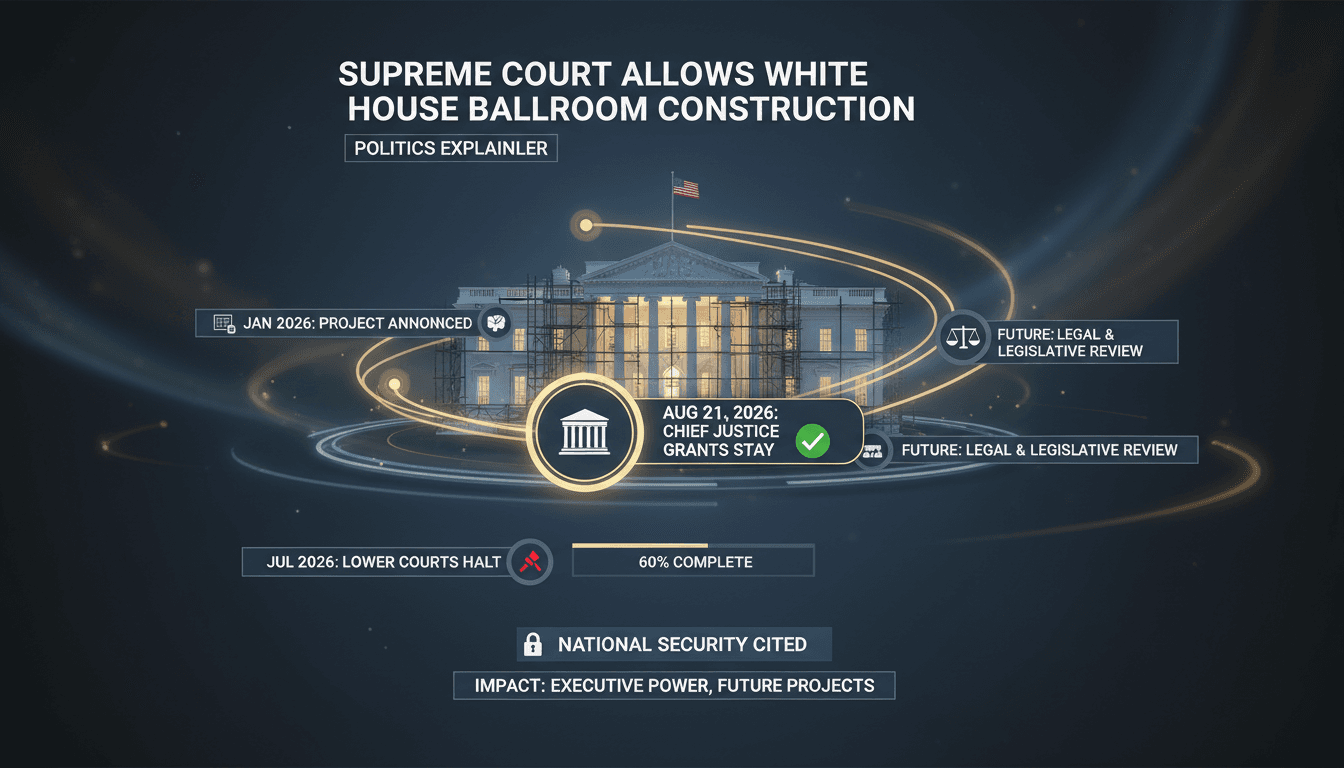
Why it matters
This ruling highlights the tension between national security imperatives and preservation of historic sites, impacting future federal projects.
What happened (in 30 seconds)
- Chief Justice John G. Roberts Jr. issued an administrative stay allowing construction of the White House ballroom to continue.
- The National Trust for Historic Preservation filed a lawsuit arguing that the project requires congressional approval, which lower courts upheld.
- The Trump administration cited national security needs and reported the project as 65% complete, prompting an emergency appeal to the Supreme Court.
The context you actually need
- The project began in October 2025 with the demolition of the East Wing to make way for a 90,000-square-foot ballroom and security features.
- Legal challenges arose from the National Trust for Historic Preservation, asserting that significant changes to federal property need congressional authorization under the Property Clause.
- Lower courts had previously ruled against the administration, leading to the Supreme Court's intervention to maintain the status quo while the case is reviewed.
What's really happening
The Supreme Court's administrative stay is a temporary measure that allows the Trump administration to continue construction on the White House ballroom while the legal battle unfolds. This decision comes after a series of lower court rulings that favored the National Trust for Historic Preservation, which argues that the project violates constitutional requirements for congressional approval of alterations to federal property.
The administration has framed the project as essential for national security, citing features like bomb shelters and missile-resistant structures. As of mid-August 2026, the project was reported to be 65% complete, with a workforce of 250 operating around the clock. This rapid progress underscores the administration's commitment to the project, despite ongoing legal challenges.
The implications of this ruling extend beyond the immediate construction of the ballroom. It raises questions about the balance of power between the executive branch and Congress regarding federal property management. If the Supreme Court ultimately sides with the Trump administration, it could set a precedent that allows future administrations to bypass congressional oversight for similar projects, potentially leading to more contentious legal battles over federal property alterations.
Moreover, the decision reflects broader themes in U.S. governance, where national security concerns often take precedence over historical preservation. This dynamic could influence how future projects are approached, particularly those involving significant alterations to historic sites. The National Trust's response indicates that they view this ruling as a temporary setback rather than a final decision, suggesting that the legal fight over the ballroom's construction is far from over.
Who feels it first (and how)
- Historic preservation advocates: They may face increased challenges in protecting historic sites from federal alterations.
- Government contractors: Companies involved in federal projects could see shifts in project timelines and funding based on legal outcomes.
- Local communities: Residents near the White House may experience changes in their environment due to ongoing construction and security measures.
What to watch next
- Supreme Court's full review: The timeline for the Court's final decision will be crucial in determining the project's future and could influence similar cases.
- Congressional response: Watch for any legislative moves to clarify or restrict executive power over federal property alterations.
- Public sentiment: Monitor how public opinion shifts regarding the balance between national security and historic preservation as the case progresses.
The Supreme Court has issued a temporary stay allowing construction to continue.
The legal battle will continue, with potential implications for future federal projects.
The long-term impact on the relationship between Congress and the executive branch regarding property alterations remains to be seen.
Frequently Asked Questions
- Why it matters?
- This ruling highlights the tension between national security imperatives and preservation of historic sites, impacting future federal projects.
- What happened (in 30 seconds)?
- Chief Justice John G. Roberts Jr. issued an administrative stay allowing construction of the White House ballroom to continue. The National Trust for Historic Preservation filed a lawsuit arguing that the project requires congressional approval, which lower courts upheld. The Trump administration cited national security needs and reported the project as 65% complete, prompting an emergency appeal to the Supreme Court.
- What's really happening?
- The Supreme Court's administrative stay is a temporary measure that allows the Trump administration to continue construction on the White House ballroom while the legal battle unfolds. This decision comes after a series of lower court rulings that favored the National Trust for Historic Preservation, which argues that the project violates constitutional requirements for congressional approval of alterations to federal property. The administration has framed the project as essential for nationa
- Who feels it first (and how)?
- Historic preservation advocates: They may face increased challenges in protecting historic sites from federal alterations. Government contractors: Companies involved in federal projects could see shifts in project timelines and funding based on legal outcomes. Local communities: Residents near the White House may experience changes in their environment due to ongoing construction and security measures.
- What to watch next?
- Supreme Court's full review: The timeline for the Court's final decision will be crucial in determining the project's future and could influence similar cases. Congressional response: Watch for any legislative moves to clarify or restrict executive power over federal property alterations. Public sentiment: Monitor how public opinion shifts regarding the balance between national security and historic preservation as the case progresses.
RT is a Russian state-funded network covering global events from a Russian perspective.
"RT is widely criticized for promoting pro-Kremlin narratives and is considered by many to be a state propaganda outlet."
— A47 Editor
Supreme Court lets Trump go on with White House ballroom project amid pending lawsuit
The US Supreme Court has permitted the continuation of construction on President Donald Trump's $400 million ballroom project at the White House, despite an ongoing lawsuit challenging the project's legality. This decision follows a previous ruling b...
Corporate leadership, finance, technology, and market trends.
"Fortune covers financial trends, leadership, and innovation with a pragmatic editorial approach."
— A47 Editor
Chief Justice John Roberts allows Trump’s ballroom crews to keep working 20-hour days
Chief Justice John Roberts has permitted the continuation of construction for a $400 million ballroom at the White House, allowing crews to work extended hours despite ongoing legal challenges regarding the project. The White House claims the initiat...
Global news coverage with extensive reporting on Middle Eastern conflicts and geopolitics.
"Al Jazeera is a Qatar-based broadcaster known for wide regional coverage and alternative perspectives."
— A47 Editor
US Supreme Court allows Trump’s ballroom project to continue for now
The US Supreme Court has allowed the Trump administration to proceed with the construction of a $400 million ballroom at the White House, despite a previous federal appeals court ruling that had halted the project due to a lack of congressional appro...
Comprehensive coverage of Middle Eastern and global issues.
"Al Jazeera is a prominent voice from the Global South, especially the Middle East, with an emphasis on underreported stories."
— A47 Editor
US Supreme Court allows Trump’s ballroom project to continue for now
The US Supreme Court has allowed the Trump administration to proceed with the construction of a $400 million ballroom at the White House, despite a previous federal appeals court ruling that had halted the project due to a lack of congressional appro...
Business, investment, entrepreneurship, leadership, and innovation.
"Forbes is known for its coverage of business leaders, market trends, and entrepreneurial ventures with a pro-business editorial stance."
— A47 Editor
Supreme Court Lets Trump’s Ballroom Construction Continue—For Now
The U.S. Supreme Court has allowed the continuation of construction for a $400 million ballroom at the White House, despite previous halts. This decision comes as the Trump administration argues that the project is essential for security reasons, cit...