
Supreme Court Allows Continuation of White House Ballroom Construction Amid Legal Challenge
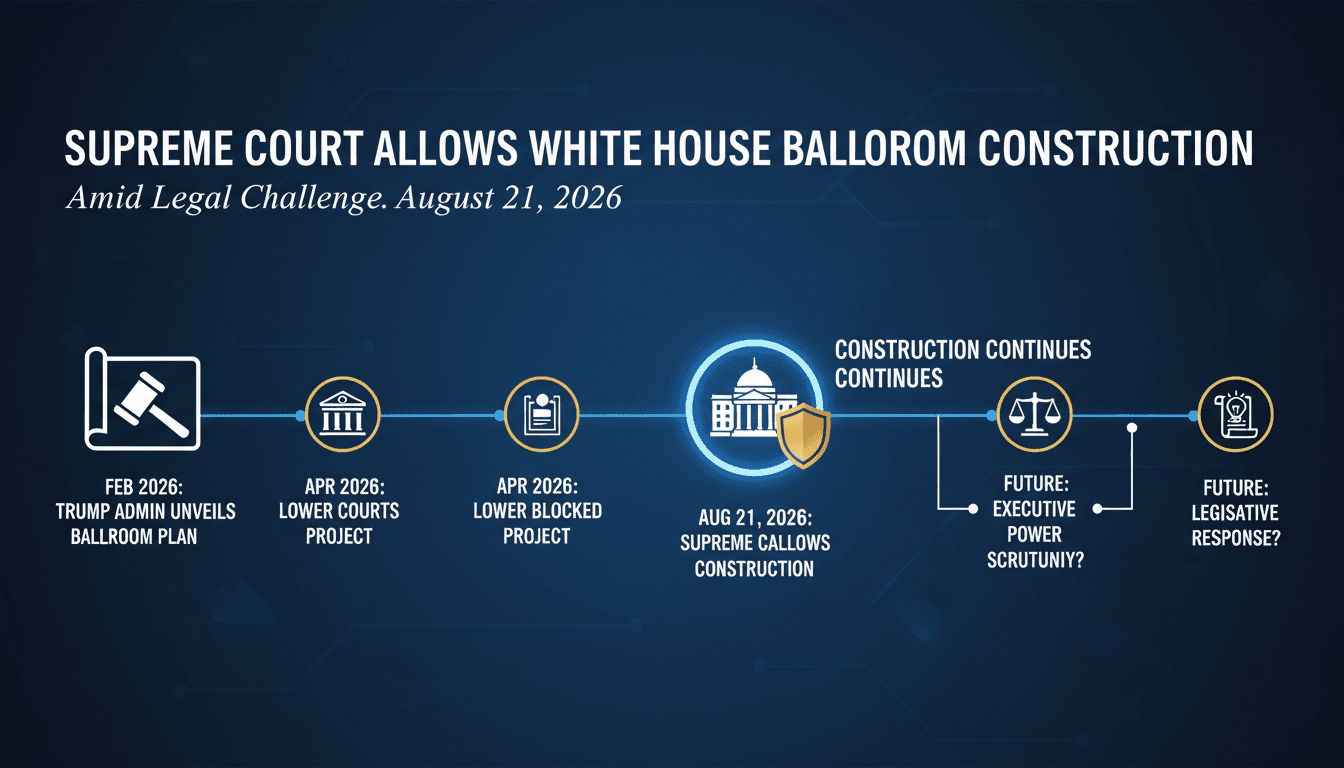
Here's what it means for you.
If you’re involved in government contracting or historic preservation, this decision could reshape project timelines and funding dynamics.
Why it matters
This ruling highlights the tension between national security imperatives and preservation of historic sites, impacting future federal projects.
What happened (in 30 seconds)
- Chief Justice John G. Roberts Jr. issued a temporary administrative stay on August 21, 2026, allowing construction of the White House ballroom to continue.
- The National Trust for Historic Preservation filed a lawsuit arguing that the project requires congressional approval, which lower courts upheld.
- The Trump administration claims the project is 65% complete and essential for national security, prompting an emergency appeal to the Supreme Court.
The context you actually need
- Construction began in October 2025, involving the demolition of part of the White House East Wing for a new ballroom and underground facilities.
- Legal challenges arose from the National Trust for Historic Preservation, asserting that federal law mandates congressional authorization for such projects.
- Lower courts ruled against the administration, leading to the Supreme Court's intervention to allow construction to proceed temporarily.
What's really happening
The Supreme Court's administrative stay on the White House ballroom construction is a pivotal moment in the ongoing legal battle between the Trump administration and preservation advocates. The project, which has been framed by the administration as a national security necessity, has faced significant legal hurdles since its inception. The National Trust for Historic Preservation argues that the construction lacks the necessary congressional approval, a claim that has resonated with lower courts, resulting in injunctions that limited above-ground work.
The administration's emergency appeal to the Supreme Court was prompted by a recent ruling from the D.C. Circuit Court, which upheld the lower court's injunction while allowing a brief pause for appeal. Chief Justice Roberts' decision to grant a temporary stay reflects the Court's willingness to consider the administration's arguments regarding national security and the project's current status—reported to be 65% complete with a workforce of 250 people working extended shifts.
This situation underscores a broader tension in U.S. governance: the balance between executive power and legislative oversight. The Trump administration's defense hinges on the assertion that the project does not impose additional costs on taxpayers, a claim that, if substantiated, could sway public opinion and political support. However, the National Trust's position emphasizes the importance of preserving historical integrity, suggesting that the project may be more about political legacy than genuine security needs.
As the Supreme Court prepares for a full review, the implications of this case extend beyond the immediate construction project. It raises questions about the future of federal projects that intersect with historic preservation laws and the extent of executive authority in bypassing legislative approval. The outcome could set a precedent for how similar projects are handled in the future, potentially altering the landscape of government contracting and historic site management.
Who feels it first (and how)
- Government contractors involved in the construction may see shifts in project timelines and funding.
- Historic preservation advocates will closely monitor the implications for future projects and legal precedents.
- Local businesses in Washington, D.C., could experience economic impacts depending on the project's completion and associated events.
What to watch next
- Supreme Court's full review: The timeline for the Court's decision will be crucial in determining the project's future and could influence similar cases.
- Public opinion shifts: As the case garners media attention, public sentiment may sway, impacting political support for the administration's initiatives.
- Legislative responses: Watch for potential congressional actions aimed at clarifying or amending laws regarding federal construction projects and historic preservation.
The Supreme Court has issued a temporary stay allowing construction to continue.
The Court will review the case in the coming months, potentially leading to a final ruling.
The long-term implications for federal project approvals and historic preservation laws remain uncertain.
Frequently Asked Questions
- Why it matters?
- This ruling highlights the tension between national security imperatives and preservation of historic sites, impacting future federal projects.
- What happened (in 30 seconds)?
- Chief Justice John G. Roberts Jr. issued a temporary administrative stay on August 21, 2026, allowing construction of the White House ballroom to continue. The National Trust for Historic Preservation filed a lawsuit arguing that the project requires congressional approval, which lower courts upheld. The Trump administration claims the project is 65% complete and essential for national security, prompting an emergency appeal to the Supreme Court.
- What's really happening?
- The Supreme Court's administrative stay on the White House ballroom construction is a pivotal moment in the ongoing legal battle between the Trump administration and preservation advocates. The project, which has been framed by the administration as a national security necessity, has faced significant legal hurdles since its inception. The National Trust for Historic Preservation argues that the construction lacks the necessary congressional approval, a claim that has resonated with lower courts
- Who feels it first (and how)?
- Government contractors involved in the construction may see shifts in project timelines and funding. Historic preservation advocates will closely monitor the implications for future projects and legal precedents. Local businesses in Washington, D.C., could experience economic impacts depending on the project's completion and associated events.
- What to watch next?
- Supreme Court's full review: The timeline for the Court's decision will be crucial in determining the project's future and could influence similar cases. Public opinion shifts: As the case garners media attention, public sentiment may sway, impacting political support for the administration's initiatives. Legislative responses: Watch for potential congressional actions aimed at clarifying or amending laws regarding federal construction projects and historic preservation.
RT is a Russian state-funded network covering global events from a Russian perspective.
"RT is widely criticized for promoting pro-Kremlin narratives and is considered by many to be a state propaganda outlet."
— A47 Editor
Supreme Court lets Trump go on with White House ballroom project amid pending lawsuit
The US Supreme Court has permitted the continuation of construction on President Donald Trump's $400 million ballroom project at the White House, despite an ongoing lawsuit challenging the project's legality. This decision follows a previous ruling b...
Corporate leadership, finance, technology, and market trends.
"Fortune covers financial trends, leadership, and innovation with a pragmatic editorial approach."
— A47 Editor
Chief Justice John Roberts allows Trump’s ballroom crews to keep working 20-hour days
Chief Justice John Roberts has permitted the continuation of construction for a $400 million ballroom at the White House, allowing crews to work extended hours despite ongoing legal challenges regarding the project. The White House claims the initiat...
Global news coverage with extensive reporting on Middle Eastern conflicts and geopolitics.
"Al Jazeera is a Qatar-based broadcaster known for wide regional coverage and alternative perspectives."
— A47 Editor
US Supreme Court allows Trump’s ballroom project to continue for now
The US Supreme Court has allowed the Trump administration to proceed with the construction of a $400 million ballroom at the White House, despite a previous federal appeals court ruling that had halted the project due to a lack of congressional appro...
Comprehensive coverage of Middle Eastern and global issues.
"Al Jazeera is a prominent voice from the Global South, especially the Middle East, with an emphasis on underreported stories."
— A47 Editor
US Supreme Court allows Trump’s ballroom project to continue for now
The US Supreme Court has allowed the Trump administration to proceed with the construction of a $400 million ballroom at the White House, despite a previous federal appeals court ruling that had halted the project due to a lack of congressional appro...