
UN Calls for International Protection Forces in Palestinian Territories Amid Escalating Settler Violence
Here's what it means for you.
As global tensions rise, the implications of international intervention in conflict zones could affect expatriate communities and trade routes.
Why it matters
The ongoing violence in the occupied Palestinian territories raises critical questions about international law and state responsibilities.
What happened (in 30 seconds)
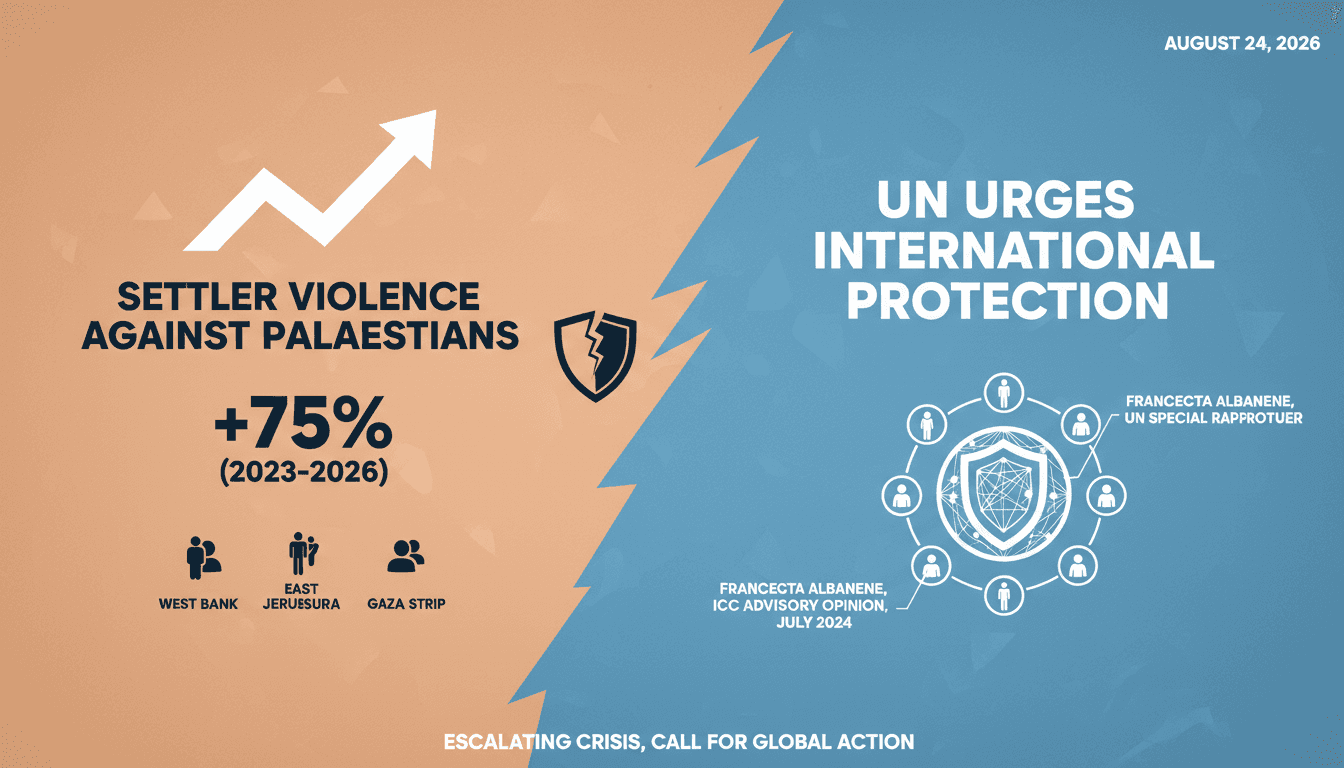
- On August 24, 2026, UN Special Rapporteur Francesca Albanese called for international protection forces in the West Bank, East Jerusalem, and Gaza Strip.
- Albanese cited documented incidents of Israeli settler violence against Palestinian civilians, including video evidence of assaults.
- The call follows a July 2024 International Court of Justice advisory opinion urging third states to act against unlawful occupation.
The context you actually need
- Settler violence has escalated throughout 2026, with over 1,330 recorded attacks on Palestinians in the West Bank from January to late July.
- Israeli security forces have often been accused of complicity or inaction during these attacks, contributing to a climate of fear and displacement.
- The July 2024 ICJ opinion declared the occupation unlawful and imposed obligations on states to refrain from supporting it, complicating international relations.
What's really happening
The call for international protection forces by Francesca Albanese is rooted in a complex interplay of legal, social, and political dynamics. The backdrop of escalating violence against Palestinian civilians by Israeli settlers has created a humanitarian crisis that demands urgent attention. Albanese's appeal is not merely a reaction to isolated incidents; it reflects a broader pattern of systemic violence that has intensified in 2026, with documented attacks averaging six per day.
The International Court of Justice's advisory opinion from July 2024 plays a pivotal role in this narrative. It established that the occupation of Palestinian territories is unlawful and imposed legal obligations on third states to act against it. This opinion has created a framework for international accountability, yet its implementation remains fraught with challenges. The paralysis of the UN Security Council, often due to U.S. vetoes, complicates the situation further, leaving many to question the efficacy of existing international mechanisms.
Albanese's emphasis on the need for practical measures beyond mere statements highlights a growing frustration with the status quo. The call for international protection forces is a direct challenge to the inaction of the international community, particularly in light of the documented complicity of Israeli security forces in settler violence. The urgency of her message is underscored by the graphic evidence she presented, which illustrates the immediate dangers faced by Palestinian civilians.
The implications of this situation extend beyond the immediate conflict. As international discourse evolves around protection mechanisms and state responsibilities, businesses and expatriate communities in regions like Dubai may find themselves affected by shifts in regional stability. The interconnectedness of global markets means that unrest in one area can have ripple effects elsewhere, influencing trade routes and economic conditions.
In summary, the call for international protection forces is not just about addressing violence; it is about redefining the responsibilities of states under international law and the role of global institutions in conflict resolution. The outcome of this advocacy could reshape international relations and influence how conflicts are managed in the future.
Who feels it first (and how)
- Palestinian civilians: Directly affected by violence and displacement.
- Israeli settlers: Involved in the ongoing conflict dynamics.
- International organizations: Tasked with responding to humanitarian crises.
- Expatriate communities in the Middle East: Potentially impacted by regional instability.
- Global businesses: Trade routes and economic interests may be affected by conflict escalation.
What to watch next
- International responses: Monitor how third states react to Albanese's call and whether any protective measures are implemented.
- UN Security Council actions: Watch for any shifts in the dynamics of the Security Council, particularly regarding U.S. vetoes.
- Settler violence trends: Keep an eye on the frequency and severity of settler attacks in the West Bank and their implications for regional stability.
Settler violence against Palestinians has escalated significantly in 2026.
International discourse on protection mechanisms will continue to evolve, influencing state responsibilities.
The effectiveness of international calls for protection forces in changing the current situation on the ground.
Frequently Asked Questions
- Why it matters?
- The ongoing violence in the occupied Palestinian territories raises critical questions about international law and state responsibilities.
- What happened (in 30 seconds)?
- On August 24, 2026, UN Special Rapporteur Francesca Albanese called for international protection forces in the West Bank, East Jerusalem, and Gaza Strip. Albanese cited documented incidents of Israeli settler violence against Palestinian civilians, including video evidence of assaults. The call follows a July 2024 International Court of Justice advisory opinion urging third states to act against unlawful occupation.
- What's really happening?
- The call for international protection forces by Francesca Albanese is rooted in a complex interplay of legal, social, and political dynamics. The backdrop of escalating violence against Palestinian civilians by Israeli settlers has created a humanitarian crisis that demands urgent attention. Albanese's appeal is not merely a reaction to isolated incidents; it reflects a broader pattern of systemic violence that has intensified in 2026, with documented attacks averaging six per day. The Internat
- Who feels it first (and how)?
- Palestinian civilians: Directly affected by violence and displacement. Israeli settlers: Involved in the ongoing conflict dynamics. International organizations: Tasked with responding to humanitarian crises. Expatriate communities in the Middle East: Potentially impacted by regional instability. Global businesses: Trade routes and economic interests may be affected by conflict escalation.
- What to watch next?
- International responses: Monitor how third states react to Albanese's call and whether any protective measures are implemented. UN Security Council actions: Watch for any shifts in the dynamics of the Security Council, particularly regarding U.S. vetoes. Settler violence trends: Keep an eye on the frequency and severity of settler attacks in the West Bank and their implications for regional stability.
Algerian and regional news coverage.
"Echorouk is a major Algerian outlet with broad national reporting."
— A47 Editor
بسبب اعتداءات المستوطنين المتكررة.. هذا ما دعت إليه فرانشيسكا ألبانيز
Francesca Albanese, the UN Special Rapporteur, has called for the deployment of international protection forces in the West Bank, East Jerusalem, and Gaza due to repeated attacks by Israeli settlers on Palestinians. Albanese shared footage showing yo...
Arabic-language coverage of international news and geopolitics.
"RT Arabic is a Russian state-funded outlet often criticized for promoting Kremlin-aligned narratives."
— A47 Editor
مقررة الأمم المتحدة تدعو لنشر قوات حماية دولية في الضفة وغزة والقدس
Francesca Albanese, the UN Special Rapporteur, has called for the deployment of international protection forces in the West Bank, East Jerusalem, and the Gaza Strip. This appeal highlights the ongoing concerns regarding the safety and security of civ...
RT is a Russian state-funded network covering global events from a Russian perspective.
"RT is widely criticized for promoting pro-Kremlin narratives and is considered by many to be a state propaganda outlet."
— A47 Editor
UN expert urges peacekeepers in Palestinian territories as settler attacks surge
UN Special Rapporteur Francesca Albanese has called for the establishment of an international protection force in the Palestinian territories amid a surge in violent attacks by Israeli settlers. This appeal comes as the situation in the West Bank det...