
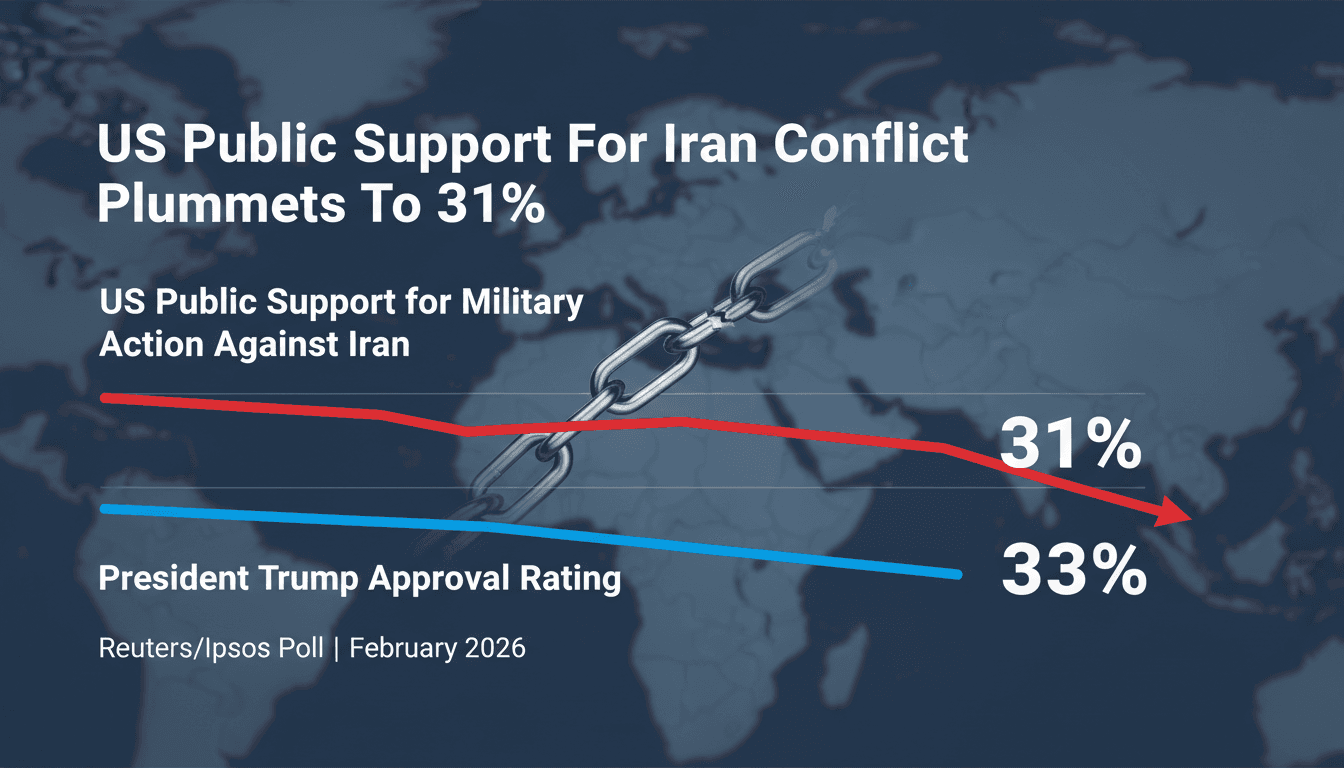
US Public Support for Military Action Against Iran Drops to 31 Percent Amid Ongoing Conflict
Here's what it means for you.
As global energy markets react to geopolitical tensions, your business could face indirect impacts from rising oil prices and disrupted supply chains.
Why it matters
The decline in US public support for military action against Iran signals potential shifts in foreign policy that could affect global energy markets and economic stability.
What happened (in 30 seconds)
- Support for military action against Iran fell to 31%, the lowest level recorded since the conflict began.
- Republican backing for the conflict decreased from 77% in March to 69%, reflecting growing discontent.
- President Trump's approval rating remains stagnant at 33%, indicating a lack of confidence in his leadership amid ongoing hostilities.
The context you actually need
- The US-Iran conflict escalated on February 28, 2026, following US and Israeli strikes, leading to significant regional instability.
- Public sentiment has shifted, with composite polling showing support for the war consistently below 40% since March 2026.
- Economic repercussions are evident, with elevated energy prices and disruptions in shipping through the Strait of Hormuz affecting global markets.
What's really happening
The Reuters/Ipsos poll released on August 25, 2026, reveals a significant decline in US public support for military action against Iran, now at 31%. This marks a notable drop from 37% in March and 34% earlier in August. The decline is particularly pronounced among Republicans, whose support has decreased from 77% to 69%. This shift in public opinion comes amid a protracted conflict that began with US and Israeli strikes on Iranian targets, which has now extended beyond initial expectations of a brief engagement.
The ongoing conflict has led to substantial economic disruptions, particularly in the energy sector. The US administration's response has included the launch of 'Operation Economic Outcast,' which imposes secondary sanctions targeting entities that facilitate Iranian economic activity. This includes potential sanctions on Chinese banks, indicating a broader strategy to isolate Iran economically. The administration's approach reflects a dual focus on military action and economic pressure, aiming to curb Iran's influence while managing domestic discontent.
Despite the administration's efforts, public sentiment remains largely opposed to the conflict. The poll indicates that 83% of respondents anticipate an extended conflict, up from 80% earlier in the month. This growing expectation of a prolonged engagement may further erode support for military action, as Americans increasingly prioritize domestic issues over foreign military engagements. The administration's dismissal of negative polling as "Demoralization Operations" suggests a disconnect between leadership and public sentiment, which could have long-term implications for Trump's approval ratings and the Republican Party's standing.
As the conflict continues, the economic ramifications are likely to be felt globally. Elevated energy prices, driven by disruptions in the Strait of Hormuz—a critical shipping lane for oil—could impact logistics, tourism, and financial stability in regions heavily reliant on energy exports. The ongoing hostilities and sanctions announcements have created a mixed signal in the markets, reflecting uncertainty about the future trajectory of US-Iran relations and their broader economic implications.
Who feels it first (and how)
- Energy sector professionals: Increased oil prices may lead to higher operational costs and reduced margins.
- Logistics companies: Disruptions in shipping routes could delay deliveries and increase shipping costs.
- Tourism and hospitality sectors: Elevated energy prices may deter travel, impacting local economies reliant on tourism.
- Investors: Market volatility may affect investment strategies, particularly in energy and defense sectors.
What to watch next
- Public opinion trends: Continued monitoring of polling data will reveal shifts in sentiment that could influence policy decisions.
- Economic indicators: Watch for changes in energy prices and their impact on inflation and consumer spending.
- Legislative responses: Potential changes in US foreign policy or military strategy could emerge based on public sentiment and economic pressures.
Support for military action against Iran is at a record low of 31%.
Continued economic disruptions and elevated energy prices will affect global markets.
The long-term impact of 'Operation Economic Outcast' on Iran's economy and US foreign relations remains uncertain.
Frequently Asked Questions
- Why it matters?
- The decline in US public support for military action against Iran signals potential shifts in foreign policy that could affect global energy markets and economic stability.
- What happened (in 30 seconds)?
- Support for military action against Iran fell to 31%, the lowest level recorded since the conflict began. Republican backing for the conflict decreased from 77% in March to 69%, reflecting growing discontent. President Trump's approval rating remains stagnant at 33%, indicating a lack of confidence in his leadership amid ongoing hostilities.
- What's really happening?
- The Reuters/Ipsos poll released on August 25, 2026, reveals a significant decline in US public support for military action against Iran, now at 31%. This marks a notable drop from 37% in March and 34% earlier in August. The decline is particularly pronounced among Republicans, whose support has decreased from 77% to 69%. This shift in public opinion comes amid a protracted conflict that began with US and Israeli strikes on Iranian targets, which has now extended beyond initial expectations of a
- Who feels it first (and how)?
- Energy sector professionals: Increased oil prices may lead to higher operational costs and reduced margins. Logistics companies: Disruptions in shipping routes could delay deliveries and increase shipping costs. Tourism and hospitality sectors: Elevated energy prices may deter travel, impacting local economies reliant on tourism. Investors: Market volatility may affect investment strategies, particularly in energy and defense sectors.
- What to watch next?
- Public opinion trends: Continued monitoring of polling data will reveal shifts in sentiment that could influence policy decisions. Economic indicators: Watch for changes in energy prices and their impact on inflation and consumer spending. Legislative responses: Potential changes in US foreign policy or military strategy could emerge based on public sentiment and economic pressures.
Global business headlines with AI angles.
"General business outlet that frequently covers AI."
— A47 Editor
A New Poll Finds Support For Iran War At A Low Point. And It's Dragging Down Trump's Popularity.
A recent poll indicates that only 31 percent of Americans support the ongoing war in Iran, reflecting a significant decline in public backing for military engagement. This low approval rating is coupled with rising concerns about the conflict's impac...
Right-of-center views on political news.
"The Washington Times is a conservative-leaning newspaper known for its political coverage and advocacy of right-of-center viewpoints."
— A47 Editor
Approval of Iran war hits record low
Support for the war with Iran among Americans has reached a record low, coinciding with President Trump's approval rating also hitting a historic low. This decline reflects growing public discontent with the ongoing conflict and its implications for ...
Arabic-language coverage of international news and geopolitics.
"RT Arabic is a Russian state-funded outlet often criticized for promoting Kremlin-aligned narratives."
— A47 Editor
حرب إيران تستنزف شعبية ترامب والجمهوريين
A new opinion poll indicates that American support for the ongoing war with Iran has dropped to its lowest level since the conflict began, now standing at 31%, down from 37% in March and 34% earlier this month.
Arabic-language coverage of international news and geopolitics.
"RT Arabic is a Russian state-funded outlet often criticized for promoting Kremlin-aligned narratives."
— A47 Editor
استطلاع جديد يكشف تراجع شعبية ترامب على خلفية حرب إيران
A recent survey conducted by Reuters revealed that public support for the war with Iran has dropped to its lowest level since the conflict began on February 28. This decline in approval ratings for the war reflects growing discontent among the Americ...
Comprehensive coverage of Middle Eastern and global issues.
"Al Jazeera is a prominent voice from the Global South, especially the Middle East, with an emphasis on underreported stories."
— A47 Editor
US public support for Iran war falls as Trump approval at record low: Poll
Recent polling indicates a significant decline in U.S. public support for the ongoing war with Iran, coinciding with President Trump's approval rating dropping to a record low of 33 percent. Factors contributing to this decline include rising gas pri...
Global news coverage with extensive reporting on Middle Eastern conflicts and geopolitics.
"Al Jazeera is a Qatar-based broadcaster known for wide regional coverage and alternative perspectives."
— A47 Editor
US public support for Iran war falls as Trump approval at record low: Poll
Recent polling indicates a significant decline in U.S. public support for the ongoing war with Iran, coinciding with President Trump's approval rating dropping to a record low of 33 percent. Factors contributing to this decline include rising gas pri...
Regional coverage and analysis focused on politics, diplomacy, and business across the Middle East.
"Al-Monitor is known for analytical reporting on Middle East politics and policy developments."
— A47 Editor
Trump's approval holds at record low as US support for Iran war falls, Reuters Ipsos poll finds
A recent Reuters/Ipsos poll indicates that U.S. public approval for the ongoing war with Iran has dropped to its lowest level since the conflict began, coinciding with President Donald Trump's approval ratings remaining at a record low. This decline ...