
US Removes Syria from State Sponsors of Terrorism List Ending 47-Year Designation
Here's what it means for you.
The U.S. decision to remove Syria from its terrorism list could reshape investment opportunities in the region.
Why it matters
This delisting marks a significant shift in U.S.-Syria relations, potentially opening doors for economic reintegration and investment.
What happened (in 30 seconds)
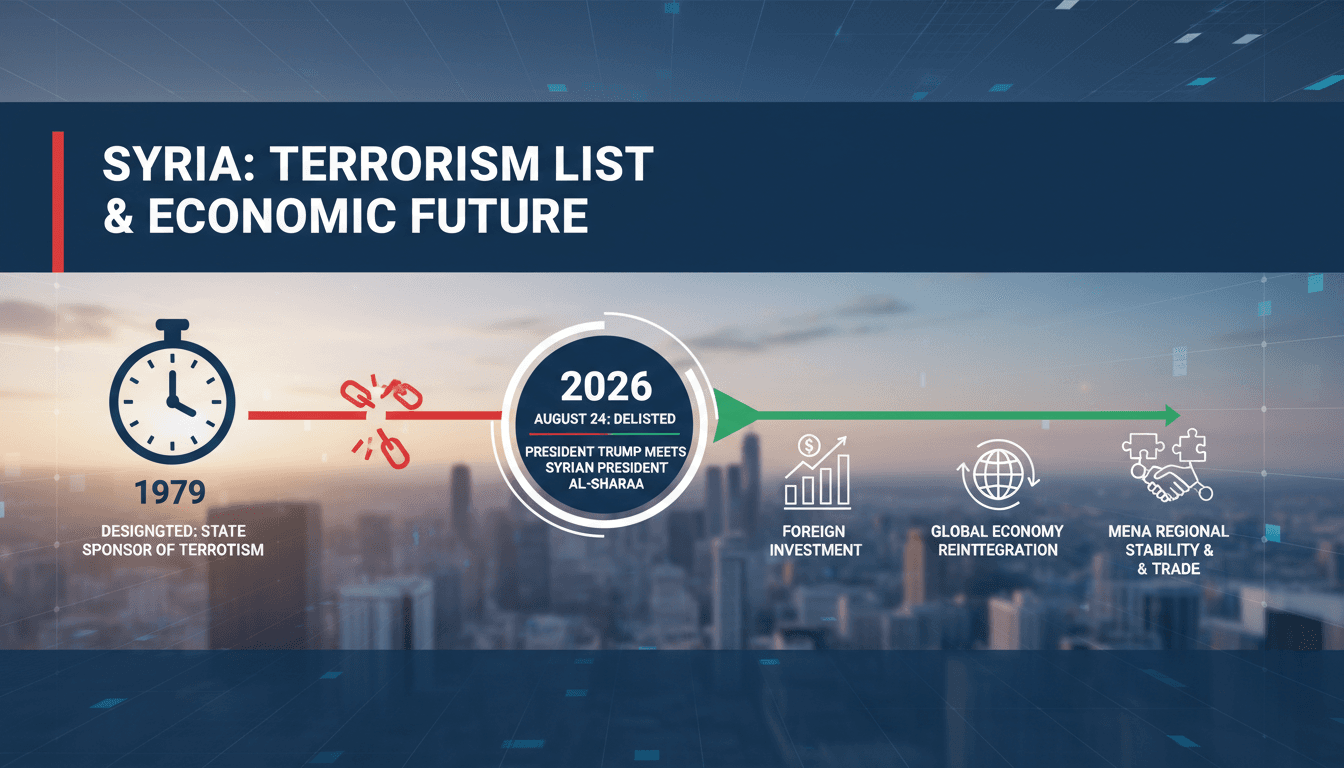
- On August 24, 2026, Syrian President Ahmed al-Sharaa announced Syria's removal from the U.S. state sponsors of terrorism list, effective immediately.
- This designation had been in place for 47 years, since 1979, primarily due to Syria's support for militant groups.
- The delisting follows a 45-day congressional review initiated by U.S. President Donald Trump, aimed at facilitating Syria's economic recovery post-regime change.
The context you actually need
- Syria was designated a state sponsor of terrorism under Hafez al-Assad for supporting militant groups, a label that persisted through Bashar al-Assad's regime until 2024.
- The U.S. initiated sanctions relief after Ahmed al-Sharaa's regime change in December 2024, signaling a shift in U.S. foreign policy towards Syria.
- The delisting is part of broader efforts to reintegrate Syria into the global economy, which may influence regional stability and trade dynamics.
What's really happening
The U.S. decision to delist Syria from its state sponsors of terrorism list is a pivotal moment in Middle Eastern geopolitics. This move, announced by President Trump following a meeting with President al-Sharaa, reflects a strategic recalibration in U.S. foreign policy. The 47-year designation had long hindered Syria's economic potential and international relations, effectively isolating it from global markets.
The delisting is not merely a symbolic gesture; it is rooted in a series of calculated incentives aimed at fostering regional stability. By removing the designation, the U.S. is signaling its willingness to engage with Syria under the new leadership of al-Sharaa, who has expressed commitments to counter-terrorism and regional cooperation. This shift is expected to facilitate private sector engagement and attract foreign investment, crucial for Syria's reconstruction efforts after years of civil war and economic decline.
Moreover, the delisting aligns with broader U.S. interests in stabilizing the region. By reintegrating Syria into the global economy, the U.S. aims to mitigate the influence of extremist groups that thrive in unstable environments. The removal of Syria from the terrorism list also coincides with the U.S. administration's focus on countering Iranian influence in the region, as a stable Syria could serve as a buffer against Iranian expansionism.
However, the implications of this decision extend beyond Syria's borders. For Gulf states, including the UAE, the delisting could open new avenues for investment and trade. As Syria seeks to rebuild its economy, Gulf investors may find opportunities in sectors such as construction, energy, and agriculture. This potential influx of capital could indirectly support regional stability, fostering a more interconnected Middle Eastern economy.
Despite these optimistic projections, the path forward remains fraught with challenges. The Syrian government must demonstrate its commitment to reform and stability to attract foreign investment. Additionally, the international community will be closely monitoring Syria's actions to ensure compliance with counter-terrorism commitments. The success of this delisting hinges on the ability of the Syrian government to navigate these complex dynamics while fostering a conducive environment for economic recovery.
Who feels it first (and how)
- Investors: Potential for new investment opportunities in reconstruction and development projects.
- Construction firms: Increased demand for infrastructure development as Syria rebuilds.
- Regional governments: Gulf states may see economic benefits from increased trade and investment flows.
- Local businesses: Opportunities for growth as foreign companies enter the market.
What to watch next
- Investment flows into Syria: Monitor the level of foreign direct investment in the coming months to gauge economic recovery.
- U.S. policy shifts: Watch for any changes in U.S. foreign policy that could impact Syria's reintegration efforts.
- Regional stability indicators: Keep an eye on developments in neighboring countries that could affect Syria's economic landscape.
Syria is officially delisted from the U.S. state sponsors of terrorism list.
Increased foreign investment and economic activity in Syria as a result of the delisting.
The long-term effectiveness of Syria's government in maintaining stability and attracting investment.
Frequently Asked Questions
- Why it matters?
- This delisting marks a significant shift in U.S.-Syria relations, potentially opening doors for economic reintegration and investment.
- What happened (in 30 seconds)?
- On August 24, 2026, Syrian President Ahmed al-Sharaa announced Syria's removal from the U.S. state sponsors of terrorism list, effective immediately. This designation had been in place for 47 years, since 1979, primarily due to Syria's support for militant groups. The delisting follows a 45-day congressional review initiated by U.S. President Donald Trump, aimed at facilitating Syria's economic recovery post-regime change.
- What's really happening?
- The U.S. decision to delist Syria from its state sponsors of terrorism list is a pivotal moment in Middle Eastern geopolitics. This move, announced by President Trump following a meeting with President al-Sharaa, reflects a strategic recalibration in U.S. foreign policy. The 47-year designation had long hindered Syria's economic potential and international relations, effectively isolating it from global markets. The delisting is not merely a symbolic gesture; it is rooted in a series of calcula
- Who feels it first (and how)?
- Investors: Potential for new investment opportunities in reconstruction and development projects. Construction firms: Increased demand for infrastructure development as Syria rebuilds. Regional governments: Gulf states may see economic benefits from increased trade and investment flows. Local businesses: Opportunities for growth as foreign companies enter the market.
- What to watch next?
- Investment flows into Syria: Monitor the level of foreign direct investment in the coming months to gauge economic recovery. U.S. policy shifts: Watch for any changes in U.S. foreign policy that could impact Syria's reintegration efforts. Regional stability indicators: Keep an eye on developments in neighboring countries that could affect Syria's economic landscape.
Algerian and regional news coverage.
"Echorouk is a major Algerian outlet with broad national reporting."
— A47 Editor
هذا ما قاله الشرع بعد رفع اسم سوريا من قائمة الإرهاب؟
Syrian President Ahmad al-Shara congratulated the Syrian people on the United States' decision to officially remove Syria from the list of state sponsors of terrorism. In a video message shared on his official account, al-Shara expressed his satisfac...
Regional and international reporting focused on Middle Eastern politics, diplomacy, and economics.
"Asharq Al-Awsat is a Saudi-owned international newspaper reflecting mainstream Gulf political perspectives."
— A47 Editor
Sharaa Says Syria 'Shakes Off Dark Stain' with Removal from US Terror List
The United States has officially removed Syria from its list of state sponsors of terrorism, a designation that had been in place for 47 years. This significant policy shift was announced on August 24, 2026, and is seen as a move to provide major san...
Comprehensive coverage of Middle Eastern and global issues.
"Al Jazeera is a prominent voice from the Global South, especially the Middle East, with an emphasis on underreported stories."
— A47 Editor
Syrian president thanks nation for getting off US state terror list
Syrian President Ahmed al-Sharaa expressed gratitude towards the nation following Syria's removal from the U.S. list of state sponsors of terrorism, marking a significant shift in U.S. foreign policy. This decision was officially announced on August ...