
Trump Administration Submits US-Saudi Civil Nuclear Cooperation Agreement to Congress
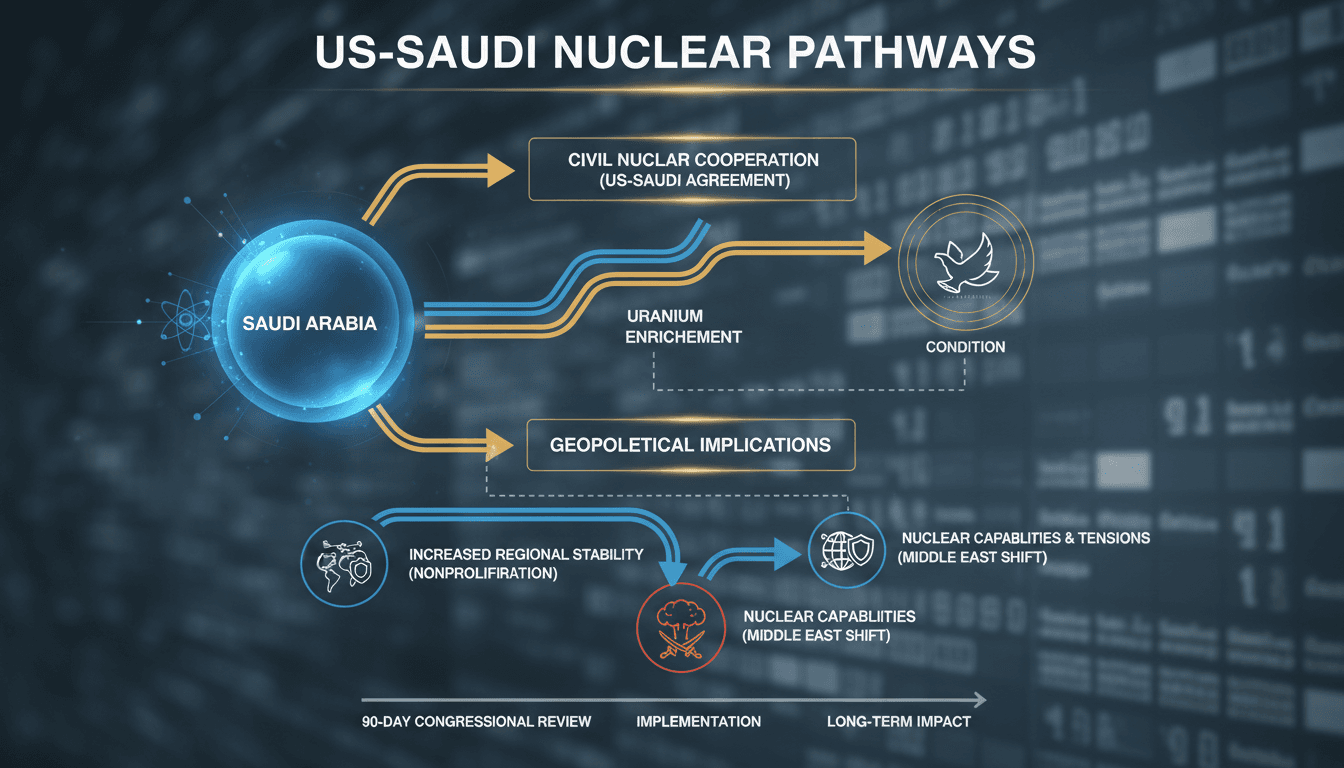
Here's what it means for you.
If you’re in the energy sector or follow international relations, this agreement could reshape market dynamics and geopolitical alliances.
Why it matters
This agreement signals a significant shift in nuclear policy and energy cooperation in the Middle East, impacting global nonproliferation efforts.
What happened (in 30 seconds)
- On August 26, 2026, the Trump administration submitted a civil nuclear cooperation agreement with Saudi Arabia to Congress for review.
- The agreement allows for potential uranium enrichment in Saudi Arabia under specific bilateral safeguards, contingent on Saudi Arabia's normalization with Israel.
- Congress has 90 days to review the agreement, during which its implementation is uncertain and subject to political dynamics.
The context you actually need
- Negotiations for this agreement concluded in October 2025, with formal signing occurring in July 2026, reflecting ongoing US-Saudi strategic alignment.
- The agreement emphasizes bilateral safeguards rather than strict nonproliferation standards, raising concerns among some US lawmakers and international observers.
- The linkage to the Abraham Accords suggests a broader geopolitical strategy, aiming to stabilize relations in a region marked by tension, particularly with Iran.
What's really happening
The US-Saudi civil nuclear cooperation agreement, often referred to as a 123 agreement, represents a pivotal moment in the evolving landscape of Middle Eastern energy politics. By allowing Saudi Arabia to potentially enrich uranium on its soil, the agreement opens the door to significant advancements in the kingdom's nuclear capabilities. This move is not merely about energy; it is deeply intertwined with the geopolitical dynamics of the region, particularly the ongoing tensions with Iran and the broader implications for US foreign policy.
The agreement's submission to Congress triggers a 90-day review period mandated by the Atomic Energy Act. During this time, Congress can either approve or disapprove the agreement, but absent any disapproval resolutions, it will automatically enter into force. This mechanism underscores the urgency and importance of the agreement, as it aligns with the Trump administration's broader strategy of fostering closer ties with Saudi Arabia while simultaneously addressing regional security concerns.
The classified nature of the agreement's text is unprecedented for a civil nuclear accord, raising eyebrows among lawmakers and international watchdogs. The lack of explicit nonproliferation clauses has led to concerns about the potential for nuclear proliferation in a region already fraught with instability. Energy Secretary Chris Wright's assertion that bilateral safeguards are sufficient for nonproliferation has not quelled these concerns, particularly among Israeli officials and some members of Congress who fear that this could pave the way for a nuclear arms race in the Middle East.
Moreover, the agreement's linkage to the Abraham Accords—designed to normalize relations between Israel and several Arab nations—adds another layer of complexity. While the text does not explicitly mention this linkage, the White House has emphasized that the normalization process is a prerequisite for the agreement's implementation. This strategic maneuvering suggests that the US is leveraging nuclear cooperation as a diplomatic tool to encourage broader regional stability and cooperation.
As the agreement unfolds, the implications for the energy market are significant. US nuclear firms may find new opportunities for collaboration and investment in Saudi Arabia, potentially reshaping the competitive landscape of the global nuclear industry. However, the long-term impacts on regional energy cooperation and nonproliferation dynamics will take years to fully materialize, making it essential for stakeholders to monitor developments closely.
Who feels it first (and how)
- Energy sector professionals in the US and Saudi Arabia may see new opportunities for collaboration and investment.
- US lawmakers will be directly involved in the review process, influencing the agreement's future.
- Regional governments in the Middle East, particularly Israel and Iran, will closely monitor the implications for security and nuclear proliferation.
What to watch next
- Congressional reactions: The positions taken by key congressional members during the review period will indicate the political climate surrounding nuclear cooperation.
- Saudi Arabia's diplomatic moves: Any steps taken by Riyadh towards normalization with Israel will be crucial in determining the agreement's implementation.
- International watchdog responses: The International Atomic Energy Agency's (IAEA) stance on the agreement and its verification measures will impact global perceptions of nonproliferation.
The agreement allows for potential uranium enrichment in Saudi Arabia under bilateral safeguards.
Congressional review will reveal significant political divisions regarding nuclear proliferation and regional security.
The long-term impacts on regional energy markets and nonproliferation dynamics remain to be seen.
Frequently Asked Questions
- Why it matters?
- This agreement signals a significant shift in nuclear policy and energy cooperation in the Middle East, impacting global nonproliferation efforts.
- What happened (in 30 seconds)?
- On August 26, 2026, the Trump administration submitted a civil nuclear cooperation agreement with Saudi Arabia to Congress for review. The agreement allows for potential uranium enrichment in Saudi Arabia under specific bilateral safeguards, contingent on Saudi Arabia's normalization with Israel. Congress has 90 days to review the agreement, during which its implementation is uncertain and subject to political dynamics.
- What's really happening?
- The US-Saudi civil nuclear cooperation agreement, often referred to as a 123 agreement, represents a pivotal moment in the evolving landscape of Middle Eastern energy politics. By allowing Saudi Arabia to potentially enrich uranium on its soil, the agreement opens the door to significant advancements in the kingdom's nuclear capabilities. This move is not merely about energy; it is deeply intertwined with the geopolitical dynamics of the region, particularly the ongoing tensions with Iran and th
- Who feels it first (and how)?
- Energy sector professionals in the US and Saudi Arabia may see new opportunities for collaboration and investment. US lawmakers will be directly involved in the review process, influencing the agreement's future. Regional governments in the Middle East, particularly Israel and Iran, will closely monitor the implications for security and nuclear proliferation.
- What to watch next?
- Congressional reactions: The positions taken by key congressional members during the review period will indicate the political climate surrounding nuclear cooperation. Saudi Arabia's diplomatic moves: Any steps taken by Riyadh towards normalization with Israel will be crucial in determining the agreement's implementation. International watchdog responses: The International Atomic Energy Agency's (IAEA) stance on the agreement and its verification measures will impact global perceptions of no
Arabic-language coverage of international news and geopolitics.
"RT Arabic is a Russian state-funded outlet often criticized for promoting Kremlin-aligned narratives."
— A47 Editor
"سي إن إن": تطور جديد في الاتفاق النووي بين السعودية والولايات المتحدة
CNN reported that the Trump administration has submitted the civil nuclear cooperation agreement signed with Saudi Arabia to Congress for review, according to an American official and several congressional staff members. This development marks a sign...
UAE-based English-language newspaper covering regional politics, economics, and global affairs.
"The National reflects Emirati policy perspectives while maintaining international editorial standards."
— A47 Editor
Trump submits Saudi nuclear deal to Congress and links pact to ties with Israel
President Donald Trump has submitted a civil nuclear energy agreement with Saudi Arabia to Congress, which is contingent upon the kingdom's recognition of Israel. This proposal, reached in July, aims to allow U.S. companies to export civilian nuclear...
Capitol Hill news, legislation, and policy insight.
"The Hill specializes in U.S. politics and policy, with a focus on Capitol Hill developments and a reputation for insider reporting."
— A47 Editor
Trump sends Saudi Arabia nuclear deal to Congress
President Trump's administration has submitted a nuclear cooperation agreement with Saudi Arabia to Congress, which would permit the kingdom to enrich uranium. This action initiates a congressional review process mandated by the Atomic Energy Act. Ad...
RT is a Russian state-funded network covering global events from a Russian perspective.
"RT is widely criticized for promoting pro-Kremlin narratives and is considered by many to be a state propaganda outlet."
— A47 Editor
Trump sends Saudi nuclear deal to Congress – media
U.S. President Donald Trump has submitted a significant nuclear cooperation agreement with Saudi Arabia to Congress for review, marking a pivotal moment in U.S.-Saudi relations and nuclear policy. This agreement aims to enhance collaboration on nucle...
Arabic-language coverage of political affairs and current events.
"Okaz political coverage typically follows mainstream Saudi framing on national and regional affairs."
— A47 Editor
ترمب يحيل الاتفاق النووي مع السعودية إلى الكونغرس
U.S. President Donald Trump has submitted a proposed nuclear cooperation agreement with Saudi Arabia to Congress for legislative review, allowing American companies to export civilian nuclear technology to the kingdom. This submission follows a month...
Oil, metals, and agriculture: supply/demand headlines, OPEC chatter, inventories, and price action.
"Solid tape for energy and metals traders tracking macro and micro catalysts."
— A47 Editor
Trump sends Saudi nuclear deal to Congress but says Riyadh must recognize Israel
President Trump has submitted a nuclear deal with Saudi Arabia to Congress, stipulating that Riyadh must recognize Israel as part of the agreement. This move highlights the ongoing geopolitical dynamics in the Middle East and the U.S. role in facilit...
Regional coverage and analysis focused on politics, diplomacy, and business across the Middle East.
"Al-Monitor is known for analytical reporting on Middle East politics and policy developments."
— A47 Editor
Trump sends Saudi nuclear deal to Congress but says Riyadh must recognize Israel
President Donald Trump has submitted a proposed civil nuclear energy agreement with Saudi Arabia to Congress, contingent upon the kingdom's recognition of Israel. This agreement, reached in July, would permit U.S. companies to export civilian nuclear...
Business and economy coverage focused on Dubai, the UAE, Saudi Arabia, and the wider Middle East.
"Arabian Business is a well-known regional business outlet with strong focus on Gulf markets, leadership, and investment stories."
— A47 Editor
Saudi Arabia-US nuclear deal sent to Congress as Trump sets Israel condition
President Donald Trump has submitted a civil nuclear deal between the United States and Saudi Arabia to Congress, contingent upon Saudi Arabia normalizing relations with Israel. This proposal aims to allow U.S. companies to export civilian nuclear te...
Arabic-language coverage of international news and geopolitics.
"RT Arabic is a Russian state-funded outlet often criticized for promoting Kremlin-aligned narratives."
— A47 Editor
ترامب يحيل الاتفاق النووي مع السعودية إلى الكونغرس مع الإبقاء على شرط التطبيع مع إسرائيل
U.S. President Donald Trump has submitted a nuclear agreement with Saudi Arabia to Congress for review, while maintaining a condition that Riyadh must normalize relations with Israel, as reported by The Wall Street Journal.
Pan-Arab political news and analysis.
"Al-Quds Al-Arabi is a London-based Arabic newspaper known for political coverage."
— A47 Editor
مسؤول: ترامب أرسل اتفاق الطاقة النووية المدنية مع السعودية للكونغرس
A U.S. official announced that President Donald Trump has sent a civil nuclear energy agreement with Saudi Arabia to Congress, emphasizing that the agreement will only proceed if the kingdom joins the Abraham Accords.
English-language news from Qatar covering domestic and regional affairs.
"Gulf Times reflects Qatari perspectives on regional developments."
— A47 Editor
Trump sends Saudi nuclear deal to Congress but says Riyadh must recognise Israel
President Donald Trump has submitted a proposed civil nuclear energy agreement with Saudi Arabia to Congress, stipulating that the deal's approval is contingent upon Saudi Arabia normalizing relations with Israel. This move underscores the administra...