
US Treasury Imposes Sanctions on Palestine Action Group Expanding Global Campaign Against Far-Left Extremism
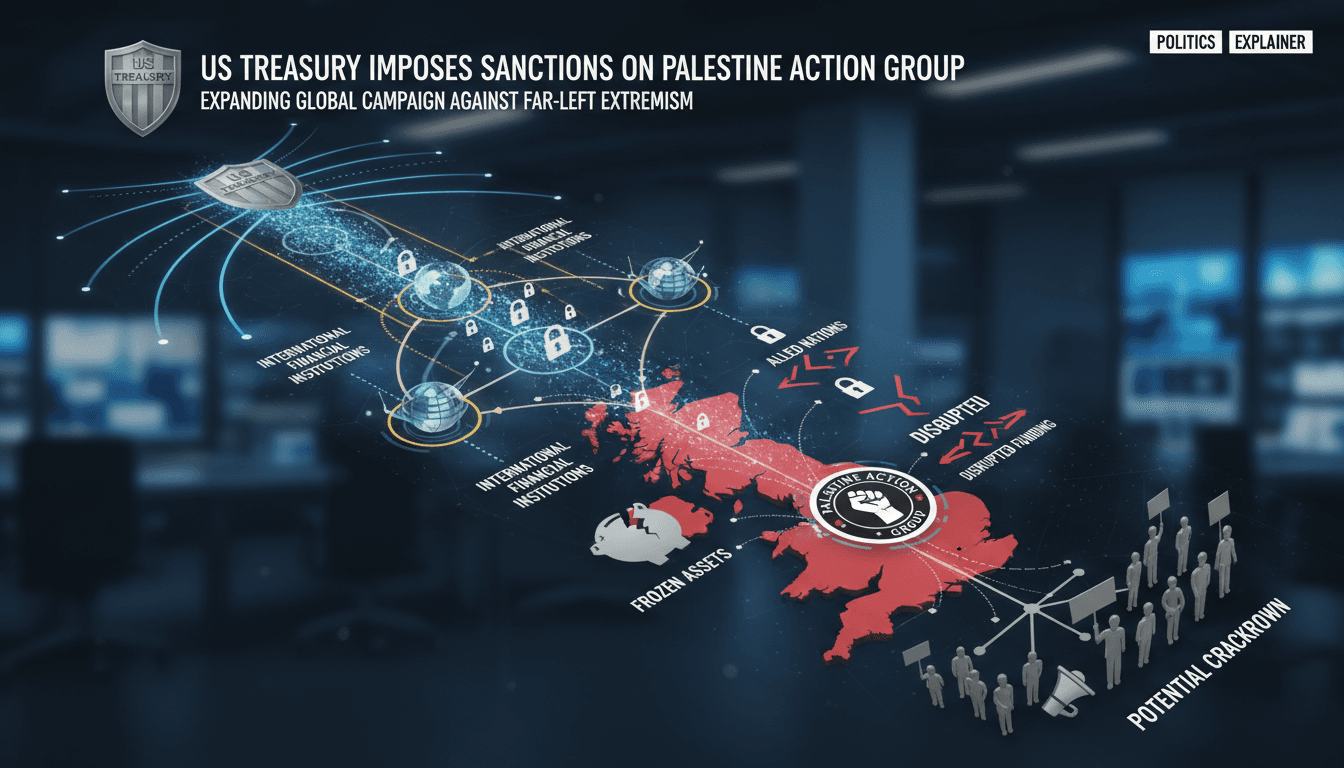
Here's what it means for you.
If you’re involved in international finance or activism, these sanctions could complicate your operations and increase compliance scrutiny.
Why it matters
This move signals a shift in global counterterrorism strategies, potentially impacting financial transactions and international relations.
What happened (in 30 seconds)
- On August 26, 2026, the US Treasury imposed sanctions on Palestine Action and related groups under Executive Order 13224.
- This action expands the Trump administration's focus on far-left extremism, transitioning from domestic to international enforcement.
- The sanctions enable asset freezes and restrict support for designated entities, affecting their financial operations globally.
The context you actually need
- The sanctions follow a July 2026 conference where Secretary of State Marco Rubio urged allies to combat 'far-left terrorism' through financial measures.
- Palestine Action has been accused of causing millions in damages to military sites, framing their actions as resistance against Israel's military operations.
- The UK had previously banned Palestine Action under its Terrorism Act, setting a precedent for the US to follow with international sanctions.
What's really happening
The sanctions against Palestine Action represent a significant escalation in the Trump administration's approach to countering what it labels as far-left extremism. Following the assassination of conservative activist Charlie Kirk in 2025, the administration designated Antifa as a domestic terrorist organization, which laid the groundwork for this broader international campaign. The sanctions are not merely punitive; they are part of a strategic shift in how the US engages with perceived threats to its interests abroad.
The Treasury's designation of Palestine Action, along with the Italian group Autistici/Inventati and Masar Badil, allows for asset freezes and prohibits US persons from providing support to these entities. This means that any financial institution or individual that engages with these groups could face severe penalties, including secondary sanctions that could impact foreign banks and entities. The implications are profound, as they extend the reach of US financial regulations beyond its borders, compelling international actors to comply with US standards or risk losing access to the US financial system.
The sanctions are also a response to the growing concern over transnational networks that utilize encrypted communications and complex funding mechanisms to operate across borders. By targeting these groups, the US aims to disrupt their financial infrastructure and limit their operational capabilities. This move is indicative of a broader trend where counterterrorism efforts are increasingly focused on ideological extremism, rather than traditional terrorist organizations.
Moreover, the sanctions come at a time when the UK is still grappling with its own legal challenges regarding the ban on Palestine Action, which is currently under judicial review. The outcome of these legal proceedings could influence how other countries approach similar groups and their activities. The Trump administration's actions may also provoke backlash from civil liberties advocates who argue that such designations politicize counterterrorism efforts and infringe on free speech.
As the global landscape shifts, financial institutions, especially those in regions like Dubai, will need to enhance their compliance measures to navigate the complexities introduced by these sanctions. The potential for increased scrutiny on transactions involving pro-Palestinian networks could lead to a chilling effect on activism and financial support for related causes.
Who feels it first (and how)
- Financial institutions: Banks and financial services must enhance compliance protocols to avoid penalties.
- Activists and NGOs: Groups supporting Palestine may face funding challenges and operational restrictions.
- International businesses: Companies engaging with sanctioned entities could experience disruptions in transactions.
What to watch next
- Legal outcomes in the UK: The Supreme Court's decision on Palestine Action's ban could set a precedent for similar cases globally.
- International compliance measures: Watch for how banks and financial institutions adapt to the new sanctions landscape.
- Political reactions: Monitor responses from civil rights organizations and political figures regarding the implications of these sanctions.
The sanctions are currently in effect and target specific organizations.
Increased compliance requirements for financial institutions globally.
The long-term impact on international relations and activism related to Palestine.
Frequently Asked Questions
- Why it matters?
- This move signals a shift in global counterterrorism strategies, potentially impacting financial transactions and international relations.
- What happened (in 30 seconds)?
- On August 26, 2026, the US Treasury imposed sanctions on Palestine Action and related groups under Executive Order 13224. This action expands the Trump administration's focus on far-left extremism, transitioning from domestic to international enforcement. The sanctions enable asset freezes and restrict support for designated entities, affecting their financial operations globally.
- What's really happening?
- The sanctions against Palestine Action represent a significant escalation in the Trump administration's approach to countering what it labels as far-left extremism. Following the assassination of conservative activist Charlie Kirk in 2025, the administration designated Antifa as a domestic terrorist organization, which laid the groundwork for this broader international campaign. The sanctions are not merely punitive; they are part of a strategic shift in how the US engages with perceived threats
- Who feels it first (and how)?
- Financial institutions: Banks and financial services must enhance compliance protocols to avoid penalties. Activists and NGOs: Groups supporting Palestine may face funding challenges and operational restrictions. International businesses: Companies engaging with sanctioned entities could experience disruptions in transactions.
- What to watch next?
- Legal outcomes in the UK: The Supreme Court's decision on Palestine Action's ban could set a precedent for similar cases globally. International compliance measures: Watch for how banks and financial institutions adapt to the new sanctions landscape. Political reactions: Monitor responses from civil rights organizations and political figures regarding the implications of these sanctions.
Pan-Arab news coverage spanning politics, business, sports, and regional affairs.
"Asharq Al-Awsat reflects a broad Arab editorial perspective with strong attention to regional geopolitics."
— A47 Editor
من «أنتيفا» إلى «فلسطين أكشن»... ترمب يدوّل الحرب على «الإرهاب اليساري»
The U.S. financial sanctions campaign against foreign groups and networks has escalated, targeting their funds and cross-border dealings, particularly focusing on entities like Antifa and Palestine Action. This move reflects a broader strategy by the...
Arabic-language coverage of political affairs and current events.
"Okaz political coverage typically follows mainstream Saudi framing on national and regional affairs."
— A47 Editor
أمريكا تصنف «فلسطين أكشن» جماعة إرهابية وتعاقب «المسار البديل»
The United States has designated the group 'Palestine Action' as a terrorist organization and imposed sanctions on the transnational group 'Alternative Palestinian Revolutionary Path' as part of President Donald Trump's efforts to tighten measures ag...
Jordanian news and regional updates.
"Roya News is a Jordanian outlet focused on breaking news and local affairs."
— A47 Editor
واشنطن تصنف بالستاين أكشن المؤيدة لفلسطين منظمة إرهابية عالمية
The United States has designated the Palestine Action movement, which supports Palestinian rights, as a global terrorist organization. This classification was announced on Wednesday and reflects the U.S. government's stance on groups advocating for P...
Pan-Arab political news and analysis.
"Al-Quds Al-Arabi is a London-based Arabic newspaper known for political coverage."
— A47 Editor
مخاوف من تجريم التضامن مع غزة وتقييد حرية التعبير بعد تصنيف إدارة ترامب “فلسطين أكشن” منظمة إرهابية
The Trump administration has classified the UK-based organization 'Palestine Action' as an international terrorist organization, imposing sanctions that prohibit Americans from engaging in transactions or providing support to the group. This decision...
Global news coverage with extensive reporting on Middle Eastern conflicts and geopolitics.
"Al Jazeera is a Qatar-based broadcaster known for wide regional coverage and alternative perspectives."
— A47 Editor
US imposes sanctions on Palestine Action and other left-wing groups
The US Treasury Department has designated the UK-based group Palestine Action as a terrorist organization, a decision that follows recent legal actions in the UK against activists from the group for their protests against Israeli policies. This move ...
Comprehensive coverage of Middle Eastern and global issues.
"Al Jazeera is a prominent voice from the Global South, especially the Middle East, with an emphasis on underreported stories."
— A47 Editor
US imposes sanctions on Palestine Action and other left-wing groups
The US Treasury Department has designated the UK-based group Palestine Action as a terrorist organization, a decision that follows recent legal actions in the UK against activists from the group for their protests against Israeli policies. This move ...
Arabic-language coverage of international news and geopolitics.
"RT Arabic is a Russian state-funded outlet often criticized for promoting Kremlin-aligned narratives."
— A47 Editor
الخزانة الأمريكية تفرض عقوبات على حركة "فلسطين أكشن" البريطانية
The U.S. Department of the Treasury has designated the British organization 'Palestine Action' as a specially designated global terrorist organization (SDGT) on Wednesday. This classification indicates that the group is considered a threat to nationa...
Pan-Arab news coverage spanning politics, business, sports, and regional affairs.
"Asharq Al-Awsat reflects a broad Arab editorial perspective with strong attention to regional geopolitics."
— A47 Editor
واشنطن تفرض عقوبات على «فلسطين أكشن»... وتصنفها «تنظيماً إرهابياً عالمياً»
The United States has imposed sanctions on the organization 'Palestine Action' and designated it as a 'global terrorist organization,' according to a notice published on the U.S. Department of the Treasury's website on Wednesday. This action reflects...