
Syrian President Appoints Mazloum Abdi as Presidential Advisor Following SDF Dissolution
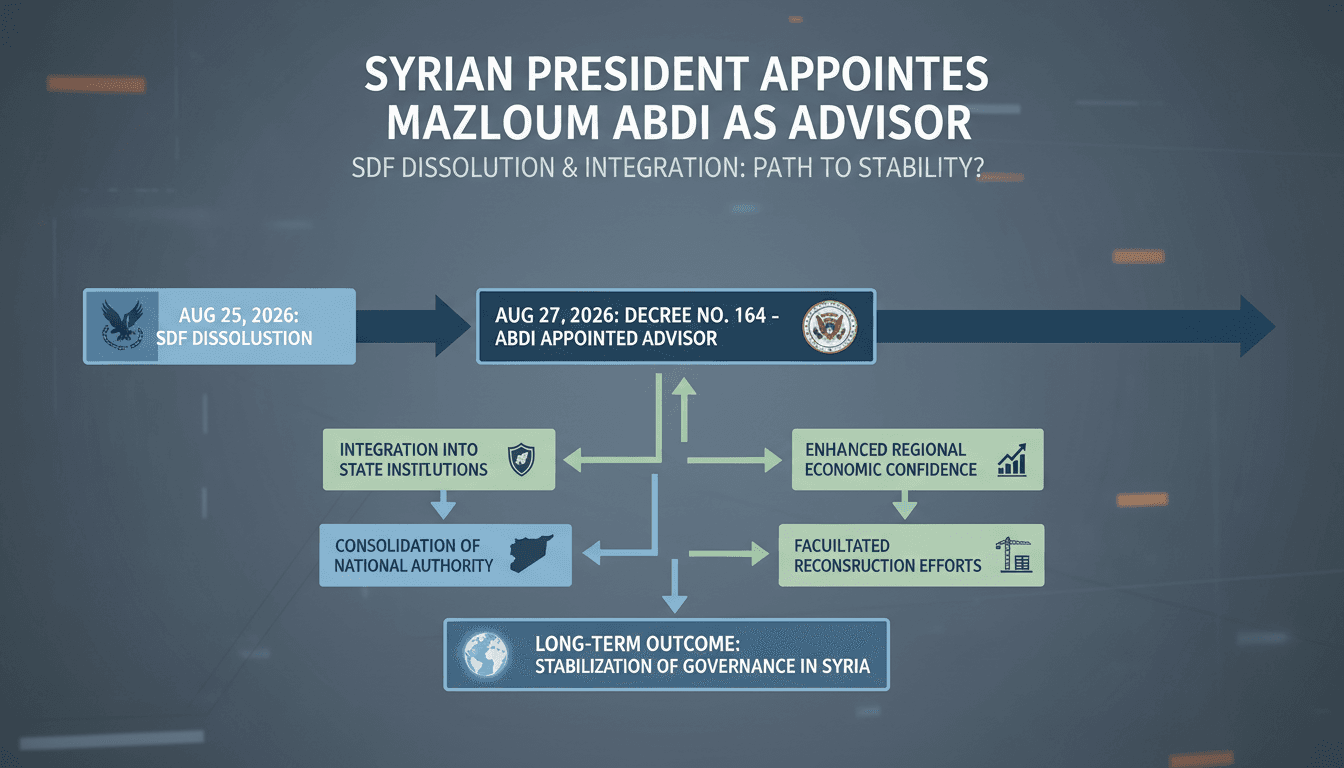
Here's what it means for you.
The recent appointment of Mazloum Abdi as a presidential advisor signals a shift in Syria's governance that could influence regional stability and investment opportunities.
Why it matters
This decree represents a significant step toward consolidating authority in Syria, which may affect economic confidence and cross-border trade in the region.
What happened (in 30 seconds)
- On August 27, 2026, President Ahmed al-Sharaa issued Decree No. 164, appointing Mazloum Abdi as an advisor to the presidency.
- This follows Abdi's announcement on August 25, dissolving the Syrian Democratic Forces (SDF) and integrating them into state institutions.
- The move aligns with ongoing efforts to unify governance in Syria after the December 2024 regime change, enhancing state authority in the region.
The context you actually need
- Syria has been in a transitional phase since the December 2024 overthrow of the Assad regime, with a focus on integrating various military and administrative structures.
- The integration framework established in March 2025 aimed to address fragmentation in northeastern Syria, particularly regarding control over resources and governance.
- Abdi's appointment is part of a broader strategy to ensure Kurdish representation within the new government, aligning with constitutional guarantees for Kurdish rights.
What's really happening
The appointment of Mazloum Abdi as a presidential advisor marks a pivotal moment in Syria's ongoing transition from a fragmented state to a more unified governance structure. Following the overthrow of the Assad regime in December 2024, the new leadership under President Ahmed al-Sharaa has prioritized the integration of various military and administrative entities, particularly those led by Kurdish forces. This integration is not merely a political maneuver; it is a strategic necessity aimed at stabilizing the country and fostering a cohesive national identity.
The dissolution of the Syrian Democratic Forces (SDF) and the Autonomous Administration of North and East Syria (AANES) is a direct outcome of negotiations that began in early 2025. These discussions culminated in a framework that sought to merge military, security, and administrative structures into the Syrian state. By appointing Abdi, who was previously a key figure in the SDF, the government is signaling its commitment to this integration process. This move is expected to enhance the legitimacy of the transitional government in the eyes of both domestic and international stakeholders.
Moreover, the integration of Kurdish forces into the Syrian army and state institutions is crucial for addressing long-standing grievances and ensuring that Kurdish rights are recognized within the new governance framework. This is particularly important given the historical tensions between Kurdish groups and the central government. The constitutional guarantees for Kurdish rights and language recognition enacted earlier in the transition further support this integration, aiming to foster a sense of inclusion among Kurdish populations.
The implications of this decree extend beyond Syria's borders. As the country stabilizes, there is potential for increased economic confidence among Gulf investors, including those in Dubai. Reduced conflict risks and enhanced prospects for cross-border trade and reconstruction projects could attract investment, benefiting various sectors. The appointment of Abdi, along with similar appointments of other Kurdish figures to state positions, reflects a broader strategy to unify governance and promote stability in the region.
In summary, the appointment of Mazloum Abdi is not just a political appointment; it is a strategic move that could reshape the landscape of governance in Syria. By integrating Kurdish forces into the state apparatus, the transitional government aims to create a more cohesive and stable Syria, which in turn could have positive ramifications for regional economic dynamics.
Who feels it first (and how)
- Kurdish communities: They may experience a greater sense of representation and inclusion in the new governance structure.
- Investors in the Gulf region: Increased stability could lead to more investment opportunities in reconstruction and trade.
- Local businesses in northeastern Syria: They may benefit from improved governance and access to resources previously controlled by the SDF.
What to watch next
- Further appointments in the transitional government: Monitoring additional integrations of Kurdish figures could indicate the depth of commitment to unification.
- Economic indicators in the region: Watch for signs of increased investment and trade activity as stability improves.
- International reactions: Responses from global powers, particularly regarding the recognition of Kurdish rights, will be crucial in shaping future dynamics.
The appointment of Mazloum Abdi as presidential advisor has been officially confirmed.
Continued integration of Kurdish forces into state institutions will proceed, enhancing governance.
The long-term impact on regional stability and economic conditions remains to be fully assessed.
Frequently Asked Questions
- Why it matters?
- This decree represents a significant step toward consolidating authority in Syria, which may affect economic confidence and cross-border trade in the region.
- What happened (in 30 seconds)?
- On August 27, 2026, President Ahmed al-Sharaa issued Decree No. 164, appointing Mazloum Abdi as an advisor to the presidency. This follows Abdi's announcement on August 25, dissolving the Syrian Democratic Forces (SDF) and integrating them into state institutions. The move aligns with ongoing efforts to unify governance in Syria after the December 2024 regime change, enhancing state authority in the region.
- What's really happening?
- The appointment of Mazloum Abdi as a presidential advisor marks a pivotal moment in Syria's ongoing transition from a fragmented state to a more unified governance structure. Following the overthrow of the Assad regime in December 2024, the new leadership under President Ahmed al-Sharaa has prioritized the integration of various military and administrative entities, particularly those led by Kurdish forces. This integration is not merely a political maneuver; it is a strategic necessity aimed at
- Who feels it first (and how)?
- Kurdish communities: They may experience a greater sense of representation and inclusion in the new governance structure. Investors in the Gulf region: Increased stability could lead to more investment opportunities in reconstruction and trade. Local businesses in northeastern Syria: They may benefit from improved governance and access to resources previously controlled by the SDF.
- What to watch next?
- Further appointments in the transitional government: Monitoring additional integrations of Kurdish figures could indicate the depth of commitment to unification. Economic indicators in the region: Watch for signs of increased investment and trade activity as stability improves. International reactions: Responses from global powers, particularly regarding the recognition of Kurdish rights, will be crucial in shaping future dynamics.
Jordanian news and regional updates.
"Roya News is a Jordanian outlet focused on breaking news and local affairs."
— A47 Editor
الرئيس السوري يُصدر مرسوماً بتعيين مظلوم عبدي مستشاراً لرئاسة الجمهورية
The Syrian president has issued a decree appointing Mazloum Abdi as an advisor to the presidency, marking a significant development in the political landscape of Syria. This appointment is expected to influence the strategic direction of the presiden...
Pan-Arab political news and analysis.
"Al-Quds Al-Arabi is a London-based Arabic newspaper known for political coverage."
— A47 Editor
الشرع يعين قائد قوات سوريا الديمقراطية المنحلة مستشارا للرئاسة
Syrian President Ahmad al-Shara issued a decree appointing Mazloum Abdi, the former commander of the dissolved Syrian Democratic Forces (SDF), as a presidential advisor. This decision follows Abdi's announcement earlier this week regarding the dissol...
Pan-Arab news coverage spanning politics, business, sports, and regional affairs.
"Asharq Al-Awsat reflects a broad Arab editorial perspective with strong attention to regional geopolitics."
— A47 Editor
الشرع يعيّن مظلوم عبدي مستشاراً للرئاسة
Syrian President Ahmad al-Shara has issued a decree appointing Mustafa Abdi, also known as Mazloum Abdi, the former commander of the disbanded Syrian Democratic Forces, as an advisor to the presidency. This appointment marks a significant shift in th...