
Jerusalem Court Acquits Settler of Assault on Nun Due to Insanity
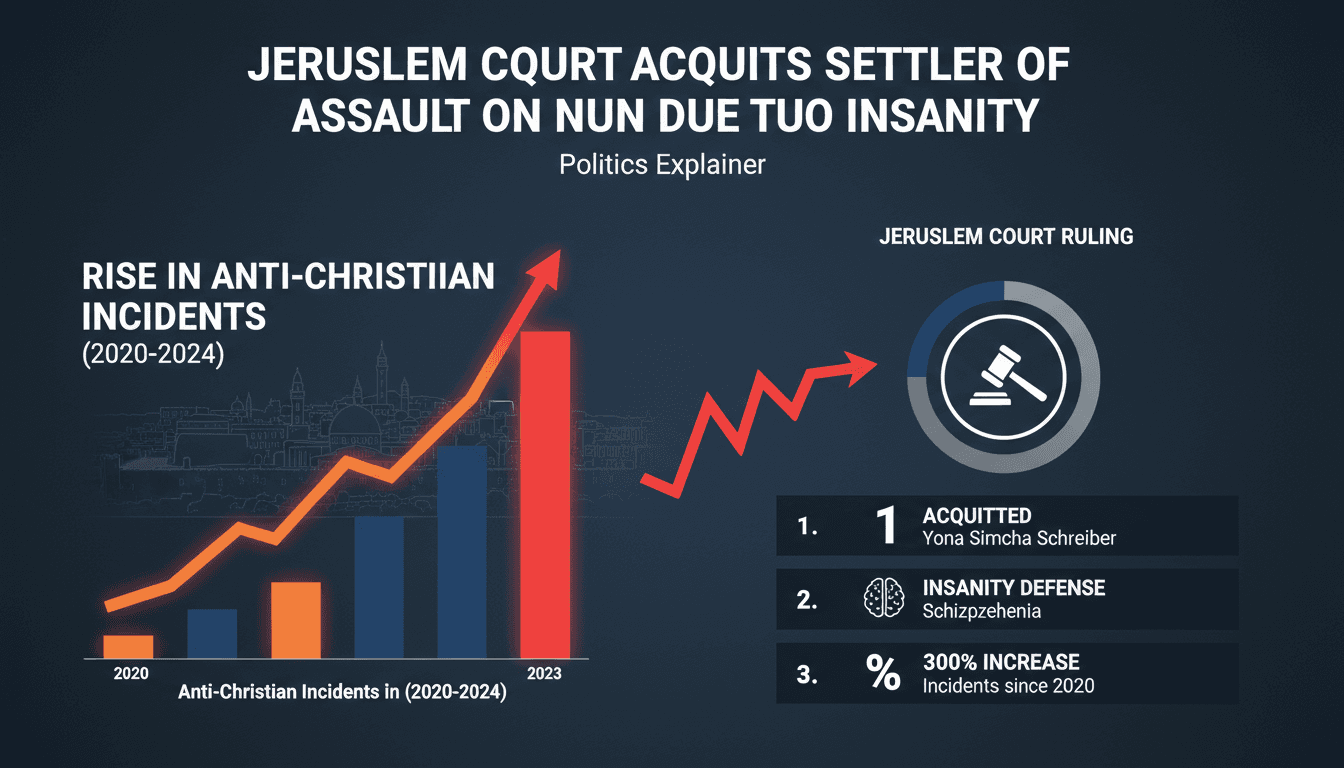
Here's what it means for you.
The ruling highlights the complexities of mental health defenses in criminal cases, impacting how societies address violence and accountability.
Why it matters
This case underscores the rising tensions in Jerusalem, reflecting broader societal issues related to religious intolerance and mental health.
What happened (in 30 seconds)
- Acquittal on insanity grounds: Yona Simcha Schreiber was acquitted of assaulting a nun due to a psychotic episode linked to schizophrenia.
- Court ruling: The Jerusalem Magistrates Court ordered his commitment to a psychiatric hospital for up to six years instead of a criminal penalty.
- Rising anti-Christian incidents: The incident occurred amid a documented increase in anti-Christian harassment in Jerusalem, with incidents tripling over the past four years.
The context you actually need
- Escalating tensions: The attack is part of a broader pattern of violence and harassment against Christian clergy and pilgrims in Jerusalem's Old City.
- Mental health considerations: The ruling reflects a growing recognition of mental health issues in the legal system, particularly in cases involving violent acts.
- Impact on communities: The incident has implications for interfaith relations and the safety of religious minorities in a region marked by conflict.
What's really happening
The acquittal of Yona Simcha Schreiber on the grounds of insanity raises significant questions about the intersection of mental health and criminal justice, particularly in a region fraught with religious and ethnic tensions. Schreiber's actions, which included a violent assault on a French Catholic nun, were deemed to stem from a psychotic episode linked to his long-standing schizophrenia. This ruling, while legally sound under Israeli law, reflects a broader societal challenge: how to balance accountability for violent acts with an understanding of mental health issues.
The court's decision to commit Schreiber to a psychiatric hospital rather than impose a criminal penalty illustrates a shift in how the legal system addresses individuals with severe mental health conditions. This approach may be seen as a compassionate response, prioritizing treatment over punishment. However, it also raises concerns about public safety and the message it sends regarding accountability for violent behavior. Advocacy groups have pointed out that the surrounding anti-Christian discourse can influence even those with mental health issues, suggesting that societal attitudes play a role in such incidents.
Moreover, the increase in anti-Christian incidents—reported to be three times higher than four years ago—highlights a troubling trend in Jerusalem. This escalation is attributed to rising religious nationalism and ongoing regional conflicts, which have created an environment where harassment of religious minorities has become more frequent. The court's ruling may inadvertently contribute to a perception that violent acts motivated by religious hostility can be excused if the perpetrator is deemed mentally ill, potentially emboldening similar behaviors in the future.
As the legal and mental health systems grapple with these complexities, the implications extend beyond individual cases. They touch on the broader societal fabric, influencing how communities coexist in a multi-faith environment. The ruling may prompt discussions about the adequacy of mental health resources, the need for better protection of vulnerable communities, and the role of law enforcement in addressing hate crimes.
Who feels it first (and how)
- Christian communities: Increased vulnerability and fear of harassment in Jerusalem.
- Mental health professionals: Greater scrutiny and demand for mental health evaluations in legal cases.
- Legal system: Potential shifts in how insanity defenses are viewed and applied in future cases.
- Religious organizations: Heightened concern over safety and the need for advocacy against religious intolerance.
What to watch next
- Monitoring anti-Christian incidents: Keep an eye on the frequency and nature of reported incidents against Christian clergy and pilgrims in Jerusalem, as this will indicate the ongoing societal climate.
- Legal precedents: Watch for future cases that may reference this ruling, particularly regarding the use of insanity defenses in violent crimes.
- Mental health policy changes: Observe any shifts in mental health policy or resources allocated to address the needs of individuals with severe mental health issues in the context of criminal behavior.
The ruling reflects a legal precedent for insanity defenses in Israel.
There will be increased advocacy for better protection of religious minorities in Jerusalem.
The long-term impact of this ruling on public perceptions of mental health and accountability in violent crimes.
Frequently Asked Questions
- Why it matters?
- This case underscores the rising tensions in Jerusalem, reflecting broader societal issues related to religious intolerance and mental health.
- What happened (in 30 seconds)?
- Acquittal on insanity grounds: Yona Simcha Schreiber was acquitted of assaulting a nun due to a psychotic episode linked to schizophrenia. Court ruling: The Jerusalem Magistrates Court ordered his commitment to a psychiatric hospital for up to six years instead of a criminal penalty. Rising anti-Christian incidents: The incident occurred amid a documented increase in anti-Christian harassment in Jerusalem, with incidents tripling over the past four years.
- What's really happening?
- The acquittal of Yona Simcha Schreiber on the grounds of insanity raises significant questions about the intersection of mental health and criminal justice, particularly in a region fraught with religious and ethnic tensions. Schreiber's actions, which included a violent assault on a French Catholic nun, were deemed to stem from a psychotic episode linked to his long-standing schizophrenia. This ruling, while legally sound under Israeli law, reflects a broader societal challenge: how to balance
- Who feels it first (and how)?
- Christian communities: Increased vulnerability and fear of harassment in Jerusalem. Mental health professionals: Greater scrutiny and demand for mental health evaluations in legal cases. Legal system: Potential shifts in how insanity defenses are viewed and applied in future cases. Religious organizations: Heightened concern over safety and the need for advocacy against religious intolerance.
- What to watch next?
- Monitoring anti-Christian incidents: Keep an eye on the frequency and nature of reported incidents against Christian clergy and pilgrims in Jerusalem, as this will indicate the ongoing societal climate. Legal precedents: Watch for future cases that may reference this ruling, particularly regarding the use of insanity defenses in violent crimes. Mental health policy changes: Observe any shifts in mental health policy or resources allocated to address the needs of individuals with severe menta
International coverage of politics, security, and social issues.
"Global News is a mainstream Canadian outlet with a centrist editorial stance, focusing on factual reporting."
— A47 Editor
Jerusalem court acquits man charged in nun attack on insanity defence
A Jerusalem court has acquitted a man charged with attacking a nun, citing an insanity defense. The incident, which occurred in April, was captured on CCTV, showing the nun being forced to the ground from behind, resulting in her hitting her head on ...
Pan-Arab news coverage spanning politics, business, sports, and regional affairs.
"Asharq Al-Awsat reflects a broad Arab editorial perspective with strong attention to regional geopolitics."
— A47 Editor
تبرئة إسرائيلي في قضية اعتداء على راهبة في القدس لـ «حالته النفسية»
An Israeli settler has been acquitted by an Israeli court for assaulting a French Catholic nun in Jerusalem, with the court citing his mental state at the time of the incident as the reason for the ruling. The incident was captured on video, raising ...
Jordanian news and regional updates.
"Roya News is a Jordanian outlet focused on breaking news and local affairs."
— A47 Editor
محكمة في كيان الاحتلال تبرئ مستوطنا من تهمة الاعتداء على راهبة فرنسية في القدس بسبب المرض نفسي
A court in the occupied territories of Jerusalem acquitted a settler of charges related to the assault on a French nun, citing mental illness as the reason for the decision. This ruling has raised concerns regarding the accountability of individuals ...