
AfD Achieves Historic Victory in Saxony-Anhalt State Election
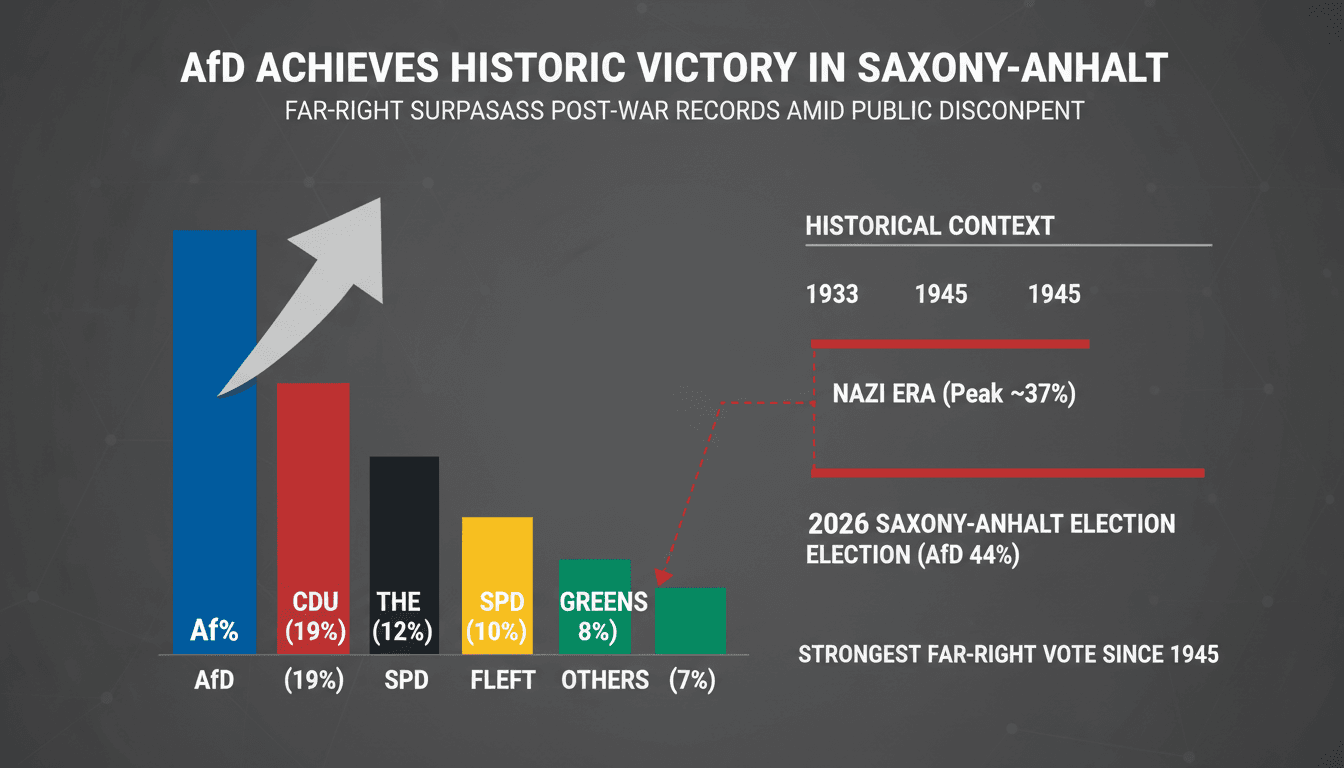
Here's what it means for you.
The rise of the AfD could reshape Germany's political dynamics, impacting economic policies and immigration debates that resonate across Europe.
Why it matters
The AfD's success challenges the traditional political order in Germany, potentially influencing broader European political trends.
What happened (in 30 seconds)
- The AfD secured approximately 44% of the vote in the Saxony-Anhalt state election, marking the highest share for a far-right party in Germany since 1945.
- Chancellor Friedrich Merz's CDU faced a significant defeat, garnering only 17.2% of the vote, reflecting growing voter discontent.
- Coalition negotiations are ongoing, with the AfD positioned for potential influence in future state elections.
The context you actually need
- The AfD has been gaining traction since its founding in 2013, primarily by opposing immigration and EU policies while advocating for closer ties with Russia.
- Mainstream parties have historically excluded the AfD from coalitions, but this election result puts pressure on that strategy as the party nears an absolute majority.
- Economic dissatisfaction is driving voter sentiment, with inflation and energy costs contributing to the AfD's appeal in Saxony-Anhalt.
What's really happening
The Alternative für Deutschland (AfD) party's recent electoral victory in Saxony-Anhalt is a significant indicator of shifting political sentiments in Germany. With approximately 44% of the vote, the AfD has not only outperformed its previous results but has also achieved the highest share for a far-right party in a German state election since the end of World War II. This outcome is emblematic of a broader trend of discontent among voters, particularly in eastern Germany, where economic stagnation, rising energy costs, and immigration issues have fueled support for the AfD.
Chancellor Friedrich Merz's Christian Democratic Union (CDU) has faced declining approval ratings since taking power in 2025, largely due to its handling of economic challenges and inflation. The CDU's failure to address these pressing issues effectively has opened the door for the AfD to capitalize on voter frustration. The party's lead candidate, Ulrich Siegmund, has framed the election result as a mandate to govern, although he has set the condition of achieving an absolute majority before assuming the premiership.
The implications of this election extend beyond Saxony-Anhalt. Nationally, the AfD is polling at around 28%, with ambitions to reach 40% in the 2029 general election. This momentum could lead to a significant shift in Germany's political landscape, as the AfD positions itself as a viable alternative to the traditional parties. The refusal of mainstream parties to form coalitions with the AfD, despite its electoral success, raises questions about the sustainability of their exclusionary 'firewall' strategy.
European politicians have expressed alarm at the AfD's rise, viewing it as a potential threat to the political stability of the continent. The reaction from markets has been muted so far, but analysts warn of possible pressure on German bonds and the euro's stability as the AfD's influence grows. As coalition negotiations unfold, the political landscape in Germany remains uncertain, with the potential for further shifts in voter sentiment as upcoming elections in Berlin and Mecklenburg-Western Pomerania approach.
Who feels it first (and how)
- Voters in eastern Germany: Discontent over economic issues and immigration policies directly influences their support for the AfD.
- Mainstream political parties: The CDU and SPD must reassess their strategies to regain voter trust and address the issues driving AfD support.
- Investors and markets: Potential instability in German bonds and the euro could affect financial markets, particularly if the AfD gains further traction.
What to watch next
- Upcoming state elections on September 20: Results in Berlin and Mecklenburg-Western Pomerania will indicate whether the AfD's momentum continues.
- Coalition negotiations in Saxony-Anhalt: The outcome will reveal how mainstream parties respond to the AfD's electoral strength and whether they adjust their strategies.
- National polling trends for the AfD: Monitoring shifts in public opinion will provide insights into the party's potential impact on the 2029 general election.
The AfD achieved approximately 44% of the vote in Saxony-Anhalt, marking a historic high for far-right parties in Germany.
The AfD will continue to gain support if mainstream parties fail to address voter concerns about the economy and immigration.
The long-term implications of the AfD's rise on Germany's political stability and European relations remain uncertain.
Frequently Asked Questions
- Why it matters?
- The AfD's success challenges the traditional political order in Germany, potentially influencing broader European political trends.
- What happened (in 30 seconds)?
- The AfD secured approximately 44% of the vote in the Saxony-Anhalt state election, marking the highest share for a far-right party in Germany since 1945. Chancellor Friedrich Merz's CDU faced a significant defeat, garnering only 17.2% of the vote, reflecting growing voter discontent. Coalition negotiations are ongoing, with the AfD positioned for potential influence in future state elections.
- What's really happening?
- The Alternative für Deutschland (AfD) party's recent electoral victory in Saxony-Anhalt is a significant indicator of shifting political sentiments in Germany. With approximately 44% of the vote, the AfD has not only outperformed its previous results but has also achieved the highest share for a far-right party in a German state election since the end of World War II. This outcome is emblematic of a broader trend of discontent among voters, particularly in eastern Germany, where economic stagnat
- Who feels it first (and how)?
- Voters in eastern Germany: Discontent over economic issues and immigration policies directly influences their support for the AfD. Mainstream political parties: The CDU and SPD must reassess their strategies to regain voter trust and address the issues driving AfD support. Investors and markets: Potential instability in German bonds and the euro could affect financial markets, particularly if the AfD gains further traction.
- What to watch next?
- Upcoming state elections on September 20: Results in Berlin and Mecklenburg-Western Pomerania will indicate whether the AfD's momentum continues. Coalition negotiations in Saxony-Anhalt: The outcome will reveal how mainstream parties respond to the AfD's electoral strength and whether they adjust their strategies. National polling trends for the AfD: Monitoring shifts in public opinion will provide insights into the party's potential impact on the 2029 general election.
International coverage from The Guardian's global desks.
"The Guardian is known for its progressive editorial stance and in-depth analysis."
— A47 Editor
Why is the far-right AfD’s state victory significant and what might happen next in German politics?
The far-right Alternative für Deutschland (AfD) party achieved a historic victory in the Saxony-Anhalt state election, securing approximately 44% of the vote, marking the largest success for a far-right party in Germany since the Nazi era. This outco...
Comprehensive coverage of Middle Eastern and global issues.
"Al Jazeera is a prominent voice from the Global South, especially the Middle East, with an emphasis on underreported stories."
— A47 Editor
Can AfD form Germany’s first far-right state government since World War II?
The far-right Alternative for Germany (AfD) party is projected to win a significant victory in the Saxony-Anhalt state election, potentially securing around 44.4% of the vote, which could lead to its first governorship since World War II. This electi...
International stories from NPR’s global desk.
"NPR is an American public media organization known for thoughtful reporting and a slightly left-leaning editorial tone."
— A47 Editor
German exit polls suggest far-right party has big lead in regional election
Exit polls indicate that Germany's far-right Alternative for Germany (AfD) party is leading in a regional election, potentially paving the way for its first state government since World War II. The election results are still pending, leaving uncertai...
Global coverage of politics, crises, and international affairs.
"HuffPost provides progressive-oriented reporting on international developments, often focusing on humanitarian and social justice issues."
— A47 Editor
German Far-Right Party Wins Big In Regional Election But Falls Short Of Majority
The Alternative for Germany (AfD) party has achieved a significant lead in the Saxony-Anhalt state election, securing approximately 44.5% of the vote according to early results. This marks a potential historic moment as the AfD aims to establish its ...
European current affairs, EU politics, and regional developments.
"France 24 is viewed as a globally focused outlet with balanced coverage and a European perspective."
— A47 Editor
Germany's far-right AfD eyes historic state victory in Saxony-Anhalt election
In the Saxony-Anhalt state election, Germany's far-right Alternative for Germany (AfD) party is poised to achieve a historic victory, potentially becoming the first far-right party to govern at the state level since World War II. Polls indicate the A...
Comprehensive coverage of Middle Eastern and global issues.
"Al Jazeera is a prominent voice from the Global South, especially the Middle East, with an emphasis on underreported stories."
— A47 Editor
Germany’s far-right AfD eyes historic first in state election
Germany's far-right Alternative for Germany (AfD) party is projected to secure power in Saxony-Anhalt, marking a historic first for the party in one of Germany's 16 states. This potential victory comes as the party is polling at over 40% ahead of the...
Global news coverage with extensive reporting on Middle Eastern conflicts and geopolitics.
"Al Jazeera is a Qatar-based broadcaster known for wide regional coverage and alternative perspectives."
— A47 Editor
Germany’s far-right AfD eyes historic first in state election
Germany's far-right Alternative for Germany (AfD) party is projected to secure power in Saxony-Anhalt, marking a historic first for the party in one of Germany's 16 states. This potential victory comes as the party is polling at over 40% ahead of the...
24/7 international news from a French perspective in multiple languages.
"France 24 is viewed as a globally focused outlet with balanced coverage and a European perspective."
— A47 Editor
Germany: AfD eyes historic state election win
In Saxony-Anhalt, the far-right party Alternative for Germany (AfD) is polling at 40% or more ahead of the regional election scheduled for September 6, 2026. If successful, this would mark the first time since 1945 that a far-right party has led a Ge...