
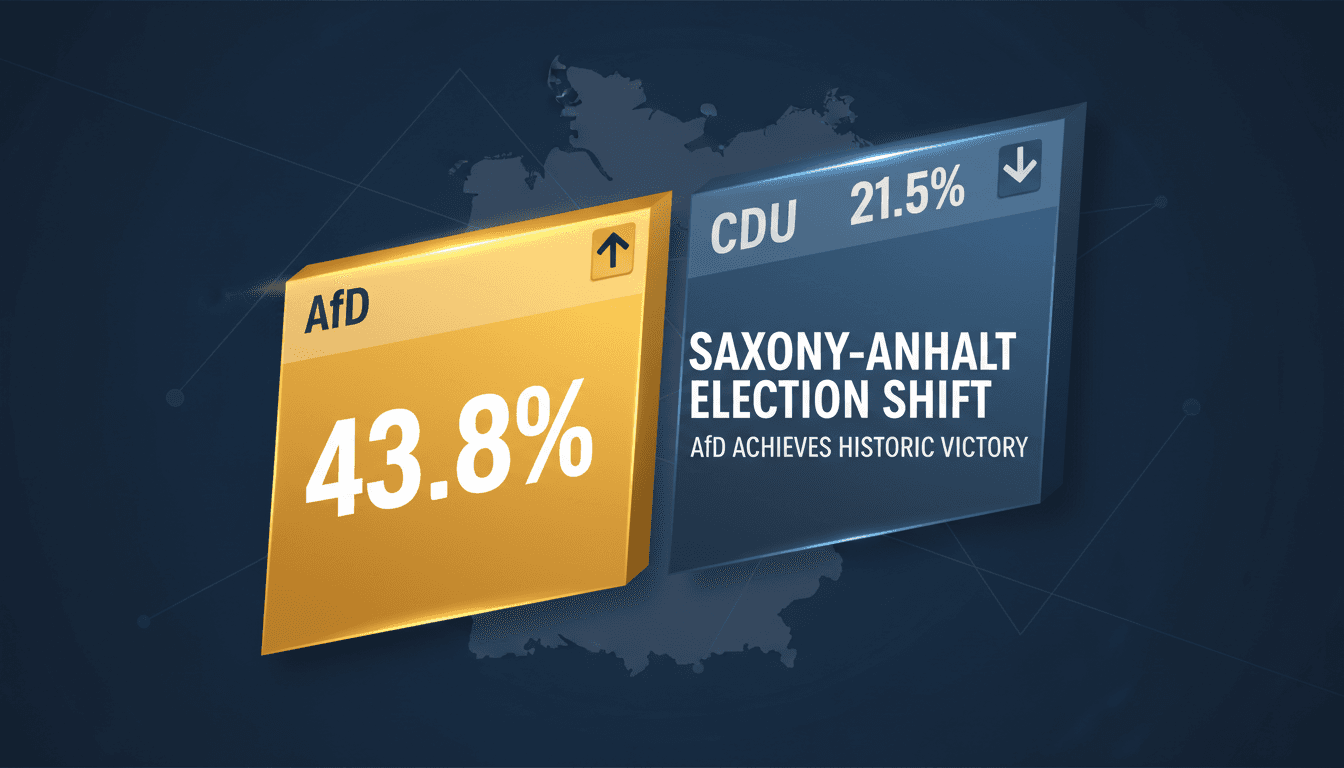
AfD Achieves Historic Victory in Saxony-Anhalt State Election
Here's what it means for you.
The rise of the AfD in Germany could reshape political alliances and economic policies across Europe, impacting global markets.
Why it matters
The AfD's strong performance signals a shift in voter sentiment that could destabilize Germany's political landscape and influence EU policies.
What happened (in 30 seconds)
- Chancellor Friedrich Merz expressed shock after the AfD secured approximately 43.8% of the vote in the Saxony-Anhalt state election.
- The CDU suffered a historic defeat, garnering only 17%, marking its worst performance in decades.
- International concern is rising, particularly from neighboring countries like France and Poland, over the potential erosion of Germany's political stability.
The context you actually need
- Voter dissatisfaction is high due to slow economic reforms and migration policies under Merz's center-right coalition government.
- The AfD has been gaining traction in eastern states, where it is often classified as extremist by intelligence services.
- Merz's leadership is under scrutiny, with declining personal approval ratings and pressure to address the growing influence of the AfD.
What's really happening
The September 6, 2026, state election in Saxony-Anhalt marked a pivotal moment in German politics, as the Alternative for Germany (AfD) achieved its strongest postwar result at the state level with 43.8% of the vote. This outcome not only positions the AfD to potentially form the first far-right state government since World War II but also raises significant questions about the future of Germany's political landscape and its implications for Europe.
Chancellor Friedrich Merz's Christian Democratic Union (CDU) faced a severe setback, plummeting to just 17% of the vote. This defeat is particularly alarming for the CDU, which has historically been a dominant force in German politics. Merz described the result as a shock that has shaken the party to its foundations, highlighting the growing discontent among voters regarding the national government's reforms and migration policies. The CDU's inability to connect with the electorate has opened the door for the AfD, which has capitalized on fears surrounding immigration and economic stagnation.
The AfD's rise is not merely a local phenomenon; it reflects broader trends across Europe, where populist and far-right parties have gained ground amid economic uncertainty and social unrest. The party's anti-immigration stance and pro-Russia rhetoric resonate with a segment of the population that feels left behind by traditional political parties. As the AfD seeks to attract CDU defectors, the potential for a coalition or minority government raises concerns about the normalization of far-right politics in Germany.
Internationally, the election results have prompted alarm from neighboring countries, particularly France and Poland, which fear the erosion of the political 'firewall' that has historically kept far-right parties at bay in Germany. The implications of this shift extend beyond Germany's borders, as it could influence EU policies on migration, economic cooperation, and security.
Merz's rejection of any coalition with the AfD indicates a commitment to maintaining the CDU's traditional values, but it also suggests a potential for increased polarization within German politics. As the CDU enters opposition in Saxony-Anhalt, the party faces internal challenges and questions about its leadership and direction moving forward.
Who feels it first (and how)
- Voters in Saxony-Anhalt: Directly impacted by the AfD's policies and governance if they form a government.
- CDU members and supporters: Facing a crisis of identity and leadership as the party grapples with its electoral defeat.
- European Union policymakers: Monitoring the situation closely, as shifts in Germany's political landscape could affect EU cohesion and policy-making.
- Investors and businesses: Concerned about potential instability and changes in economic policies that could arise from a far-right government.
What to watch next
- Internal CDU dynamics: Watch for potential leadership challenges within the CDU as members react to the electoral defeat and strategize for the future.
- AfD coalition attempts: Monitor the AfD's efforts to form a government or attract CDU defectors, which could set a precedent for future elections.
- International reactions: Pay attention to how neighboring countries respond to the AfD's rise, particularly regarding EU policies on migration and economic cooperation.
The AfD secured 43.8% of the vote in Saxony-Anhalt, marking a historic victory.
The CDU will face internal challenges and scrutiny regarding its leadership and strategy moving forward.
The long-term implications of the AfD's rise on Germany's political stability and EU relations.
Frequently Asked Questions
- Why it matters?
- The AfD's strong performance signals a shift in voter sentiment that could destabilize Germany's political landscape and influence EU policies.
- What happened (in 30 seconds)?
- Chancellor Friedrich Merz expressed shock after the AfD secured approximately 43.8% of the vote in the Saxony-Anhalt state election. The CDU suffered a historic defeat, garnering only 17%, marking its worst performance in decades. International concern is rising, particularly from neighboring countries like France and Poland, over the potential erosion of Germany's political stability.
- What's really happening?
- The September 6, 2026, state election in Saxony-Anhalt marked a pivotal moment in German politics, as the Alternative for Germany (AfD) achieved its strongest postwar result at the state level with 43.8% of the vote. This outcome not only positions the AfD to potentially form the first far-right state government since World War II but also raises significant questions about the future of Germany's political landscape and its implications for Europe. Chancellor Friedrich Merz's Christian Democra
- Who feels it first (and how)?
- Voters in Saxony-Anhalt: Directly impacted by the AfD's policies and governance if they form a government. CDU members and supporters: Facing a crisis of identity and leadership as the party grapples with its electoral defeat. European Union policymakers: Monitoring the situation closely, as shifts in Germany's political landscape could affect EU cohesion and policy-making. Investors and businesses: Concerned about potential instability and changes in economic policies that could arise from a fa
- What to watch next?
- Internal CDU dynamics: Watch for potential leadership challenges within the CDU as members react to the electoral defeat and strategize for the future. AfD coalition attempts: Monitor the AfD's efforts to form a government or attract CDU defectors, which could set a precedent for future elections. International reactions: Pay attention to how neighboring countries respond to the AfD's rise, particularly regarding EU policies on migration and economic cooperation.
Editor-curated FT homepage stories spanning markets, business, world, and opinion.
"The Financial Times is a globally respected business publication with a centrist/center-left tone and strong markets focus."
— A47 Editor
Merz in ‘shock’ as far-right AfD celebrates ‘dream result’
Chancellor Friedrich Merz expressed shock following the far-right Alternative for Germany (AfD) party's significant electoral success, which positions them to potentially secure 40% of the vote in upcoming federal elections. This surge comes after th...
International coverage from The Guardian's global desks.
"The Guardian is known for its progressive editorial stance and in-depth analysis."
— A47 Editor
German chancellor vows to stay in office despite AfD triumph in state election
German Chancellor Friedrich Merz has vowed to remain in office despite the far-right Alternative für Deutschland (AfD) party's significant victory in the Saxony-Anhalt state election, where they secured approximately 44.4% of the vote, marking a hist...
Global political, business, and cultural coverage from WSJ international desks.
"The Wall Street Journal offers extensive international reporting with a reputation for financial insight and a center-right editorial stance."
— A47 Editor
After Far-Right Triumph, Merz Faces Narrow Path to Save His Government
The far-right Alternative for Germany (AfD) party has achieved a historic victory in the Saxony-Anhalt state election, securing approximately 44.4% of the vote, a significant breakthrough for the party since World War II. This result poses a challeng...
Right-of-center views on political news.
"The Washington Times is a conservative-leaning newspaper known for its political coverage and advocacy of right-of-center viewpoints."
— A47 Editor
Germany's Merz shocked by far-right state election triumph but doubles down on unpopular reforms
German Chancellor Friedrich Merz expressed shock at the recent electoral success of a far-right party in a regional election, which positions them to potentially form the first far-right state government in Germany since the Nazi era. Despite this al...
24/7 international news from a French perspective in multiple languages.
"France 24 is viewed as a globally focused outlet with balanced coverage and a European perspective."
— A47 Editor
REPLAY: 'Shocked' Merz speaks after far-right election victory
German Chancellor Friedrich Merz expressed his deep shock following a significant electoral defeat in the Saxony-Anhalt state election, where his center-right party lost to the far-right Alternative for Germany (AfD), which secured approximately 44.4...
Global political, business, and cultural coverage from WSJ international desks.
"The Wall Street Journal offers extensive international reporting with a reputation for financial insight and a center-right editorial stance."
— A47 Editor
After Far-Right Election Breakthrough, Germany’s Merz Faces Painful Dilemma
The far-right Alternative for Germany (AfD) party has achieved a historic victory in the Saxony-Anhalt state election, securing approximately 44.4% of the vote, significantly ahead of its rivals. This breakthrough marks the first time since World War...
European current affairs, EU politics, and regional developments.
"France 24 is viewed as a globally focused outlet with balanced coverage and a European perspective."
— A47 Editor
Germany's Merz vows to stick with reforms despite election drubbing by far right
German Chancellor Friedrich Merz has pledged to continue his reform agenda despite a significant electoral defeat for his center-right CDU party in Saxony-Anhalt, where the far-right AfD secured nearly 44% of the vote, marking the CDU's worst perform...
Editor-curated FT homepage stories spanning markets, business, world, and opinion.
"The Financial Times is a globally respected business publication with a centrist/center-left tone and strong markets focus."
— A47 Editor
Germany’s Merz on the ropes after far right delivers devastating blow
The recent electoral victory of the far-right Alternative for Germany (AfD) party in Saxony-Anhalt has dealt a significant blow to Chancellor Friedrich Merz, highlighting the erosion of Germany's political center. This development raises concerns abo...