
US Imposes New Sanctions on Cuban Leadership Amid Economic Crisis
Here's what it means for you.
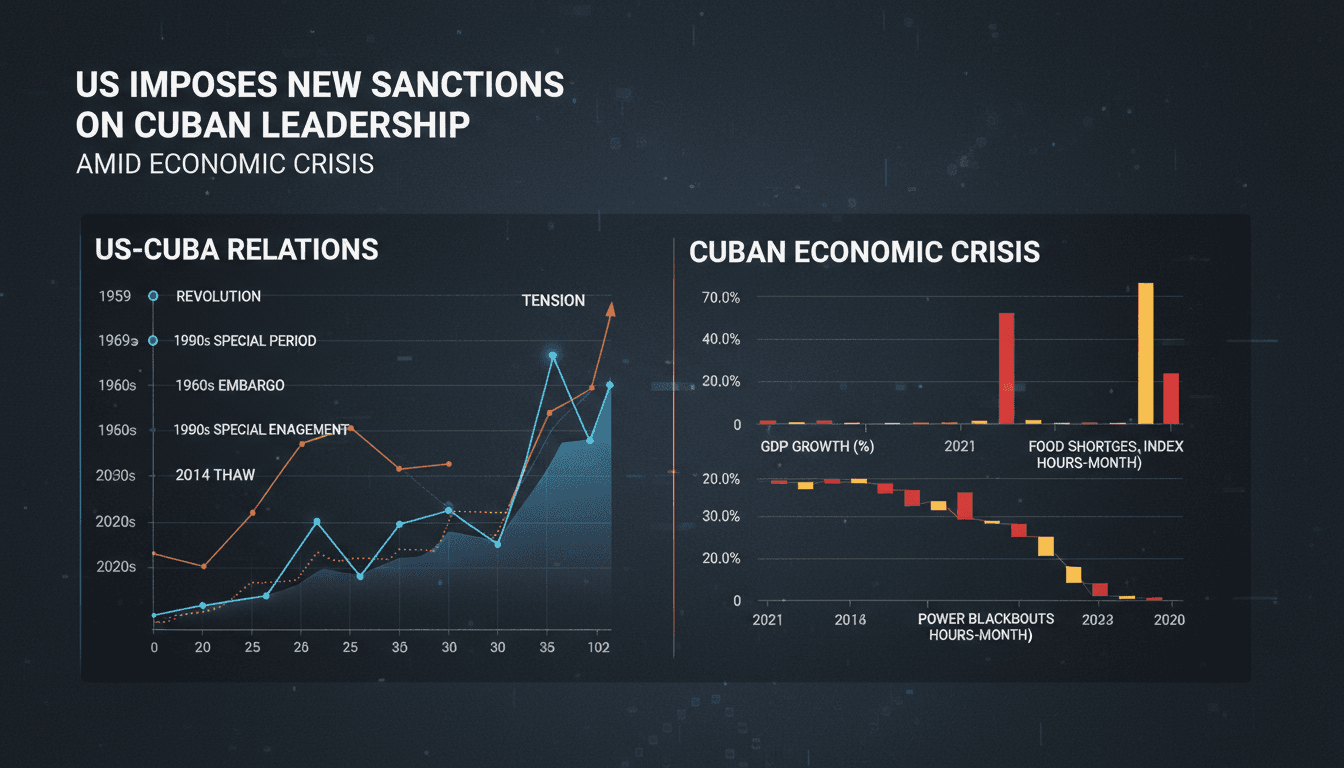
The recent sanctions imposed by the United States on Cuban President Miguel Díaz-Canel and members of the Castro family signal a significant escalation in U.S. foreign policy towards Cuba. This move is likely to exacerbate the already strained relations between the two nations, impacting diplomatic and humanitarian efforts. For businesses and policymakers, the situation may lead to increased uncertainty in U.S.-Cuba interactions, particularly in areas related to trade and aid. As Cuba grapples with severe economic challenges, including food shortages and blackouts, the sanctions could hinder the government's ability to address these pressing issues. Stakeholders should monitor the evolving dynamics closely, as the implications of these sanctions may ripple through various sectors.
What happened
On June 5, 2026, the United States announced new sanctions targeting Cuban President Miguel Díaz-Canel and several members of the Castro family. This action is part of a broader strategy aimed at addressing the political and humanitarian situation in Cuba. The sanctions specifically focus on three immediate family members of the Cuban leadership, underscoring the U.S. intent to influence key figures within the regime.
The sanctions come amid ongoing economic difficulties in Cuba, characterized by significant food shortages and widespread blackouts. By targeting influential leaders, the U.S. aims to exert pressure on the Cuban government to reconsider its policies and address the humanitarian crises affecting its citizens.
The Context
Cuba is currently facing a dire economic landscape, with severe shortages of food and essential services. The U.S. sanctions reflect a long-standing strategy to influence the political dynamics within the island nation, particularly by focusing on legacy leadership figures like the Castro family. The timing of these sanctions is critical, as they coincide with heightened public discontent in Cuba over the government's handling of economic issues.
The sanctions are not merely punitive; they are intended to signal to the Cuban leadership that the U.S. is closely monitoring its actions. This move may also resonate with the Cuban populace, who are increasingly frustrated with the government's inability to provide basic necessities. As the situation unfolds, the international community will be watching closely to see how the Cuban government responds.
Takeaway
The recent sanctions may further strain U.S.-Cuba relations, complicating future diplomatic engagements and humanitarian efforts. Observers should watch for potential responses from the Cuban government, which may include rhetoric against the U.S. or attempts to rally domestic support. Additionally, developments in U.S. foreign policy towards Cuba could emerge as a focal point in upcoming discussions among policymakers.
As the economic situation in Cuba continues to deteriorate, the effectiveness of these sanctions in prompting change remains to be seen. Stakeholders should remain vigilant, as the evolving landscape could have significant implications for both nations moving forward.
Global markets, investing, and macroeconomics from a premier financial newsroom.
"Bloomberg is respected for in-depth financial reporting and data-driven analysis."
— A47 Editor
US Sanctions Cuba’s Díaz-Canel as Trump Ramps Up Pressure
The United States has imposed sanctions on Cuban President Miguel Díaz-Canel and his family, intensifying the pressure on the communist government of Cuba. This action reflects the ongoing tensions between the US and Cuba, particularly under the Trum...
24/7 international news from a French perspective in multiple languages.
"France 24 is viewed as a globally focused outlet with balanced coverage and a European perspective."
— A47 Editor
US imposes sanctions on Cuban president, Castro family members
The United States has imposed new sanctions on Cuba's president Miguel Diaz-Canel and several members of the Castro family, including Raul Castro's son and grandson, as part of an ongoing strategy to increase pressure on the communist government of C...
Global news coverage with extensive reporting on Middle Eastern conflicts and geopolitics.
"Al Jazeera is a Qatar-based broadcaster known for wide regional coverage and alternative perspectives."
— A47 Editor
US raises pressure on Cuba as it sanctions President Diaz-Canel
The United States has intensified its sanctions against Cuba, specifically targeting President Miguel Diaz-Canel, amid ongoing food shortages and blackouts on the island. This move is part of a broader strategy to increase pressure on the Cuban gover...
Comprehensive coverage of Middle Eastern and global issues.
"Al Jazeera is a prominent voice from the Global South, especially the Middle East, with an emphasis on underreported stories."
— A47 Editor
US raises pressure on Cuba as it sanctions President Diaz-Canel
The United States has intensified its sanctions against Cuba, specifically targeting President Miguel Diaz-Canel, amid ongoing food shortages and blackouts on the island. This move is part of a broader strategy to increase pressure on the Cuban gover...