
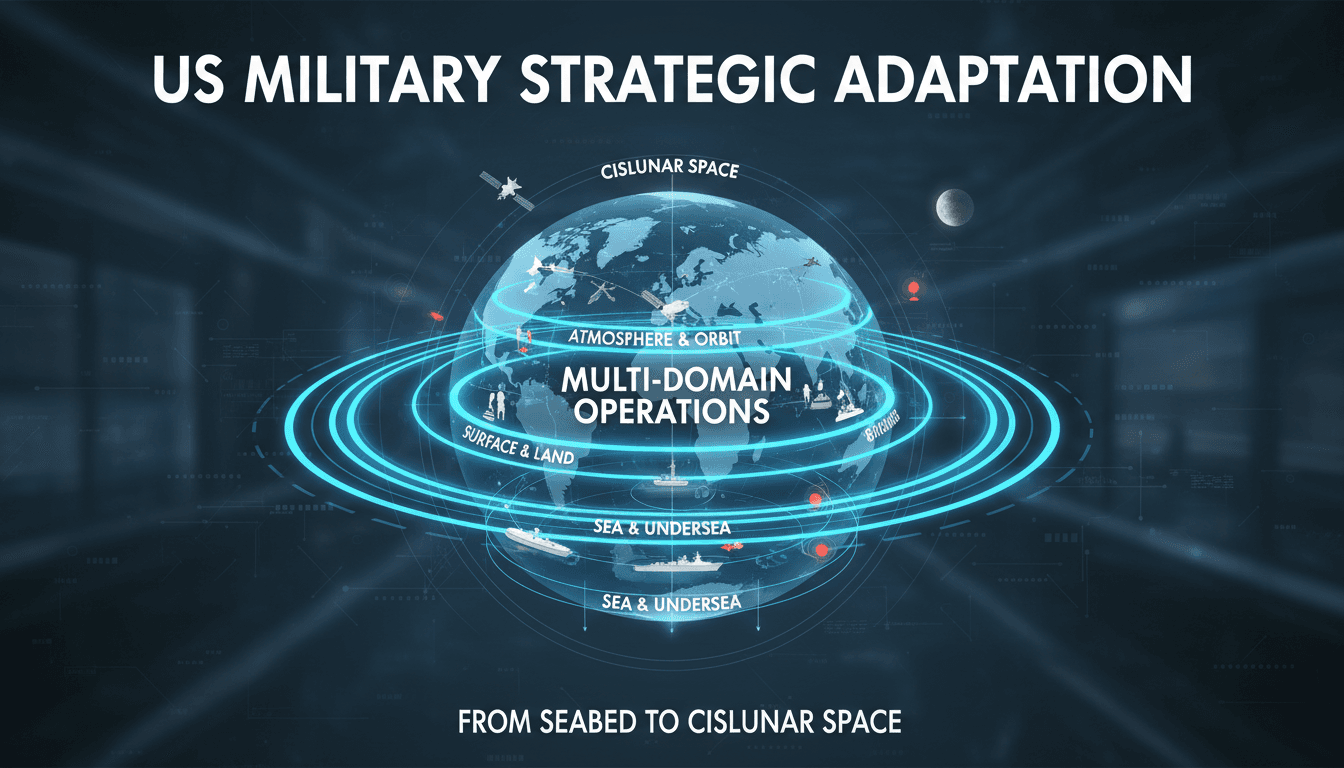
US Military Leadership Calls for Strategic Adaptation to Multi-Domain Operations
Why it matters
The US military's strategic pivot signals a new era of competition in space and under the sea, affecting global defense policies and international relations.
What happened (in 30 seconds)
- On September 16, 2026, Gen. Dan Caine called for US military adaptation from the seabed to cislunar space during a conference in Maryland.
- This marks the first public acknowledgment of deployed on-orbit space control weapons, emphasizing the need for superior capabilities in contested environments.
- China has condemned the US's military expansion into space, warning against the militarization of outer space.
The context you actually need
- The US Space Force was established in 2019 to address emerging challenges in space, particularly from adversaries like China and Russia.
- The 1967 Outer Space Treaty allows conventional weapons in orbit, leading to debates about the militarization of space and its implications for global security.
- The US plans to expand its Space Force personnel by 25,000 over the next five years, indicating a significant investment in military capabilities.
What's really happening
Gen. Dan Caine's address at the Air, Space and Cyber Conference underscores a critical shift in military strategy, reflecting the evolving nature of warfare. The call for adaptation from the seabed to cislunar space highlights the increasing complexity of modern battlefields, where traditional assumptions about uncontested logistics and safe zones are being dismantled.
The US military's acknowledgment of on-orbit space control weapons represents a significant escalation in its operational capabilities. This move is not merely about defense; it is a proactive strategy to ensure dominance in multi-domain operations, particularly against adversaries like China, which has been aggressively pursuing its own military capabilities in space and near-Earth environments.
Lt. Gen. Gregory Gagnon’s confirmation of preparations for lunar operations further illustrates the urgency of this adaptation. The US is not just reacting to threats; it is positioning itself to secure its interests in the cislunar region, where competition for resources and strategic advantages is likely to intensify. This proactive stance is essential as adversaries develop autonomous systems capable of hunting, jamming, and tracking US forces.
The implications of this shift extend beyond military strategy. As the US enhances its capabilities, it may prompt a new arms race in space, with other nations feeling compelled to respond. This could lead to increased tensions and instability in international relations, particularly in regions where military presence is already contentious.
Moreover, the expansion of the Space Force personnel by 25,000 over the next five years signals a significant investment in human capital and technological advancement. This not only reflects the US's commitment to maintaining its military edge but also indicates potential opportunities for defense contractors and technology firms involved in space and military innovations.
As the US navigates this new landscape, the focus on superior sensing, decision-making, and lethality will likely shape the future of military engagements and international security frameworks.
Who feels it first (and how)
- Defense contractors: Increased demand for advanced military technologies and systems.
- International businesses: Potential shifts in trade and investment due to changing security dynamics.
- Government agencies: Heightened focus on national security and defense policies.
- Tech firms: Opportunities in developing autonomous systems and space technologies.
What to watch next
- International responses: Monitor how other nations, particularly China and Russia, react to the US's military expansion in space.
- Legislative developments: Watch for new policies or funding initiatives related to space and defense from the US government.
- Technological advancements: Keep an eye on innovations in military technology, particularly in autonomous systems and space operations.
The US military is expanding its operational scope to include cislunar space.
Increased competition and potential arms races in space among global powers.
The long-term impacts on international relations and global security dynamics.
Frequently Asked Questions
- Why it matters?
- The US military's strategic pivot signals a new era of competition in space and under the sea, affecting global defense policies and international relations.
- What happened (in 30 seconds)?
- On September 16, 2026, Gen. Dan Caine called for US military adaptation from the seabed to cislunar space during a conference in Maryland. This marks the first public acknowledgment of deployed on-orbit space control weapons, emphasizing the need for superior capabilities in contested environments. China has condemned the US's military expansion into space, warning against the militarization of outer space.
- What's really happening?
- Gen. Dan Caine's address at the Air, Space and Cyber Conference underscores a critical shift in military strategy, reflecting the evolving nature of warfare. The call for adaptation from the seabed to cislunar space highlights the increasing complexity of modern battlefields, where traditional assumptions about uncontested logistics and safe zones are being dismantled. The US military's acknowledgment of on-orbit space control weapons represents a significant escalation in its operational capa
- Who feels it first (and how)?
- Defense contractors: Increased demand for advanced military technologies and systems. International businesses: Potential shifts in trade and investment due to changing security dynamics. Government agencies: Heightened focus on national security and defense policies. Tech firms: Opportunities in developing autonomous systems and space technologies.
- What to watch next?
- International responses: Monitor how other nations, particularly China and Russia, react to the US's military expansion in space. Legislative developments: Watch for new policies or funding initiatives related to space and defense from the US government. Technological advancements: Keep an eye on innovations in military technology, particularly in autonomous systems and space operations.
English-language reporting on Saudi politics, policy, and society.
"Saudi Gazette reflects mainstream Saudi institutional perspectives."
— A47 Editor
Top Trump commander says US must prepare to fight across seabed to space
US troops are being urged to prepare for combat in new domains, including Earth's orbit and around the moon, as articulated by Gen Dan Caine, chairman of the Joint Chiefs of Staff, during the Air, Space and Cyber Conference in Maryland. This marks a ...
Reports on science policy, discoveries, and public debate in the scientific realm.
"The Guardian’s science section is known for thoughtful and critical reporting on global research, ethics, and public understanding of science."
— A47 Editor
Top Trump military adviser says US must prepare to fight around moon
General Dan Caine, the top military adviser to former President Donald Trump, stated at the Air, Space and Cyber Conference that U.S. troops must prepare for combat not only in Earth's orbit but also around the moon, following the U.S. announcement o...
News from the United States including domestic politics, society, and culture.
"The Guardian is known for its progressive editorial stance and in-depth analysis, often advocating for social justice, environmental issues, and liberal values."
— A47 Editor
Top Trump military adviser says US must prepare to fight around moon
<p>Gen Dan Caine comments at Washington summit come after US revealed it has deployed weapons in space</p><p>American troops need to prepare for combat not only in Earth’s orbit but around the moon, Donald Trump’s top military adviser said on Wednesd...
Conservative-leaning political and national coverage.
"The Washington Times is a conservative-leaning newspaper known for its political coverage and advocacy of right-of-center viewpoints."
— A47 Editor
U.S. must be ready to win battles in space, around the moon, Joint Chiefs Chairman Dan Caine says
In a significant address, Joint Chiefs of Staff Chairman Dan Caine asserted that the U.S. must prepare for potential conflicts in space, particularly around the moon, as the concept of space warfare transitions from science fiction to reality.
Space science news, astronomy updates, and spaceflight developments.
"Space.com delivers space science news, astronomy updates, and spaceflight developments with engaging coverage."
— A47 Editor
The battlefield now extends all the way to the moon, U.S. military's highest-ranking officer says
Gen. Dan Caine, chairman of the Joint Chiefs of Staff, stated that the U.S. military must now prepare for operations that extend from the seafloor to the moon, highlighting the evolving nature of warfare. This assertion reflects a significant shift i...