
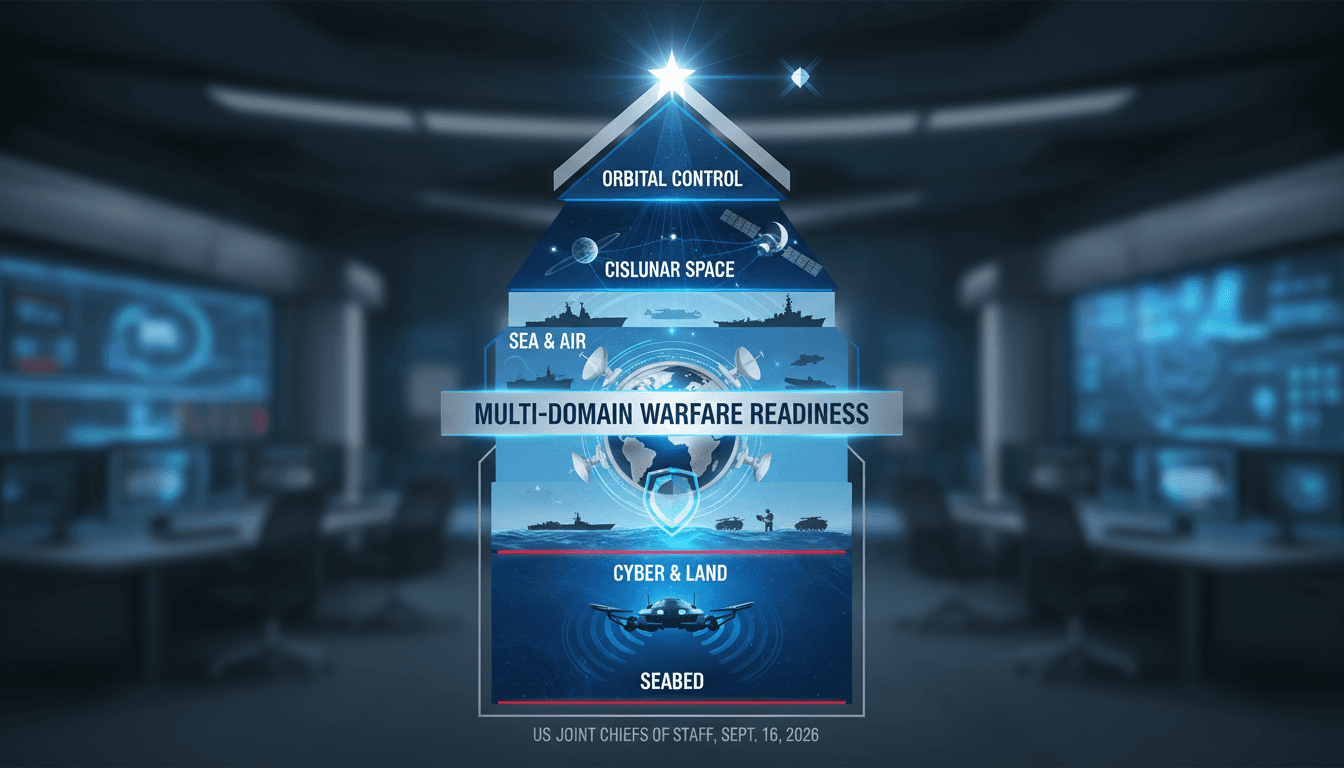
US Military Emphasizes Multi-Domain Warfare Readiness from Seabed to Space
Why it matters
The US military's strategic pivot signals heightened competition in global security, affecting international relations and economic stability.
What happened (in 30 seconds)
- On September 16, 2026, Gen. Dan Caine emphasized the need for US military readiness across multiple domains, from the seabed to cislunar space.
- The US confirmed the deployment of on-orbit space control weapons, challenging existing international norms.
- China reacted strongly, denouncing the militarization of space and urging the US to cease its orbital buildup.
The context you actually need
- Intensifying competition among the US, China, and Russia in space has escalated since the establishment of the US Space Force in 2019.
- The 1967 Outer Space Treaty, which prohibits nuclear weapons in space, allows for conventional arms, leading to a gray area in military capabilities.
- The US Space Force is targeting a size increase to 25,000 personnel within five years, reflecting a commitment to cislunar operations.
What's really happening
The remarks by Gen. Dan Caine at the Air, Space and Cyber Conference mark a significant shift in US military doctrine, emphasizing the need for readiness in a multi-domain environment. This shift is driven by the recognition that traditional assumptions about uncontested logistics and safe resupply lines are no longer valid. The emergence of autonomous systems and AI in warfare has transformed the battlefield, where forces can be tracked and targeted in real-time.
The US military's acknowledgment of on-orbit space control weapons represents a departure from previous norms, particularly the constraints imposed by the Outer Space Treaty. While the treaty bans nuclear weapons in space, it does not prohibit conventional arms, allowing for a strategic gray area that the US is now exploiting. This development is a direct response to the growing capabilities of adversaries like China and Russia, who have been actively pursuing their own space warfare technologies.
Lt. Gen. Gregory Gagnon of the Space Force highlighted the need for lunar orbit defense, indicating that the US is preparing for potential conflicts in cislunar space, an area that includes the Moon and its vicinity. This preparation is not just about defense; it also involves asserting US interests in a region that is becoming increasingly contested.
The broader implications of these developments extend beyond military readiness. As the US enhances its capabilities in space, it may lead to increased tensions with adversaries, particularly China, which has publicly condemned the militarization of space. This geopolitical friction could have ripple effects on global markets, particularly in sectors related to defense, technology, and international trade.
Moreover, the focus on multi-domain warfare suggests that businesses and governments worldwide need to reassess their strategies in light of potential conflicts that could arise from these new military doctrines. The integration of AI and autonomous systems into warfare also raises ethical and operational questions that could affect industries ranging from defense contracting to cybersecurity.
Who feels it first (and how)
- Defense contractors: Increased demand for advanced military technologies and systems.
- Tech companies: Opportunities in AI and autonomous systems for military applications.
- International businesses: Potential disruptions in trade and investment due to heightened geopolitical tensions.
- Government agencies: Need for policy adjustments in response to evolving military strategies.
What to watch next
- US military budget allocations: Increased funding for the Space Force and multi-domain operations will indicate the seriousness of this strategic pivot.
- International responses: Watch for reactions from China and Russia, as their military developments could escalate tensions further.
- Technological advancements: Innovations in AI and autonomous systems will shape future military capabilities and strategies.
The US military is actively adapting to multi-domain warfare.
Increased geopolitical tensions between the US and its adversaries, particularly in space.
The long-term impact on global markets and international relations remains to be seen.
Frequently Asked Questions
- Why it matters?
- The US military's strategic pivot signals heightened competition in global security, affecting international relations and economic stability.
- What happened (in 30 seconds)?
- On September 16, 2026, Gen. Dan Caine emphasized the need for US military readiness across multiple domains, from the seabed to cislunar space. The US confirmed the deployment of on-orbit space control weapons, challenging existing international norms. China reacted strongly, denouncing the militarization of space and urging the US to cease its orbital buildup.
- What's really happening?
- The remarks by Gen. Dan Caine at the Air, Space and Cyber Conference mark a significant shift in US military doctrine, emphasizing the need for readiness in a multi-domain environment. This shift is driven by the recognition that traditional assumptions about uncontested logistics and safe resupply lines are no longer valid. The emergence of autonomous systems and AI in warfare has transformed the battlefield, where forces can be tracked and targeted in real-time. The US military's acknowledgme
- Who feels it first (and how)?
- Defense contractors: Increased demand for advanced military technologies and systems. Tech companies: Opportunities in AI and autonomous systems for military applications. International businesses: Potential disruptions in trade and investment due to heightened geopolitical tensions. Government agencies: Need for policy adjustments in response to evolving military strategies.
- What to watch next?
- US military budget allocations: Increased funding for the Space Force and multi-domain operations will indicate the seriousness of this strategic pivot. International responses: Watch for reactions from China and Russia, as their military developments could escalate tensions further. Technological advancements: Innovations in AI and autonomous systems will shape future military capabilities and strategies.
English-language reporting on Saudi politics, policy, and society.
"Saudi Gazette reflects mainstream Saudi institutional perspectives."
— A47 Editor
Top Trump commander says US must prepare to fight across seabed to space
US troops are being urged to prepare for combat in new domains, including Earth's orbit and around the moon, as articulated by Gen Dan Caine, chairman of the Joint Chiefs of Staff, during the Air, Space and Cyber Conference in Maryland. This marks a ...
Reports on science policy, discoveries, and public debate in the scientific realm.
"The Guardian’s science section is known for thoughtful and critical reporting on global research, ethics, and public understanding of science."
— A47 Editor
Top Trump military adviser says US must prepare to fight around moon
General Dan Caine, the top military adviser to former President Donald Trump, stated at the Air, Space and Cyber Conference that U.S. troops must prepare for combat not only in Earth's orbit but also around the moon, following the U.S. announcement o...
News from the United States including domestic politics, society, and culture.
"The Guardian is known for its progressive editorial stance and in-depth analysis, often advocating for social justice, environmental issues, and liberal values."
— A47 Editor
Top Trump military adviser says US must prepare to fight around moon
<p>Gen Dan Caine comments at Washington summit come after US revealed it has deployed weapons in space</p><p>American troops need to prepare for combat not only in Earth’s orbit but around the moon, Donald Trump’s top military adviser said on Wednesd...
Conservative-leaning political and national coverage.
"The Washington Times is a conservative-leaning newspaper known for its political coverage and advocacy of right-of-center viewpoints."
— A47 Editor
U.S. must be ready to win battles in space, around the moon, Joint Chiefs Chairman Dan Caine says
In a significant address, Joint Chiefs of Staff Chairman Dan Caine asserted that the U.S. must prepare for potential conflicts in space, particularly around the moon, as the concept of space warfare transitions from science fiction to reality.
Space science news, astronomy updates, and spaceflight developments.
"Space.com delivers space science news, astronomy updates, and spaceflight developments with engaging coverage."
— A47 Editor
The battlefield now extends all the way to the moon, U.S. military's highest-ranking officer says
Gen. Dan Caine, chairman of the Joint Chiefs of Staff, stated that the U.S. military must now prepare for operations that extend from the seafloor to the moon, highlighting the evolving nature of warfare. This assertion reflects a significant shift i...