
Syria's Parliament Abolishes Counter-Terrorism Court and Voids Rulings
Why it matters
This move signals a significant shift towards transitional justice in Syria, potentially influencing international relations and humanitarian efforts.
What happened (in 30 seconds)
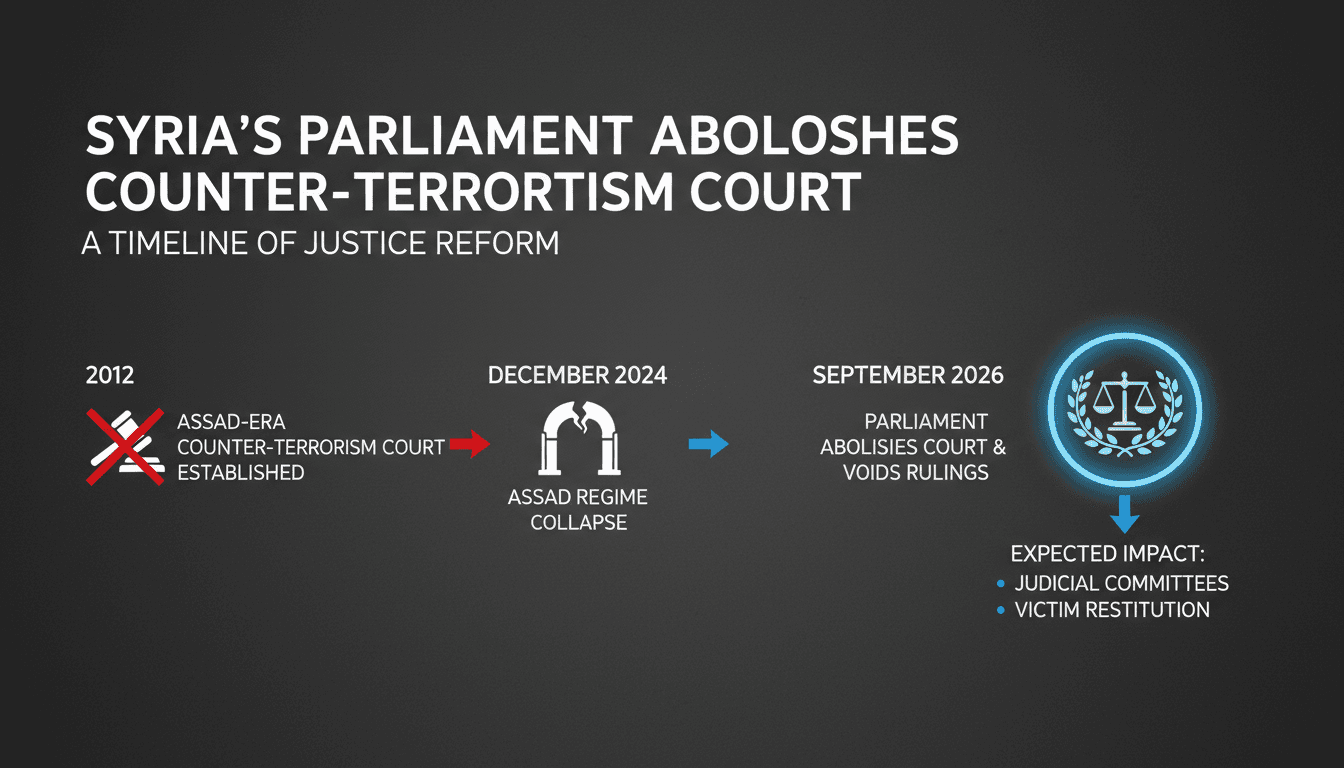
- Syria's parliament voted on September 16, 2026, to abolish the Counter-Terrorism Court established under Bashar al-Assad.
- All rulings from the court have been nullified, addressing long-standing demands for justice from victims of the regime.
- Specialized judicial committees will oversee the restitution of confiscated properties and funds to affected individuals.
The context you actually need
- The Counter-Terrorism Court was created in 2012 to suppress dissent during the Syrian uprising, leading to the prosecution of approximately 90,560 cases, often without fair trial standards.
- Following Assad's regime collapse in December 2024, the new authorities began dismantling the court's structure, signaling a shift in governance and judicial practices.
- The recent legislative action is part of broader transitional justice efforts aimed at addressing the injustices of the past decade and restoring rights to victims.
What's really happening
On September 16, 2026, Syria's People's Assembly took a historic step by unanimously voting to repeal Law No. 22 of 2012, which had established the Counter-Terrorism Court. This court had been a tool of repression, prosecuting thousands of Syrians, including peaceful activists, under dubious legal standards. The court's proceedings were notorious for relying on torture-extracted confessions and lacking due process, leading to widespread condemnation from human rights organizations.
The decision to abolish the court and nullify its rulings is a direct response to the demands for transitional justice that have been echoed by victims and advocates since the onset of the Syrian conflict. The new legislation mandates the formation of specialized judicial committees by the Supreme Judicial Council, tasked with annulling unjust verdicts and overseeing the restitution of confiscated properties. This move not only addresses the grievances of those wronged by the Assad regime but also marks a symbolic break from the oppressive judicial practices that characterized the previous government.
The legislative action follows a series of executive measures taken by the new authorities, including the dismissal of judges associated with the court and the cancellation of asset seizures. These steps indicate a commitment to reforming the judicial system and restoring rights to individuals who suffered under the previous regime. The court's abolition is expected to facilitate the return of seized assets to victims, which is particularly relevant for those in the Syrian diaspora, including expatriates in Dubai and the UAE.
As the new government under President Ahmed al-Sharaa continues to navigate the complexities of post-Assad governance, the focus will now shift to the implementation of these judicial reforms. The establishment of restitution committees is crucial for rebuilding trust in the legal system and ensuring that victims receive the justice they deserve. This process will likely be monitored closely by international observers and human rights organizations, as it could set a precedent for other transitional justice efforts in the region.
Who feels it first (and how)
- Victims of the Assad regime: Individuals who faced unjust prosecution and property confiscation will benefit from the restitution process.
- Human rights organizations: Groups advocating for justice will see their efforts validated and may increase their engagement in Syria.
- Syrian expatriates: Those living abroad, particularly in Dubai and the UAE, may find pathways to reclaim assets previously seized by the regime.
What to watch next
- Implementation of restitution committees: Monitoring how effectively these committees operate will be crucial for assessing the success of the judicial reforms.
- International response: Watch for reactions from global human rights organizations and foreign governments regarding Syria's transitional justice efforts.
- Public sentiment in Syria: The response from the Syrian populace to these changes will indicate the level of trust in the new government and its judicial system.
The Counter-Terrorism Court has been abolished, and its rulings nullified.
The establishment of restitution committees will proceed, facilitating asset recovery for victims.
The long-term effectiveness of these reforms in restoring public trust in the judicial system remains to be seen.
Frequently Asked Questions
- Why it matters?
- This move signals a significant shift towards transitional justice in Syria, potentially influencing international relations and humanitarian efforts.
- What happened (in 30 seconds)?
- Syria's parliament voted on September 16, 2026, to abolish the Counter-Terrorism Court established under Bashar al-Assad. All rulings from the court have been nullified, addressing long-standing demands for justice from victims of the regime. Specialized judicial committees will oversee the restitution of confiscated properties and funds to affected individuals.
- What's really happening?
- On September 16, 2026, Syria's People's Assembly took a historic step by unanimously voting to repeal Law No. 22 of 2012, which had established the Counter-Terrorism Court. This court had been a tool of repression, prosecuting thousands of Syrians, including peaceful activists, under dubious legal standards. The court's proceedings were notorious for relying on torture-extracted confessions and lacking due process, leading to widespread condemnation from human rights organizations. The decision
- Who feels it first (and how)?
- Victims of the Assad regime: Individuals who faced unjust prosecution and property confiscation will benefit from the restitution process. Human rights organizations: Groups advocating for justice will see their efforts validated and may increase their engagement in Syria. Syrian expatriates: Those living abroad, particularly in Dubai and the UAE, may find pathways to reclaim assets previously seized by the regime.
- What to watch next?
- Implementation of restitution committees: Monitoring how effectively these committees operate will be crucial for assessing the success of the judicial reforms. International response: Watch for reactions from global human rights organizations and foreign governments regarding Syria's transitional justice efforts. Public sentiment in Syria: The response from the Syrian populace to these changes will indicate the level of trust in the new government and its judicial system.
UAE-based English-language newspaper covering regional politics, economics, and global affairs.
"The National reflects Emirati policy perspectives while maintaining international editorial standards."
— A47 Editor
Syria abolishes Assad-era 'terrorism' court and voids rulings
Syria has officially abolished the Counter-Terrorism Court established during Bashar al-Assad's regime, nullifying its legal rulings. This decision, reported by state-run media, marks a significant legislative shift for the newly formed assembly unde...
Global news coverage with extensive reporting on Middle Eastern conflicts and geopolitics.
"Al Jazeera is a Qatar-based broadcaster known for wide regional coverage and alternative perspectives."
— A47 Editor
Syria abolishes al-Assad-era ‘terrorism’ court as Kurdish tensions flare
Syria has officially abolished the al-Assad-era ‘terrorism’ court amid rising tensions with Kurdish groups, signaling a shift in the country's judicial approach as it seeks to unify after 14 years of conflict. President Ahmed al-Sharaa's administrati...
Comprehensive coverage of Middle Eastern and global issues.
"Al Jazeera is a prominent voice from the Global South, especially the Middle East, with an emphasis on underreported stories."
— A47 Editor
Syria abolishes al-Assad-era ‘terrorism’ court as Kurdish tensions flare
Syria has officially abolished the al-Assad-era ‘terrorism’ court amid rising tensions with Kurdish groups, signaling a shift in the country's judicial approach as it seeks to unify after 14 years of conflict. President Ahmed al-Sharaa's administrati...
Regional coverage and analysis focused on politics, diplomacy, and business across the Middle East.
"Al-Monitor is known for analytical reporting on Middle East politics and policy developments."
— A47 Editor
Syria parliament votes to abolish Assad-era terrorism court, nullify rulings
Syria's parliament voted to abolish the Counter-Terrorism Court established during Bashar al-Assad's regime, nullifying its legal rulings. This decision, reported by state-run Al-Ikhbariya TV, marks a significant legislative shift for the newly forme...