
Syria's Parliament Abolishes Counter-Terrorism Court and Nullifies Rulings
Why it matters
The abolition of the Counter-Terrorism Court signals a significant move towards accountability and justice in Syria, impacting both domestic and international perceptions of the new government.
What happened (in 30 seconds)
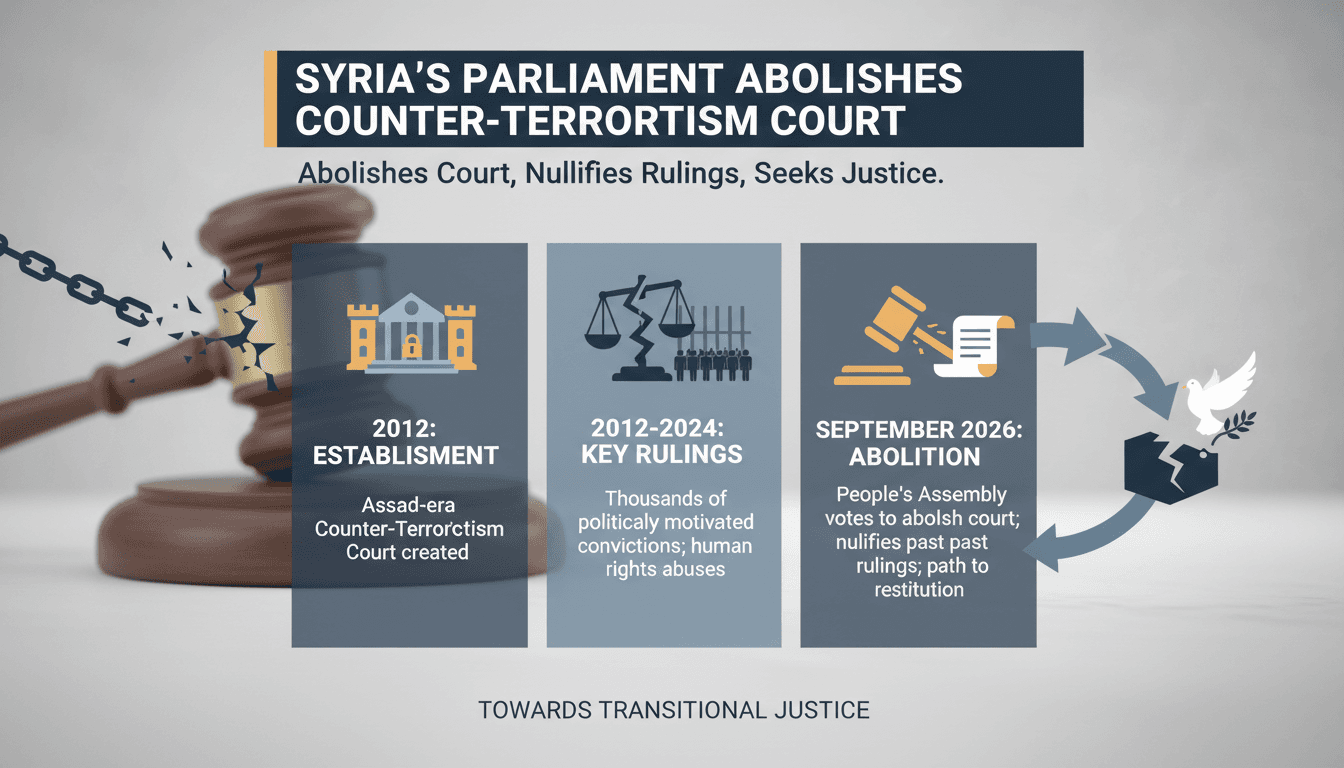
- On September 16, 2026, Syria's People's Assembly voted unanimously to abolish the Counter-Terrorism Court and nullify its rulings.
- The decision enables the formation of specialized judicial committees to facilitate restitution for victims whose properties were confiscated under the court's jurisdiction.
- This legislative action addresses systemic abuses and aims to establish transitional justice following the collapse of the Assad regime in December 2024.
The context you actually need
- The Counter-Terrorism Court was established in 2012 to suppress dissent during the Syrian uprising, leading to mass prosecutions of political opponents.
- International bodies criticized the court for its lack of due process, arbitrary detentions, and reliance on torture, undermining the rule of law.
- The new parliament, convened under President Ahmed al-Sharaa, has already treated the court as defunct, signaling a shift towards judicial reform and accountability.
What's really happening
The unanimous vote to abolish the Counter-Terrorism Court represents a critical juncture in Syria's post-conflict recovery. Established in 2012 under Bashar al-Assad, the court was notorious for its role in suppressing dissent and facilitating mass incarcerations of political opponents. With approximately 90,560 cases examined by the court as of October 2020, its legacy is one of systemic abuse and injustice.
The new legislative action, taken by Syria's People's Assembly, reflects a broader commitment to transitional justice and accountability. By nullifying the court's rulings, the parliament aims to rectify past injustices and restore the rights of victims. This includes the establishment of specialized judicial committees tasked with reviewing cases, annulling unjust rulings, and facilitating the restitution of confiscated properties. Notably, assets restored to victims will be exempt from taxes and fees for the period between March 2011 and December 2024, further incentivizing the restitution process.
The move is also a response to international criticism and a strategic effort to rebuild Syria's image on the global stage. Human rights organizations have long condemned the court for its lack of due process, and the new government appears to be taking steps to align itself with international norms. This shift could enhance Syria's diplomatic relations and potentially open avenues for foreign aid and investment, crucial for the country's reconstruction.
However, the path forward is fraught with challenges. While the abolition of the court is a positive step, experts caution that new repressive mechanisms could emerge in its place. The ongoing proceedings against former regime figures initiated in April 2026 will be closely watched, as they may indicate the government's commitment to genuine reform or merely a façade to placate international observers.
In summary, the abolition of the Counter-Terrorism Court is a significant legislative action that aims to address past abuses and lay the groundwork for a more just legal system in Syria. The establishment of judicial committees for restitution is a crucial step towards healing the wounds of a decade-long conflict.
Who feels it first (and how)
- Syrian expatriates: They may benefit from the restitution of properties and assets lost during the Assad regime.
- Human rights organizations: They will likely monitor the implementation of the new judicial committees and the outcomes of restitution claims.
- Legal professionals: Lawyers and legal advocates in Syria may see increased demand for their services as victims seek to reclaim their rights.
What to watch next
- Implementation of judicial committees: Monitoring how effectively these committees operate will be crucial in determining the success of the restitution process.
- International response: Watch for reactions from international bodies and foreign governments regarding Syria's commitment to justice and accountability.
- Emergence of new legal frameworks: The potential introduction of new laws or mechanisms to replace the Counter-Terrorism Court could indicate the direction of Syria's legal reforms.
The Counter-Terrorism Court has been abolished, and its rulings nullified.
The establishment of judicial committees will proceed, facilitating property restitution for victims.
The long-term effectiveness of these reforms in preventing new repressive mechanisms remains to be seen.
Frequently Asked Questions
- Why it matters?
- The abolition of the Counter-Terrorism Court signals a significant move towards accountability and justice in Syria, impacting both domestic and international perceptions of the new government.
- What happened (in 30 seconds)?
- On September 16, 2026, Syria's People's Assembly voted unanimously to abolish the Counter-Terrorism Court and nullify its rulings. The decision enables the formation of specialized judicial committees to facilitate restitution for victims whose properties were confiscated under the court's jurisdiction. This legislative action addresses systemic abuses and aims to establish transitional justice following the collapse of the Assad regime in December 2024.
- What's really happening?
- The unanimous vote to abolish the Counter-Terrorism Court represents a critical juncture in Syria's post-conflict recovery. Established in 2012 under Bashar al-Assad, the court was notorious for its role in suppressing dissent and facilitating mass incarcerations of political opponents. With approximately 90,560 cases examined by the court as of October 2020, its legacy is one of systemic abuse and injustice. The new legislative action, taken by Syria's People's Assembly, reflects a broader com
- Who feels it first (and how)?
- Syrian expatriates: They may benefit from the restitution of properties and assets lost during the Assad regime. Human rights organizations: They will likely monitor the implementation of the new judicial committees and the outcomes of restitution claims. Legal professionals: Lawyers and legal advocates in Syria may see increased demand for their services as victims seek to reclaim their rights.
- What to watch next?
- Implementation of judicial committees: Monitoring how effectively these committees operate will be crucial in determining the success of the restitution process. International response: Watch for reactions from international bodies and foreign governments regarding Syria's commitment to justice and accountability. Emergence of new legal frameworks: The potential introduction of new laws or mechanisms to replace the Counter-Terrorism Court could indicate the direction of Syria's legal reforms.
UAE-based English-language newspaper covering regional politics, economics, and global affairs.
"The National reflects Emirati policy perspectives while maintaining international editorial standards."
— A47 Editor
Syria abolishes Assad-era 'terrorism' court and voids rulings
Syria has officially abolished the Counter-Terrorism Court established during Bashar al-Assad's regime, nullifying its legal rulings. This decision, made by the Syrian parliament, marks a significant legislative shift as the country seeks to redefine...
Global news coverage with extensive reporting on Middle Eastern conflicts and geopolitics.
"Al Jazeera is a Qatar-based broadcaster known for wide regional coverage and alternative perspectives."
— A47 Editor
Syria abolishes al-Assad-era ‘terrorism’ court as Kurdish tensions flare
Syria has officially abolished the al-Assad-era ‘terrorism’ court amid rising tensions with Kurdish groups, signaling a shift in the country's judicial approach as it seeks to unify after 14 years of conflict. President Ahmed al-Sharaa's administrati...
Comprehensive coverage of Middle Eastern and global issues.
"Al Jazeera is a prominent voice from the Global South, especially the Middle East, with an emphasis on underreported stories."
— A47 Editor
Syria abolishes al-Assad-era ‘terrorism’ court as Kurdish tensions flare
Syria has officially abolished the al-Assad-era ‘terrorism’ court amid rising tensions with Kurdish groups, signaling a shift in the country's judicial approach as it seeks to unify after 14 years of conflict. President Ahmed al-Sharaa's administrati...
Regional coverage and analysis focused on politics, diplomacy, and business across the Middle East.
"Al-Monitor is known for analytical reporting on Middle East politics and policy developments."
— A47 Editor
Syria parliament votes to abolish Assad-era terrorism court, nullify rulings
Syria's parliament voted to abolish the Counter-Terrorism Court established during Bashar al-Assad's regime, nullifying its legal rulings. This decision, reported by state-run Al-Ikhbariya TV, marks a significant legislative shift for the newly forme...