
ECB President Lagarde Blocks Binance's MiCA License Application in Greece
Why it matters
This intervention highlights the growing tension between regulatory bodies and crypto exchanges, impacting market dynamics and compliance standards.
What happened (in 30 seconds)
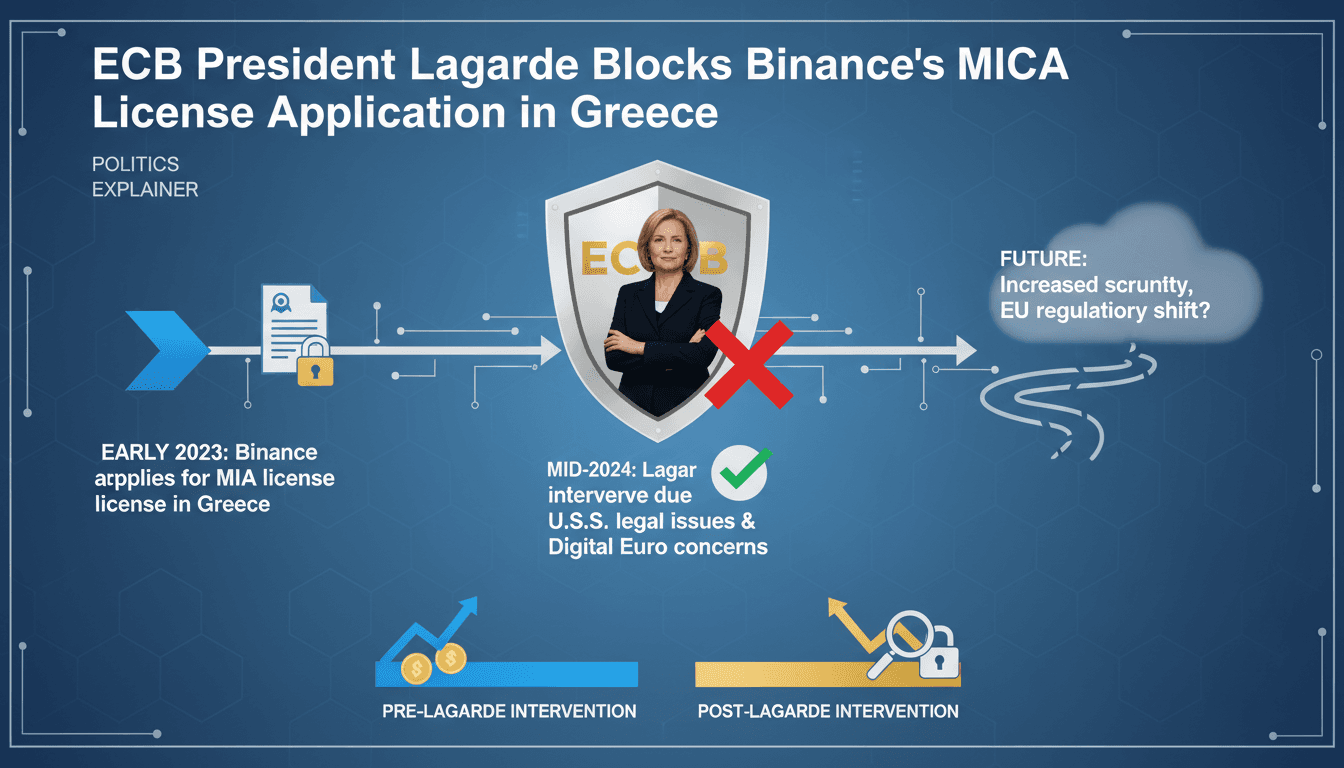
- Christine Lagarde, President of the European Central Bank, intervened to block Binance's MiCA license application in Greece.
- Concerns included Binance's past compliance issues and the potential impact on the ECB's digital euro initiative.
- Binance withdrew its application in June 2026 and is now seeking authorization in another EU member state.
The context you actually need
- Binance faced over $4 billion in penalties in 2023 for violations of U.S. anti-money laundering and sanctions laws, raising compliance concerns.
- The MiCA framework, which requires crypto-asset service providers to obtain licenses, became fully applicable in 2026, intensifying regulatory scrutiny.
- The ECB is advancing its digital euro project amid fears that dollar-pegged stablecoins could dominate the market, undermining its monetary policy.
What's really happening
The intervention by Christine Lagarde to block Binance's MiCA license application in Greece is a significant moment in the evolving landscape of cryptocurrency regulation in Europe. While the ECB does not have formal licensing authority under the MiCA framework, Lagarde's direct involvement underscores the central bank's concerns about the implications of large crypto exchanges on monetary policy and financial stability.
Binance, one of the largest cryptocurrency exchanges globally, submitted its MiCA application through Greece's Hellenic Capital Market Commission (HCMC) in late 2025 or early 2026. By late May 2026, Greek officials indicated that the application was complete, and a press release was prepared to announce its approval. However, shortly after notifying the European Securities and Markets Authority (ESMA) of the impending approval, Lagarde intervened, contacting Greek Prime Minister Kyriakos Mitsotakis to request a delay or denial of the application.
The primary concerns driving this intervention were Binance's past compliance issues, particularly its 2023 guilty plea in the U.S. for anti-money laundering and sanctions violations, which resulted in over $4 billion in penalties. This history raised red flags about the exchange's ability to operate within the EU's regulatory framework. Additionally, there were fears that Binance's scale could accelerate the adoption of dollar-based stablecoins, which could undermine the ECB's efforts to promote its digital euro initiative.
As a result of this intervention, Binance withdrew its application on June 24, 2026, before any formal decision was made. The exchange cited the need for user clarity ahead of the July 1 MiCA deadline as a reason for its withdrawal. Despite this setback, Binance has expressed its commitment to obtaining authorization in another EU member state, indicating that it will continue to seek a foothold in the European market.
This incident reflects a broader trend of increasing regulatory scrutiny on cryptocurrency firms, particularly those with significant market influence. As the EU continues to implement the MiCA framework, firms like Binance will face heightened compliance expectations, which could lead to delays in market integration and service availability for users.
Who feels it first (and how)
- Crypto exchanges: Increased regulatory scrutiny may lead to operational delays and compliance costs.
- Investors: Potential disruptions in service and access to platforms could affect trading and investment strategies.
- Regulatory bodies: Heightened expectations for compliance and oversight may strain resources and influence policy development.
- EU member states: Variations in regulatory responses could create a fragmented market landscape.
What to watch next
- Regulatory developments: Monitor how other EU member states respond to Binance's withdrawal and the implications for future applications.
- Market reactions: Watch for shifts in user behavior and trading volumes on crypto exchanges as compliance pressures mount.
- Stablecoin policies: Keep an eye on the ECB's progress with the digital euro and how it may influence the adoption of stablecoins in the EU.
Binance withdrew its MiCA application in Greece due to regulatory intervention.
Other EU member states may face similar scrutiny regarding crypto licensing applications.
The long-term impact on Binance's operations and the broader EU crypto market remains uncertain.
Frequently Asked Questions
- Why it matters?
- This intervention highlights the growing tension between regulatory bodies and crypto exchanges, impacting market dynamics and compliance standards.
- What happened (in 30 seconds)?
- Christine Lagarde, President of the European Central Bank, intervened to block Binance's MiCA license application in Greece. Concerns included Binance's past compliance issues and the potential impact on the ECB's digital euro initiative. Binance withdrew its application in June 2026 and is now seeking authorization in another EU member state.
- What's really happening?
- The intervention by Christine Lagarde to block Binance's MiCA license application in Greece is a significant moment in the evolving landscape of cryptocurrency regulation in Europe. While the ECB does not have formal licensing authority under the MiCA framework, Lagarde's direct involvement underscores the central bank's concerns about the implications of large crypto exchanges on monetary policy and financial stability. Binance, one of the largest cryptocurrency exchanges globally, submitted i
- Who feels it first (and how)?
- Crypto exchanges: Increased regulatory scrutiny may lead to operational delays and compliance costs. Investors: Potential disruptions in service and access to platforms could affect trading and investment strategies. Regulatory bodies: Heightened expectations for compliance and oversight may strain resources and influence policy development. EU member states: Variations in regulatory responses could create a fragmented market landscape.
- What to watch next?
- Regulatory developments: Monitor how other EU member states respond to Binance's withdrawal and the implications for future applications. Market reactions: Watch for shifts in user behavior and trading volumes on crypto exchanges as compliance pressures mount. Stablecoin policies: Keep an eye on the ECB's progress with the digital euro and how it may influence the adoption of stablecoins in the EU.
Covers blockchain, cryptocurrency news, project analysis, and market insights.
"CoinDesk is a well-established cryptocurrency and blockchain news provider, offering comprehensive insights, market data, and industry research."
— A47 Editor
ECB President Christine Lagarde intervened to block Binance’s EU MiCA license: WSJ
European Central Bank (ECB) President Christine Lagarde intervened to halt Binance's application for a Markets in Crypto-Assets (MiCA) license in Greece, despite the ECB lacking formal licensing authority under MiCA. This intervention has led to a si...
Real-time updates, analysis, and reports on the blockchain and cryptocurrency sectors.
"Crypto News delivers real-time updates, analysis, and reports on the blockchain and cryptocurrency sectors."
— A47 Editor
Binance keeps MiCA plans intact despite Lagarde intervention report
Binance has decided to maintain its plans for European licensing despite a report suggesting that European Central Bank President Christine Lagarde intervened in its unsuccessful application for a Markets in Crypto-Assets (MiCA) license in Greece. Th...
Covers blockchain, cryptocurrency news, project analysis, and market insights.
"Cointelegraph is a leading crypto-focused media outlet known for timely news, analysis, and educational content related to blockchain and digital assets."
— A47 Editor
Binance brushes off Lagarde MiCA speculation, reaffirms Europe commitment
Binance has reaffirmed its commitment to securing authorization in Europe, despite declining to comment on speculation regarding European Central Bank (ECB) President Christine Lagarde's involvement in its Markets in Crypto-Assets (MiCA) licensing ef...
Real-time updates, analysis, and reports on the blockchain and cryptocurrency sectors.
"Crypto News delivers real-time updates, analysis, and reports on the blockchain and cryptocurrency sectors."
— A47 Editor
Binance MiCA bid faces new scrutiny after Lagarde report
Binance's bid for a Markets in Crypto-Assets (MiCA) license in Greece has come under scrutiny following a report indicating that European Central Bank President Christine Lagarde intervened to block the application. This development raises concerns a...
Markets desk coverage, trading insights, and investor updates.
"WSJ’s markets reporting provides in-depth analysis and context for investors."
— A47 Editor
Christine Lagarde Helped Block Binance’s Foothold in Europe
Christine Lagarde, the President of the European Central Bank (ECB), intervened to prevent Binance, a leading cryptocurrency exchange that recently pleaded guilty to financial crimes in the U.S., from establishing operations in Europe. This decision ...