
Kalshi Loses Appeal in 6th Circuit Court, Increasing Likelihood of Supreme Court Review
Why it matters
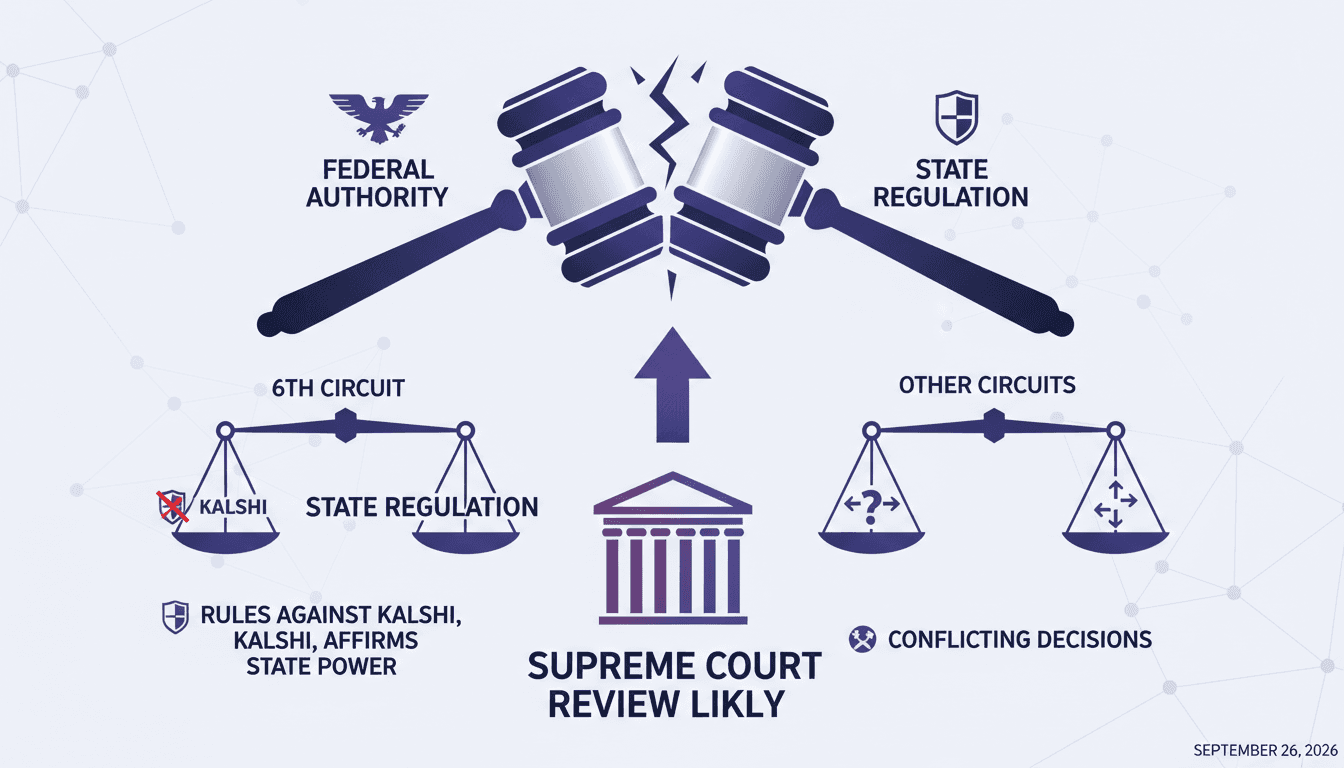
This ruling intensifies the ongoing conflict between federal and state regulatory frameworks, impacting how prediction markets are governed.
What happened (in 30 seconds)
- On September 26, 2026, the 6th US Circuit Court of Appeals ruled against Kalshi, affirming state authority over sports-event contracts.
- The court found that Kalshi's contracts do not qualify as swaps under CFTC jurisdiction, rejecting federal preemption claims.
- This decision adds to a circuit split, raising the likelihood of a Supreme Court review to clarify regulatory authority.
The context you actually need
- Kalshi operates as a prediction market under the Commodity Futures Trading Commission (CFTC), claiming its contracts should be treated as swaps.
- Conflicting rulings from the 3rd and 9th Circuits have created uncertainty, with some states asserting their right to regulate these markets as gambling.
- The 6th Circuit's decision aligns with Ohio and Tennessee's stance, emphasizing state control over sports-related contracts.
What's really happening
The 6th Circuit's ruling against Kalshi marks a significant moment in the evolving landscape of prediction markets and regulatory authority. The court unanimously determined that Kalshi's sports-event contracts do not meet the criteria for swaps as defined by the CFTC, thereby allowing state laws to govern these contracts without federal preemption. This decision is pivotal as it underscores the tension between federal oversight and state regulatory power, particularly in the realm of gambling and financial markets.
Kalshi's argument hinged on the premise that its contracts should be classified as swaps under the Commodity Exchange Act, which would preempt state gambling laws. However, the court found that the nature of Kalshi's contracts did not align with the legal definitions necessary for CFTC jurisdiction. This ruling not only affects Kalshi but also sets a precedent for other prediction markets navigating similar regulatory challenges.
The implications of this ruling extend beyond Kalshi itself. With the 6th Circuit's decision, states like Ohio and Tennessee gain clarity and authority to regulate sports-event contracts, potentially leading to a patchwork of regulations across the country. This fragmentation could hinder the growth of prediction markets, as operators may face varying compliance requirements depending on the state.
Moreover, the ruling has prompted Kalshi to express its intent to pursue further appeals, indicating that the company views the current regulatory landscape as unworkable. The involvement of state lawmakers filing amicus briefs and New Jersey's petition for certiorari in its related case suggests that this issue is far from settled. The potential for Supreme Court intervention looms large, as the highest court may need to address the conflicting interpretations of the Commodity Exchange Act and the authority of state regulators.
As the legal landscape evolves, market participants are left in a state of heightened uncertainty. The outcome of this case could significantly influence the future of prediction markets, shaping how they operate and are regulated across the United States.
Who feels it first (and how)
- Prediction market operators: Facing increased regulatory scrutiny and potential operational hurdles.
- State gaming authorities: Gaining clarity and authority to enforce state regulations on sports-event contracts.
- Investors and participants: Experiencing uncertainty regarding the legality and future of their investments in prediction markets.
What to watch next
- Supreme Court involvement: Watch for any announcements regarding certiorari petitions, as a Supreme Court review could redefine regulatory authority.
- State regulatory responses: Monitor how various states adjust their regulations in light of this ruling and the potential for new legislation.
- Market reactions: Observe how prediction market operators like Kalshi adapt their business models in response to the evolving legal landscape.
The 6th Circuit ruled against Kalshi, affirming state authority over sports-event contracts.
The Supreme Court may review the case to resolve the circuit split on regulatory authority.
The long-term impact on the growth and operation of prediction markets across the United States.
Frequently Asked Questions
- Why it matters?
- This ruling intensifies the ongoing conflict between federal and state regulatory frameworks, impacting how prediction markets are governed.
- What happened (in 30 seconds)?
- On September 26, 2026, the 6th US Circuit Court of Appeals ruled against Kalshi, affirming state authority over sports-event contracts. The court found that Kalshi's contracts do not qualify as swaps under CFTC jurisdiction, rejecting federal preemption claims. This decision adds to a circuit split, raising the likelihood of a Supreme Court review to clarify regulatory authority.
- What's really happening?
- The 6th Circuit's ruling against Kalshi marks a significant moment in the evolving landscape of prediction markets and regulatory authority. The court unanimously determined that Kalshi's sports-event contracts do not meet the criteria for swaps as defined by the CFTC, thereby allowing state laws to govern these contracts without federal preemption. This decision is pivotal as it underscores the tension between federal oversight and state regulatory power, particularly in the realm of gambling a
- Who feels it first (and how)?
- Prediction market operators: Facing increased regulatory scrutiny and potential operational hurdles. State gaming authorities: Gaining clarity and authority to enforce state regulations on sports-event contracts. Investors and participants: Experiencing uncertainty regarding the legality and future of their investments in prediction markets.
- What to watch next?
- Supreme Court involvement: Watch for any announcements regarding certiorari petitions, as a Supreme Court review could redefine regulatory authority. State regulatory responses: Monitor how various states adjust their regulations in light of this ruling and the potential for new legislation. Market reactions: Observe how prediction market operators like Kalshi adapt their business models in response to the evolving legal landscape.
Covers blockchain, cryptocurrency news, project analysis, and market insights.
"Cointelegraph is a leading crypto-focused media outlet known for timely news, analysis, and educational content related to blockchain and digital assets."
— A47 Editor
Kalshi loses appeal, setting up potential Supreme Court case
The 6th US Circuit Court of Appeals has ruled against Kalshi, a prediction market platform, affirming that state laws in Ohio and Tennessee can regulate sports-event contracts, which poses significant challenges for the company.
Real-time updates, analysis, and reports on the blockchain and cryptocurrency sectors.
"Crypto News delivers real-time updates, analysis, and reports on the blockchain and cryptocurrency sectors."
— A47 Editor
Kalshi lost another appeals case. Can states regulate prediction markets as gambling?
Kalshi has faced another legal setback as the Sixth Circuit Court ruled against the prediction market platform in Ohio and Tennessee, affirming that state laws can regulate its sports-event contracts. This decision follows a previous ruling in Nevada...
Comprehensive coverage of Middle Eastern and global issues.
"Al Jazeera is a prominent voice from the Global South, especially the Middle East, with an emphasis on underreported stories."
— A47 Editor
US court rules against Kalshi, says states can regulate prediction markets
A US appeals court has ruled against Kalshi, a prediction market platform, affirming that states have the authority to regulate such markets. This decision adds to the ongoing legal discourse surrounding the regulation of prediction markets, which ha...
Global news coverage with extensive reporting on Middle Eastern conflicts and geopolitics.
"Al Jazeera is a Qatar-based broadcaster known for wide regional coverage and alternative perspectives."
— A47 Editor
US court rules against Kalshi, says states can regulate prediction markets
A US appeals court has ruled against Kalshi, a prediction market platform, affirming that states have the authority to regulate such markets. This decision adds to the ongoing legal discourse surrounding the regulation of prediction markets, which ha...
Covers blockchain, cryptocurrency news, project analysis, and market insights.
"CoinDesk is a well-established cryptocurrency and blockchain news provider, offering comprehensive insights, market data, and industry research."
— A47 Editor
Another appeals court rules against prediction market provider Kalshi, says sports contracts are subject to state regulations
A panel from the Sixth Circuit Court of Appeals ruled that contracts related to sports events on prediction markets, specifically those offered by Kalshi, are not classified as swaps and thus fall under state regulations rather than federal oversight...
Curated tech headlines including AI stories.
"Influential aggregator surfacing the day’s top tech/AI links."
— A47 Editor
A US appeals court rules that Kalshi's sports contracts are not "swaps" subject only to CFTC regulation, allowing states to regulate them under gambling laws (Jonathan Stempel/Reuters)
A US appeals court has ruled that Kalshi's sports contracts are not classified as 'swaps' under the Commodity Futures Trading Commission (CFTC) regulations, allowing individual states to regulate these contracts as gambling. This decision marks a sig...
U.S. business news, corporate developments, and economy.
"The Wall Street Journal is respected for deep financial and economic reporting with a center-right editorial perspective."
— A47 Editor
Kalshi’s Embrace of Sports Betting Tests Rules for Prediction Markets
Kalshi, a prediction market platform, is facing legal challenges as judges have issued conflicting rulings regarding its operations, particularly concerning whether it is circumventing state gambling laws. This situation may escalate to the Supreme C...
Coverage of national news and issues shaping the United States, including politics, economy, and society.
"The Wall Street Journal is one of the most respected financial and news publications in the U.S., known for its rigorous reporting and center-right editorial perspective."
— A47 Editor
Kalshi’s Embrace of Sports Betting Tests Rules for Prediction Markets
Kalshi, a prediction market platform, is facing legal challenges as judges have issued conflicting rulings regarding its compliance with state laws, particularly concerning sports betting. This situation may escalate to the Supreme Court, which could...
Sports news with an emphasis on business, economics, and strategy behind major events and leagues.
"WSJ’s sports coverage is distinguished by its focus on financial and strategic aspects of the sports world."
— A47 Editor
Kalshi’s Embrace of Sports Betting Tests Rules for Prediction Markets
Kalshi, a platform for prediction markets, is facing scrutiny as judges have issued conflicting rulings regarding its sports betting operations, potentially leading to a Supreme Court case. This situation arises amid a growing interest in prediction ...