
Kalshi's Sixth Circuit Appeal Denied, Increasing Supreme Court Review Likelihood
Why it matters
This ruling highlights the ongoing tension between state and federal regulations in the rapidly evolving landscape of prediction markets.
What happened (in 30 seconds)
- On September 26, 2026, the Sixth Circuit Court of Appeals ruled against Kalshi, affirming state authority to regulate sports-event contracts.
- The court found that Kalshi's contracts do not qualify as "swaps" under federal law, allowing states like Ohio and Tennessee to enforce their gambling laws.
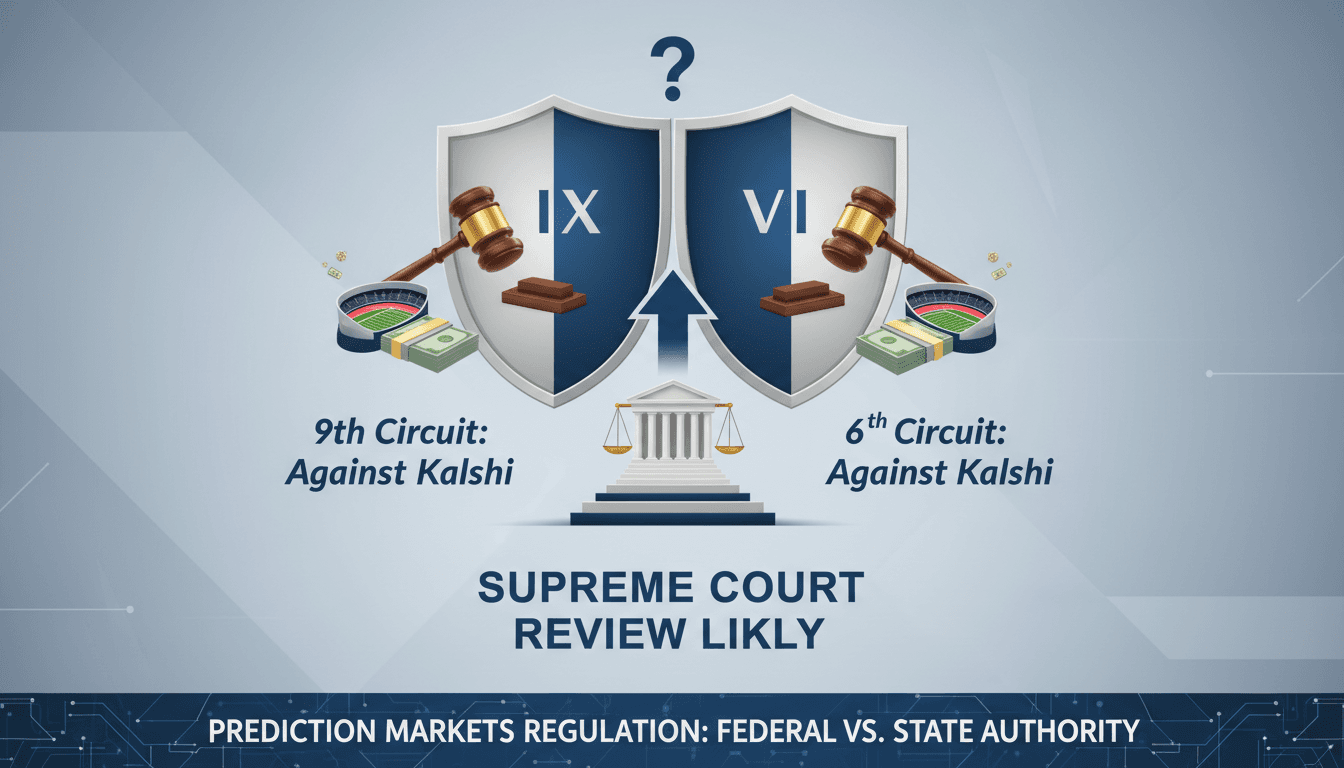
- This decision creates a circuit split, increasing the likelihood of a U.S. Supreme Court review following conflicting rulings from other circuits.
The context you actually need
- Kalshi operates as a prediction market under CFTC registration, offering contracts tied to various outcomes, including sports.
- State regulators have increasingly asserted their authority over prediction markets, leading to legal battles over jurisdiction and regulatory oversight.
- Prior rulings have shown inconsistency across circuits, with the Third Circuit favoring Kalshi in New Jersey while the Ninth Circuit upheld state regulations in Nevada.
What's really happening
The recent ruling by the Sixth Circuit Court of Appeals against Kalshi is a significant development in the ongoing legal battle over prediction markets and their regulation. Kalshi, a platform that allows users to bet on the outcomes of various events, including sports, has been operating under the assumption that its contracts qualify as "swaps" and thus fall under the exclusive jurisdiction of the Commodity Futures Trading Commission (CFTC). However, the Sixth Circuit unanimously ruled that Kalshi's contracts do not meet the definition of swaps as outlined in the Commodity Exchange Act.
This ruling is particularly important because it reinforces the authority of state regulators in Ohio and Tennessee to impose their gambling laws on prediction markets. The court's decision vacates a previous injunction that favored Kalshi in Tennessee and upholds the denial of relief in Ohio. This creates a patchwork of regulations across the United States, where different states can impose varying rules on prediction markets, leading to uncertainty for market participants.
The implications of this ruling extend beyond Kalshi itself. With the Third Circuit having previously ruled in favor of Kalshi in New Jersey, a circuit split has now emerged. This inconsistency among federal appellate courts raises the likelihood that the U.S. Supreme Court will take up the issue to provide clarity on whether federal law preempts state regulations in this context. Kalshi has expressed confidence that the decision will not withstand further review, highlighting the inefficiencies of a state-by-state regulatory approach.
As the legal landscape evolves, market participants face continued uncertainty. The outcome of potential Supreme Court intervention could reshape the regulatory framework for prediction markets, impacting how these platforms operate and how users engage with them. The stakes are high, as a ruling in favor of federal preemption could streamline regulations but also limit state authority, while a ruling against it would solidify state control and potentially stifle innovation in the prediction market space.
Who feels it first (and how)
- Prediction market operators: Companies like Kalshi may face increased regulatory hurdles and operational challenges.
- Sports bettors: Individuals engaging in prediction markets could see changes in the availability and legality of betting options based on state regulations.
- State lawmakers: Legislators in states like Ohio and Tennessee may feel empowered to enforce stricter regulations on prediction markets.
What to watch next
- Supreme Court intervention: Watch for any petitions filed by Kalshi or other states seeking Supreme Court review, as this could set a precedent for future regulation.
- State legislative actions: Monitor how states respond to the ruling, particularly in terms of new regulations or legal challenges to prediction markets.
- Market participant reactions: Observe how prediction market operators adapt their business models in response to the evolving legal landscape.
The Sixth Circuit ruled against Kalshi, affirming state authority over sports-event contracts.
The U.S. Supreme Court may review the case due to the established circuit split.
The long-term impact on prediction markets and how operators will adapt to varying state regulations.
Frequently Asked Questions
- Why it matters?
- This ruling highlights the ongoing tension between state and federal regulations in the rapidly evolving landscape of prediction markets.
- What happened (in 30 seconds)?
- On September 26, 2026, the Sixth Circuit Court of Appeals ruled against Kalshi, affirming state authority to regulate sports-event contracts. The court found that Kalshi's contracts do not qualify as "swaps" under federal law, allowing states like Ohio and Tennessee to enforce their gambling laws. This decision creates a circuit split, increasing the likelihood of a U.S. Supreme Court review following conflicting rulings from other circuits.
- What's really happening?
- The recent ruling by the Sixth Circuit Court of Appeals against Kalshi is a significant development in the ongoing legal battle over prediction markets and their regulation. Kalshi, a platform that allows users to bet on the outcomes of various events, including sports, has been operating under the assumption that its contracts qualify as "swaps" and thus fall under the exclusive jurisdiction of the Commodity Futures Trading Commission (CFTC). However, the Sixth Circuit unanimously ruled that Ka
- Who feels it first (and how)?
- Prediction market operators: Companies like Kalshi may face increased regulatory hurdles and operational challenges. Sports bettors: Individuals engaging in prediction markets could see changes in the availability and legality of betting options based on state regulations. State lawmakers: Legislators in states like Ohio and Tennessee may feel empowered to enforce stricter regulations on prediction markets.
- What to watch next?
- Supreme Court intervention: Watch for any petitions filed by Kalshi or other states seeking Supreme Court review, as this could set a precedent for future regulation. State legislative actions: Monitor how states respond to the ruling, particularly in terms of new regulations or legal challenges to prediction markets. Market participant reactions: Observe how prediction market operators adapt their business models in response to the evolving legal landscape.
Covers blockchain, cryptocurrency news, project analysis, and market insights.
"Cointelegraph is a leading crypto-focused media outlet known for timely news, analysis, and educational content related to blockchain and digital assets."
— A47 Editor
Kalshi loses appeal, setting up potential Supreme Court case
The 6th US Circuit Court of Appeals has ruled against Kalshi, a prediction market platform, affirming that state laws in Ohio and Tennessee can regulate sports-event contracts, which poses significant challenges for the company.
Real-time updates, analysis, and reports on the blockchain and cryptocurrency sectors.
"Crypto News delivers real-time updates, analysis, and reports on the blockchain and cryptocurrency sectors."
— A47 Editor
Kalshi lost another appeals case. Can states regulate prediction markets as gambling?
Kalshi has faced another legal setback as the Sixth Circuit Court ruled against the prediction market platform in Ohio and Tennessee, affirming that state laws can regulate its sports-event contracts. This decision follows a previous ruling in Nevada...
Global news coverage with extensive reporting on Middle Eastern conflicts and geopolitics.
"Al Jazeera is a Qatar-based broadcaster known for wide regional coverage and alternative perspectives."
— A47 Editor
US court rules against Kalshi, says states can regulate prediction markets
A US appeals court has ruled against Kalshi, a prediction market platform, affirming that states have the authority to regulate such markets. This decision adds to the ongoing legal discourse surrounding the regulation of prediction markets, which ha...
Comprehensive coverage of Middle Eastern and global issues.
"Al Jazeera is a prominent voice from the Global South, especially the Middle East, with an emphasis on underreported stories."
— A47 Editor
US court rules against Kalshi, says states can regulate prediction markets
A US appeals court has ruled against Kalshi, a prediction market platform, affirming that states have the authority to regulate such markets. This decision adds to the ongoing legal discourse surrounding the regulation of prediction markets, which ha...
Covers blockchain, cryptocurrency news, project analysis, and market insights.
"CoinDesk is a well-established cryptocurrency and blockchain news provider, offering comprehensive insights, market data, and industry research."
— A47 Editor
Another appeals court rules against prediction market provider Kalshi, says sports contracts are subject to state regulations
A panel from the Sixth Circuit Court of Appeals ruled that contracts related to sports events on prediction markets, specifically those offered by Kalshi, are not classified as swaps and thus fall under state regulations rather than federal oversight...
Curated tech headlines including AI stories.
"Influential aggregator surfacing the day’s top tech/AI links."
— A47 Editor
A US appeals court rules that Kalshi's sports contracts are not "swaps" subject only to CFTC regulation, allowing states to regulate them under gambling laws (Jonathan Stempel/Reuters)
A US appeals court has ruled that Kalshi's sports contracts are not classified as 'swaps' under the Commodity Futures Trading Commission (CFTC) regulations, allowing individual states to regulate these contracts as gambling. This decision marks a sig...