
Kalshi Faces Legal Challenges Over Sports Event Contracts Amid Regulatory Conflicts
Why it matters
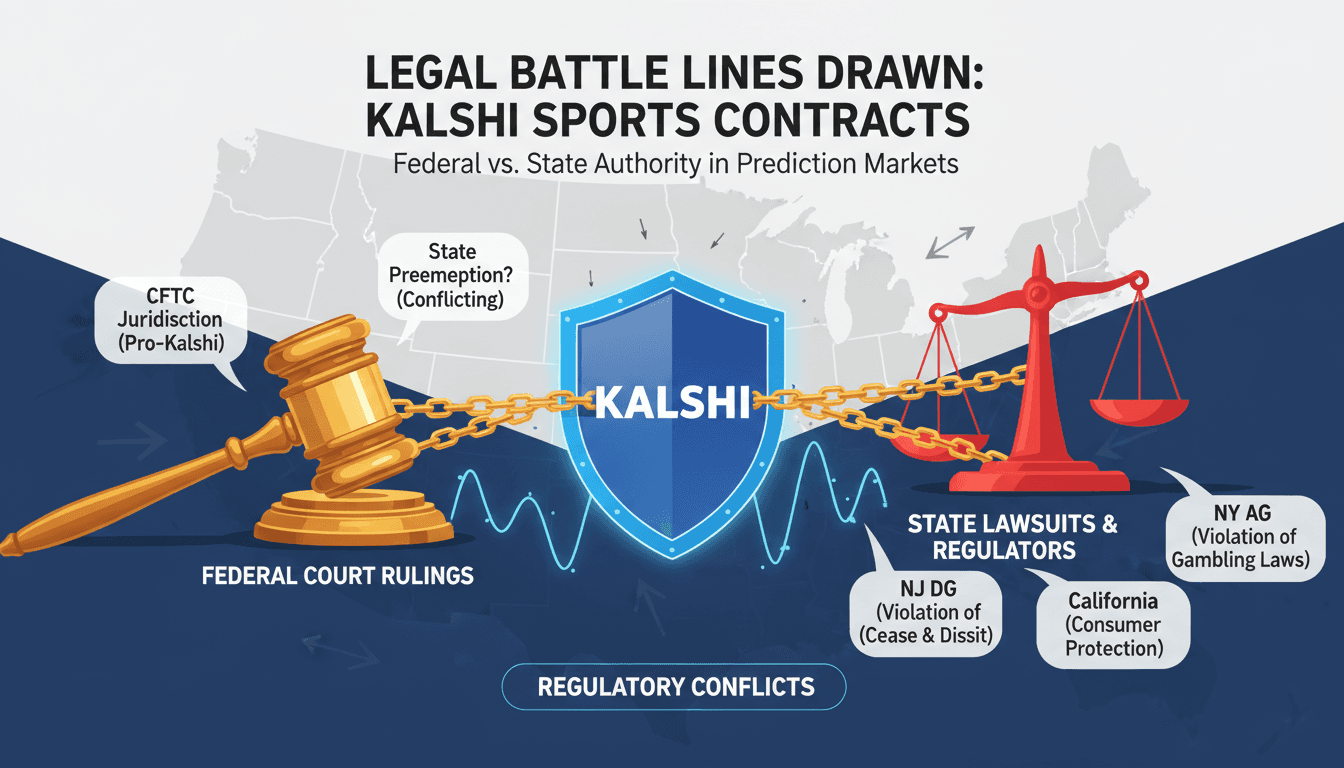
This conflict highlights the ongoing struggle between federal oversight and state regulations in the rapidly evolving landscape of sports betting.
What happened (in 30 seconds)
- Kalshi launched sports event contracts in January 2025, quickly dominating trading volume in the prediction market space.
- Multiple states, including Massachusetts and New York, have initiated lawsuits against Kalshi, claiming its contracts violate state gambling laws.
- Conflicting court rulings have emerged, with some courts siding with Kalshi's federal preemption argument while others uphold state restrictions.
The context you actually need
- The 2018 Supreme Court ruling in Murphy v. NCAA allowed states to regulate sports betting, leading to a surge in state-level markets.
- Kalshi, approved by the CFTC in 2020, began offering contracts that allow users to bet on the outcomes of sports events, positioning itself as a major player in the prediction market.
- The CFTC's role is crucial as it proposes rules to clarify the jurisdiction over these contracts, potentially impacting how states can regulate them.
What's really happening
Kalshi's introduction of sports event contracts in January 2025 marked a significant shift in the prediction market landscape. By offering yes/no contracts on sports outcomes, Kalshi has rapidly gained traction, accounting for a substantial portion of trading volume. This aggressive expansion has not gone unnoticed, prompting legal challenges from various state attorneys general who argue that these contracts constitute unlicensed sports wagering. They assert that Kalshi's operations bypass essential state regulations regarding age restrictions, licensing, and tax obligations.
The legal landscape is complicated by the 2018 Supreme Court decision in Murphy v. NCAA, which dismantled the federal ban on sports betting and empowered states to regulate their own markets. Kalshi, having been designated as a regulated market by the Commodity Futures Trading Commission (CFTC) in 2020, contends that its contracts fall under federal derivatives regulation, thus preempting state laws. This assertion has led to a patchwork of conflicting court rulings. For instance, the Third Circuit Court of Appeals ruled in April 2026 that CFTC authority supersedes state restrictions in one case, while a Utah district court reached the opposite conclusion in August 2026.
As litigation unfolds, the CFTC is actively proposing rules to clarify the definition of gaming and affirm its jurisdiction over such contracts. This regulatory push aims to establish a clearer framework for prediction markets, which could either reinforce Kalshi's position or empower states to impose stricter regulations. The stakes are high, as the U.S. gambling industry generated approximately $17.9 billion in tax revenue for state and local governments in the previous year, making it a significant source of funding for various public services.
The ongoing tension between federal and state authorities not only affects Kalshi but also sets a precedent for how emerging markets will be regulated in the future. As states pursue injunctions and litigation to limit Kalshi's operations, the outcome of these legal battles could redefine the landscape of prediction markets and sports betting in the U.S.
Who feels it first (and how)
- State governments: They may lose potential tax revenue from unregulated sports betting.
- Consumers: Users in states with injunctions may find their access to Kalshi's platform restricted.
- Investors and market participants: They face uncertainty regarding the legality and future of prediction markets, impacting investment strategies.
What to watch next
- Court rulings: Keep an eye on upcoming decisions from state and federal courts that could clarify the legal status of Kalshi's contracts.
- CFTC rule proposals: Monitor the CFTC's efforts to establish clearer regulations, as these could significantly influence market operations.
- State legislative actions: Watch for new state laws or amendments aimed at regulating prediction markets, which could reshape the competitive landscape.
Kalshi's sports event contracts have sparked legal challenges from multiple states.
The CFTC will continue to propose rules to clarify its jurisdiction over prediction markets.
The ultimate outcome of the conflicting court rulings and their implications for Kalshi and state regulations.
Frequently Asked Questions
- Why it matters?
- This conflict highlights the ongoing struggle between federal oversight and state regulations in the rapidly evolving landscape of sports betting.
- What happened (in 30 seconds)?
- Kalshi launched sports event contracts in January 2025, quickly dominating trading volume in the prediction market space. Multiple states, including Massachusetts and New York, have initiated lawsuits against Kalshi, claiming its contracts violate state gambling laws. Conflicting court rulings have emerged, with some courts siding with Kalshi's federal preemption argument while others uphold state restrictions.
- What's really happening?
- Kalshi's introduction of sports event contracts in January 2025 marked a significant shift in the prediction market landscape. By offering yes/no contracts on sports outcomes, Kalshi has rapidly gained traction, accounting for a substantial portion of trading volume. This aggressive expansion has not gone unnoticed, prompting legal challenges from various state attorneys general who argue that these contracts constitute unlicensed sports wagering. They assert that Kalshi's operations bypass esse
- Who feels it first (and how)?
- State governments: They may lose potential tax revenue from unregulated sports betting. Consumers: Users in states with injunctions may find their access to Kalshi's platform restricted. Investors and market participants: They face uncertainty regarding the legality and future of prediction markets, impacting investment strategies.
- What to watch next?
- Court rulings: Keep an eye on upcoming decisions from state and federal courts that could clarify the legal status of Kalshi's contracts. CFTC rule proposals: Monitor the CFTC's efforts to establish clearer regulations, as these could significantly influence market operations. State legislative actions: Watch for new state laws or amendments aimed at regulating prediction markets, which could reshape the competitive landscape.
Sports news with an emphasis on business, economics, and strategy behind major events and leagues.
"WSJ’s sports coverage is distinguished by its focus on financial and strategic aspects of the sports world."
— A47 Editor
Kalshi’s Embrace of Sports Betting Tests Rules for Prediction Markets
Kalshi, a platform for prediction markets, is facing scrutiny as judges have issued conflicting rulings regarding its sports betting operations, potentially leading to a Supreme Court case. This situation arises amid a growing interest in prediction ...
Coverage of national news and issues shaping the United States, including politics, economy, and society.
"The Wall Street Journal is one of the most respected financial and news publications in the U.S., known for its rigorous reporting and center-right editorial perspective."
— A47 Editor
Kalshi’s Embrace of Sports Betting Tests Rules for Prediction Markets
Kalshi, a prediction market platform, is facing legal challenges as judges have issued conflicting rulings regarding its compliance with state laws, particularly concerning sports betting. This situation may escalate to the Supreme Court, which could...
Covers blockchain, cryptocurrency news, project analysis, and market insights.
"Cointelegraph is a leading crypto-focused media outlet known for timely news, analysis, and educational content related to blockchain and digital assets."
— A47 Editor
US lawmakers from gaming states urge SCOTUS to take up Kalshi case
US lawmakers from gaming states are urging the Supreme Court of the United States (SCOTUS) to take up the case involving Kalshi, a prediction market company, which could clarify the legal landscape surrounding sports betting. This case arises from on...