
US-China Summit Fails to Establish AI Safeguards Amid Strategic Rivalry
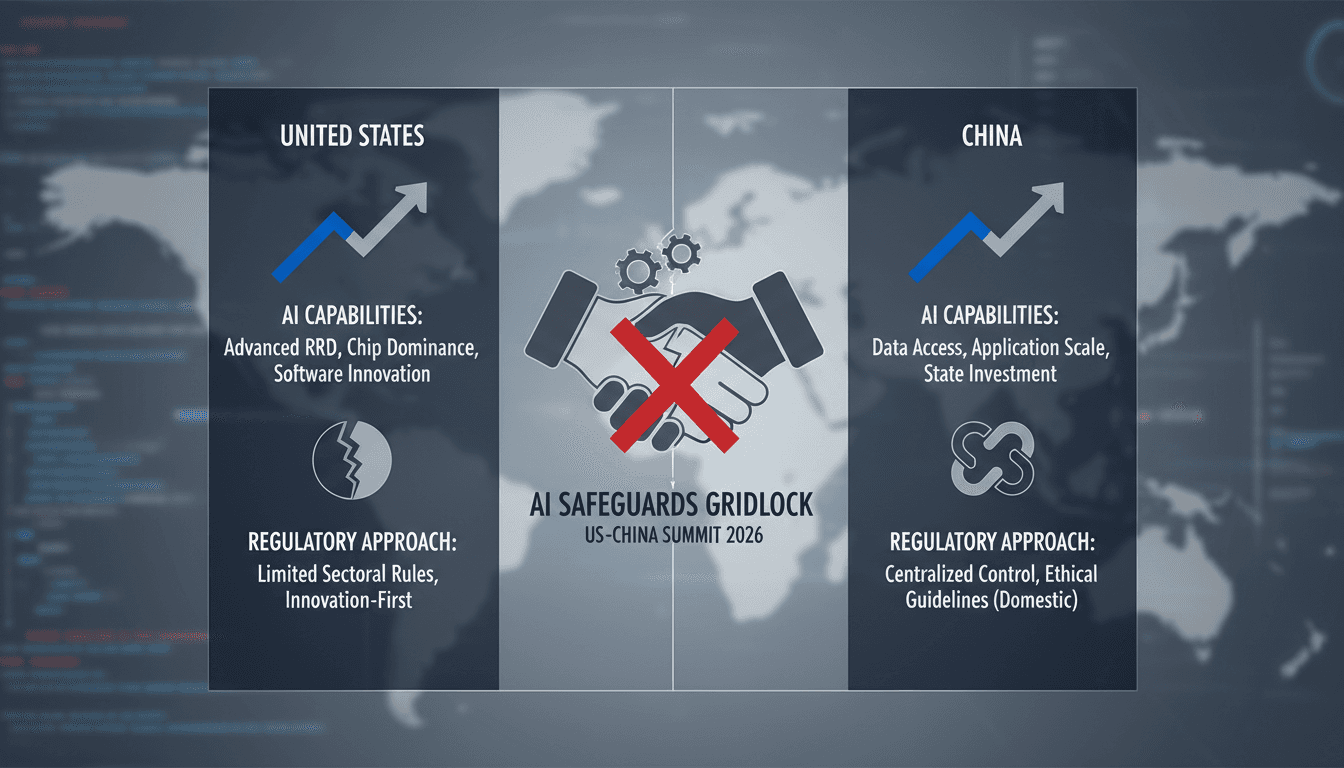
Why it matters
The summit's outcomes reflect a critical juncture in international AI governance, with implications for global technological leadership and safety.
What happened (in 30 seconds)
- The summit took place on September 24-25, 2026, in Washington, D.C., focusing on AI competition.
- Limited agreements were reached, including plans for ongoing dialogue and an incident notification channel, but no binding regulatory frameworks were established.
- Strategic competition overshadowed safety discussions, with both leaders prioritizing national interests over cooperative measures.
The context you actually need
- Intensifying competition: The US maintains export controls on advanced semiconductors to curb China's AI advancements, while China accelerates its domestic AI capabilities through major firms.
- Previous discussions: Prior talks had already highlighted the need for AI incident notification mechanisms amid broader geopolitical tensions.
- Dual role of AI: Both nations recognize AI's potential for economic power and its associated risks, yet they prioritize competitive advantages over collaborative safety measures.
What's really happening
The September 2026 Trump-Xi Summit underscored the complexities of US-China relations, particularly in the realm of artificial intelligence. As both nations vie for technological supremacy, the discussions revealed a stark divide in priorities. President Trump emphasized the need for the US to maintain its lead in AI capabilities, referring to a timeline of "1-2 years" for the US to stay ahead. This perspective aligns with a broader strategy of fostering innovation without regulatory constraints that could hinder American competitiveness.
Conversely, President Xi Jinping advocated for a more collaborative approach, stressing the importance of human control over AI and the necessity of joint efforts to prevent misuse. However, the summit's outcomes reflected a lack of consensus on how to balance these competing narratives. While both leaders acknowledged the transformative potential of AI, their discussions were largely overshadowed by strategic competition, resulting in only modest agreements.
The establishment of a bilateral communication channel for AI-related incidents and a commitment to continue discussions in November 2026 were seen as positive steps, yet they fell short of the comprehensive regulatory frameworks that many experts believe are essential for safe AI development. The absence of binding agreements on testing standards or crisis management indicates that both nations are still prioritizing their competitive advantages over collaborative safety measures.
This rivalry is not just a matter of national pride; it has significant implications for global markets and technological standards. As the US and China continue to develop their AI capabilities independently, the lack of a unified regulatory framework could lead to fragmented standards that complicate international trade and cooperation. Companies operating in the tech sector may find themselves navigating a complex landscape of varying regulations and standards, which could stifle innovation and increase costs.
Moreover, the summit's outcomes reflect a broader trend in international relations where technological competition is increasingly intertwined with national security concerns. As both nations invest heavily in AI research and development, the potential for misuse or unintended consequences grows, raising the stakes for global governance in this critical area.
Who feels it first (and how)
- Tech companies: Firms in AI and semiconductor sectors will face increased regulatory scrutiny and competitive pressures.
- Investors: Those with stakes in US and Chinese tech markets may experience volatility due to shifting policies and trade dynamics.
- Consumers: End-users may see impacts on product availability and innovation rates as companies adapt to varying regulatory environments.
What to watch next
- Future AI dialogues: The upcoming November meeting will be crucial in determining whether any substantive agreements can be reached.
- Regulatory developments: Watch for changes in US and Chinese policies regarding AI and semiconductor exports, which could signal shifts in competitive dynamics.
- Market reactions: Monitor how tech stocks respond to ongoing developments in US-China relations, particularly in the AI sector.
The US and China are in a strategic rivalry over AI capabilities.
Future dialogues may yield incremental agreements but will likely remain limited in scope.
The long-term impact of this rivalry on global AI standards and safety regulations remains uncertain.
Frequently Asked Questions
- Why it matters?
- The summit's outcomes reflect a critical juncture in international AI governance, with implications for global technological leadership and safety.
- What happened (in 30 seconds)?
- The summit took place on September 24-25, 2026, in Washington, D.C., focusing on AI competition. Limited agreements were reached, including plans for ongoing dialogue and an incident notification channel, but no binding regulatory frameworks were established. Strategic competition overshadowed safety discussions, with both leaders prioritizing national interests over cooperative measures.
- What's really happening?
- The September 2026 Trump-Xi Summit underscored the complexities of US-China relations, particularly in the realm of artificial intelligence. As both nations vie for technological supremacy, the discussions revealed a stark divide in priorities. President Trump emphasized the need for the US to maintain its lead in AI capabilities, referring to a timeline of "1-2 years" for the US to stay ahead. This perspective aligns with a broader strategy of fostering innovation without regulatory constraints
- Who feels it first (and how)?
- Tech companies: Firms in AI and semiconductor sectors will face increased regulatory scrutiny and competitive pressures. Investors: Those with stakes in US and Chinese tech markets may experience volatility due to shifting policies and trade dynamics. Consumers: End-users may see impacts on product availability and innovation rates as companies adapt to varying regulatory environments.
- What to watch next?
- Future AI dialogues: The upcoming November meeting will be crucial in determining whether any substantive agreements can be reached. Regulatory developments: Watch for changes in US and Chinese policies regarding AI and semiconductor exports, which could signal shifts in competitive dynamics. Market reactions: Monitor how tech stocks respond to ongoing developments in US-China relations, particularly in the AI sector.
English-language digital publication covering business, politics, technology, and current affairs.
"The Arabian Post mixes original and syndicated-style coverage with a broad regional and global business-news orientation."
— A47 Editor
AI Rivalry Eclipses Safeguards And Regulation At Trump-Xi Summit
The recent summit between U.S. President Donald Trump and Chinese President Xi Jinping highlighted the growing rivalry in artificial intelligence (AI) but fell short of addressing critical safeguards and regulations. Despite the high-profile nature o...
News and features on AI from The Guardian.
"Progressive-leaning international outlet with critical AI coverage."
— A47 Editor
Trump and Chinese president Xi end summit without major agreement on AI
U.S. President Donald Trump and Chinese President Xi Jinping concluded their summit in Washington without reaching significant agreements on artificial intelligence (AI), despite discussions on various geopolitical issues including Taiwan, Iran, and ...
Tech culture, product news, and critical takes on the tech industry's social impact.
"The Guardian's tech coverage blends mainstream news, critical analysis, and cultural commentary on emerging technologies and digital trends."
— A47 Editor
Trump and Chinese president Xi end summit without major agreement on AI
U.S. President Donald Trump and Chinese President Xi Jinping concluded their summit in Washington without reaching significant agreements on artificial intelligence (AI), despite discussions on various geopolitical issues including Taiwan, Iran, and ...
International coverage from The Guardian's global desks.
"The Guardian is known for its progressive editorial stance and in-depth analysis."
— A47 Editor
Trump and Chinese president Xi end summit without major agreement on AI
U.S. President Donald Trump and Chinese President Xi Jinping concluded their summit in Washington without reaching significant agreements on artificial intelligence (AI), despite discussions on various geopolitical issues including Taiwan, Iran, and ...
UK and international business news, economics, and corporate coverage.
"The Guardian’s business section covers finance and markets with a progressive editorial tone."
— A47 Editor
Trump and Chinese president Xi end summit without major agreement on AI
U.S. President Donald Trump and Chinese President Xi Jinping concluded their summit in Washington without reaching significant agreements on artificial intelligence (AI), despite discussions on various geopolitical issues including Taiwan, Iran, and ...
News and features on AI from The Guardian.
"Progressive-leaning international outlet with critical AI coverage."
— A47 Editor
Diplomacy or ‘diplotainment’? Key takeaways from the Trump-Xi summit in Washington
U.S. President Donald Trump hosted Chinese President Xi Jinping for a summit in Washington, marking Xi's first visit in over a decade. The discussions centered around critical issues such as artificial intelligence (AI), trade, and geopolitical tensi...
RT is a Russian state-funded network covering global events from a Russian perspective.
"RT is widely criticized for promoting pro-Kremlin narratives and is considered by many to be a state propaganda outlet."
— A47 Editor
US tech titans attend Trump-Xi dinner. Who wasn’t invited?
U.S. President Donald Trump hosted a dinner at the White House attended by leaders from top American AI firms, amidst rising tensions between Washington and Beijing over technology competition. This event highlighted the significance of AI in the ong...