
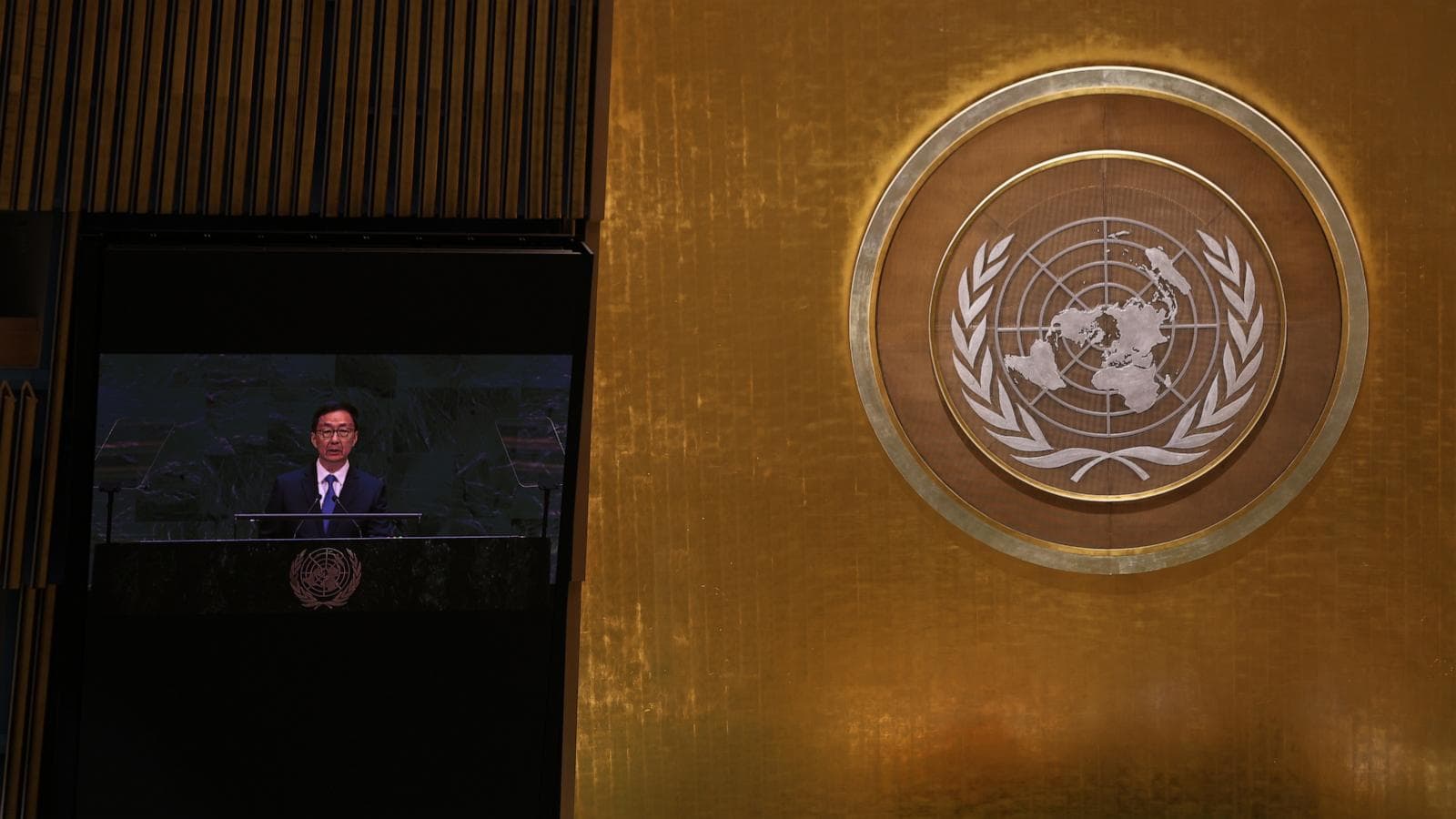
China's Vice President Han Zheng Advocates for Global Development at UN General Assembly
Why it matters
China's advocacy for multilateralism and development may influence global economic policies and partnerships, impacting your business landscape.
What happened (in 30 seconds)
- Han Zheng, China's Vice President, addressed the UN General Assembly on September 26, 2026, focusing on global development as a solution to challenges.
- Key themes included multilateralism, criticism of protectionism, and China's economic initiatives like the Belt and Road.
- No direct mention of Taiwan was made, aligning with China's strategy to avoid escalating tensions amid ongoing U.S.-China relations.
The context you actually need
- Ongoing tensions exist between the U.S. and China, particularly regarding tariffs and military actions in the Middle East.
- China's Global Development Initiative, launched in 2021, aims to position the country as a leader in international development and cooperation.
- Han's speech follows a significant meeting between Xi Jinping and Donald Trump, indicating a strategic alignment in China's diplomatic messaging.
What's really happening
Han Zheng's address at the UN General Assembly is a calculated move within a broader geopolitical strategy. By emphasizing development, China seeks to position itself as a stabilizing force in a world increasingly marked by protectionism and unilateral actions. The speech highlighted China's significant contribution to global economic growth, accounting for approximately 30% of recent increases, according to UN records. This statistic underscores China's role as a key player in the global economy, which is particularly relevant as nations grapple with post-pandemic recovery.
The Belt and Road Initiative (BRI) was prominently featured, showcasing China's commitment to infrastructure development and international cooperation. By framing these initiatives as models for global progress, Han Zheng aims to attract countries to align with China's vision, potentially countering U.S. influence. The avoidance of direct references to Taiwan indicates a strategic choice to de-escalate tensions while still asserting China's sovereignty.
Moreover, Han's criticism of protectionism reflects a broader concern that such policies yield no winners, a sentiment that resonates with many nations facing economic challenges. By advocating for multilateral dialogue over military actions, China positions itself as a proponent of peace and stability, appealing to countries wary of conflict.
The implications of this speech extend beyond immediate diplomatic relations. As countries consider their economic partnerships, China's focus on development may lead to increased investment in infrastructure and technology, particularly in regions aligned with the BRI. This could reshape global trade routes and economic alliances, influencing sectors from construction to technology.
In summary, Han Zheng's address is not merely a diplomatic formality; it is a strategic assertion of China's role in shaping the future of global governance and economic collaboration. The emphasis on development as a central theme reflects a desire to redefine international relations in a way that favors China's economic model and initiatives.
Who feels it first (and how)
- Investors in infrastructure and technology sectors may see new opportunities as China promotes development initiatives.
- Countries involved in the Belt and Road Initiative could experience increased trade and investment flows, impacting local economies.
- Businesses in sectors sensitive to geopolitical shifts, such as energy and defense, may need to adapt strategies in response to changing alliances.
What to watch next
- China's economic partnerships: Monitor new agreements or investments in countries participating in the Belt and Road Initiative, as these could signal shifts in global trade dynamics.
- U.S.-China relations: Watch for any changes in tariffs or military posturing that could affect market stability and investor confidence.
- Global responses: Observe how other nations react to China's call for multilateralism, particularly in forums like the G20 or regional trade agreements.
China's focus on development and multilateralism is consistent with its long-standing diplomatic strategy.
Increased investment in infrastructure projects globally, particularly in developing nations aligned with China.
The immediate impact on U.S.-China relations and how this will affect global economic stability.
Frequently Asked Questions
- Why it matters?
- China's advocacy for multilateralism and development may influence global economic policies and partnerships, impacting your business landscape.
- What happened (in 30 seconds)?
- Han Zheng, China's Vice President, addressed the UN General Assembly on September 26, 2026, focusing on global development as a solution to challenges. Key themes included multilateralism, criticism of protectionism, and China's economic initiatives like the Belt and Road. No direct mention of Taiwan was made, aligning with China's strategy to avoid escalating tensions amid ongoing U.S.-China relations.
- What's really happening?
- Han Zheng's address at the UN General Assembly is a calculated move within a broader geopolitical strategy. By emphasizing development, China seeks to position itself as a stabilizing force in a world increasingly marked by protectionism and unilateral actions. The speech highlighted China's significant contribution to global economic growth, accounting for approximately 30% of recent increases, according to UN records. This statistic underscores China's role as a key player in the global econom
- Who feels it first (and how)?
- Investors in infrastructure and technology sectors may see new opportunities as China promotes development initiatives. Countries involved in the Belt and Road Initiative could experience increased trade and investment flows, impacting local economies. Businesses in sectors sensitive to geopolitical shifts, such as energy and defense, may need to adapt strategies in response to changing alliances.
- What to watch next?
- China's economic partnerships: Monitor new agreements or investments in countries participating in the Belt and Road Initiative, as these could signal shifts in global trade dynamics. U.S.-China relations: Watch for any changes in tariffs or military posturing that could affect market stability and investor confidence. Global responses: Observe how other nations react to China's call for multilateralism, particularly in forums like the G20 or regional trade agreements.
Major U.S. developments and regional news.
"ABC News delivers broad national coverage with a mainstream editorial stance, focusing on accessibility and balanced reporting."
— A47 Editor
China, as usual, uses UN speech to promote global development as solution to world's challenges
China's Vice President delivered a speech at the United Nations, reiterating the country's commitment to global development as a solution to various international challenges. He addressed issues such as the U.S. conflict with Iran, artificial intelli...
English-language reporting on Saudi politics, policy, and society.
"Saudi Gazette reflects mainstream Saudi institutional perspectives."
— A47 Editor
China opposes ‘unilateral military actions,’ urges two-state solution at UN
Chinese Vice President Han Zheng addressed the UN General Assembly, opposing unilateral military actions amid the US-Iran conflict and advocating for a two-state solution to the Palestinian issue. He emphasized the need for dialogue and consultation ...
Global business headlines with AI angles.
"General business outlet that frequently covers AI."
— A47 Editor
China's VP Urged Nations To Embrace Multilateralism In UN Address. His Speech Was Full Of Thinly-Veiled Criticisms Of The U.S.
In a recent address at the United Nations, China's Vice-President Han Zheng called on nations to embrace multilateralism, subtly criticizing U.S. policies regarding Cuba, the Middle East, and international trade without explicitly naming the country....