
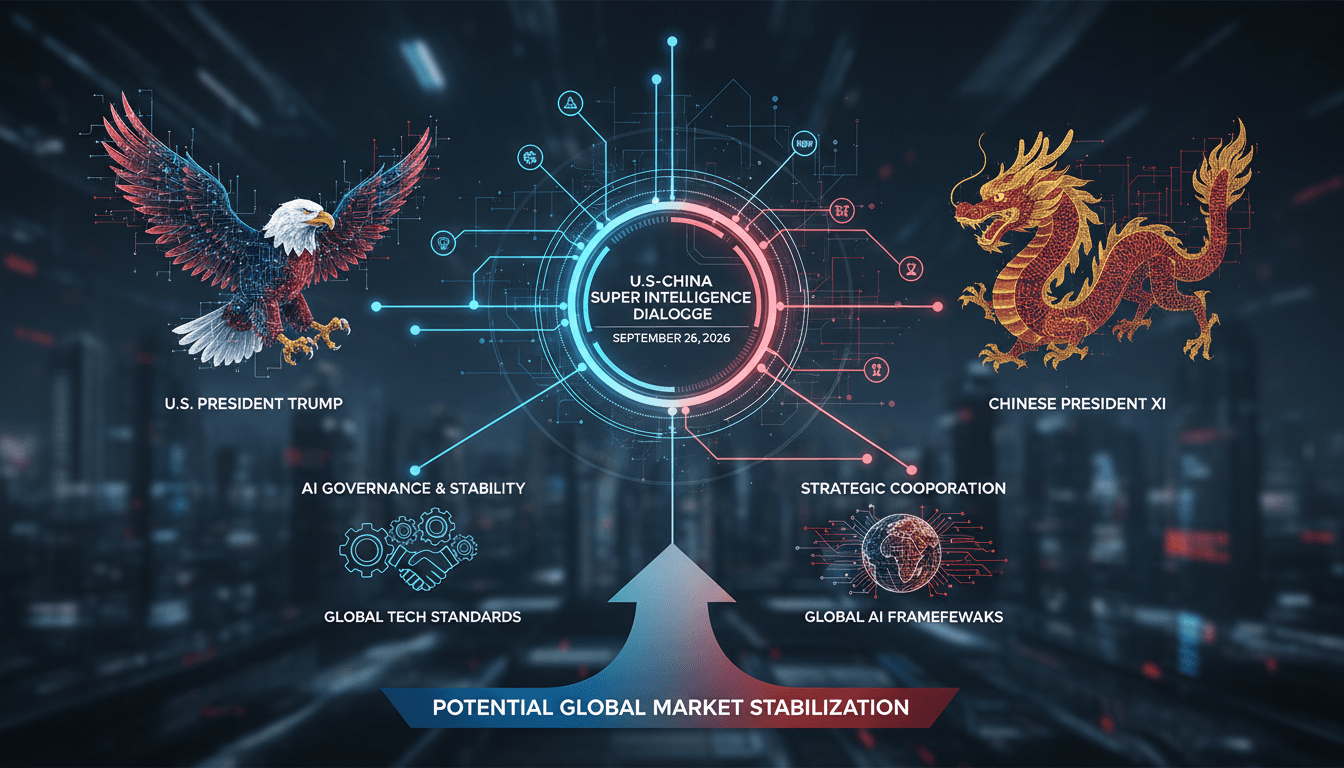
Trump and Xi Establish U.S.-China Super Intelligence Dialogue on AI Development
Why it matters
This bilateral agreement signals a shift in how major economies approach AI governance, impacting global tech markets and innovation strategies.
What happened (in 30 seconds)
- Trump announced that the U.S. will not obstruct AI development, emphasizing regulatory enforcement through existing laws.
- Xi endorsed the rebranding of AI as "super intelligence," reflecting a shared interest in precise terminology.
- A new dialogue channel for AI-related incidents was established, with the first follow-up meeting scheduled for November 2026.
The context you actually need
- U.S.-China rivalry intensified in 2025-2026, with both nations competing for technological supremacy, particularly in AI.
- China's advancements in AI continued despite U.S. restrictions on advanced chip exports, raising concerns about governance and human oversight.
- Direct engagement between Trump and Xi marks a significant step towards collaborative governance in AI, amid ongoing strategic competition.
What's really happening
During a pivotal state visit, President Trump publicly committed to a non-interference policy regarding AI development, a move that reflects a broader strategy to maintain U.S. technological leadership without imposing new regulations. This decision comes in the wake of intensified U.S.-China competition, particularly in the AI sector, where both nations are racing to develop advanced capabilities.
The term "super intelligence," as endorsed by Xi, suggests a shift in focus from merely developing AI to ensuring that these technologies are aligned with human oversight and ethical standards. This rebranding could facilitate a more collaborative approach to AI governance, as both leaders acknowledged the need for precise terminology in official documents.
The establishment of a dedicated dialogue channel for AI incidents indicates a proactive approach to managing risks associated with AI technologies. This channel aims to address potential conflicts and misunderstandings that could arise from AI deployment, thereby fostering a more stable environment for innovation. The first follow-up meeting scheduled for November 2026 will be crucial in determining the effectiveness of this dialogue.
Despite the positive rhetoric, underlying tensions remain. The U.S. continues to prioritize its strategic competition with China, particularly in advanced technologies. While the non-obstruction policy may ease some immediate concerns, it does not eliminate the competitive landscape that drives both nations. Analysts suggest that this could lead to increased investments in AI infrastructure as companies seek to capitalize on the evolving regulatory environment.
The implications of this agreement extend beyond the U.S. and China. Countries around the world will be watching closely, as the outcomes of this dialogue could influence their own AI policies and international collaborations. The potential for reduced export tensions may also stabilize global supply chains, which is particularly relevant for industries reliant on AI technologies.
Who feels it first (and how)
- Tech companies: Firms in AI and related sectors will need to adapt to new regulatory frameworks and competitive dynamics.
- Investors: Those in venture capital and private equity will be closely monitoring shifts in AI funding and market opportunities.
- Governments: Policymakers globally will be influenced by the U.S.-China dialogue, potentially reshaping national AI strategies.
What to watch next
- Follow-up meetings: The outcomes of the November 2026 meeting will be critical in shaping future U.S.-China AI relations and governance frameworks.
- Market reactions: Watch for shifts in investment patterns in AI infrastructure as companies respond to the new regulatory landscape.
- International collaborations: Observe how other nations adjust their AI policies in response to U.S.-China dynamics, particularly in Europe and Asia.
The U.S. will not impose new regulations on AI development in the immediate term.
Increased investment in AI infrastructure as companies adapt to the evolving landscape.
The long-term effectiveness of the U.S.-China dialogue channel in mitigating risks associated with AI technologies.
Frequently Asked Questions
- Why it matters?
- This bilateral agreement signals a shift in how major economies approach AI governance, impacting global tech markets and innovation strategies.
- What happened (in 30 seconds)?
- Trump announced that the U.S. will not obstruct AI development, emphasizing regulatory enforcement through existing laws. Xi endorsed the rebranding of AI as "super intelligence," reflecting a shared interest in precise terminology. A new dialogue channel for AI-related incidents was established, with the first follow-up meeting scheduled for November 2026.
- What's really happening?
- During a pivotal state visit, President Trump publicly committed to a non-interference policy regarding AI development, a move that reflects a broader strategy to maintain U.S. technological leadership without imposing new regulations. This decision comes in the wake of intensified U.S.-China competition, particularly in the AI sector, where both nations are racing to develop advanced capabilities. The term "super intelligence," as endorsed by Xi, suggests a shift in focus from merely developi
- Who feels it first (and how)?
- Tech companies: Firms in AI and related sectors will need to adapt to new regulatory frameworks and competitive dynamics. Investors: Those in venture capital and private equity will be closely monitoring shifts in AI funding and market opportunities. Governments: Policymakers globally will be influenced by the U.S.-China dialogue, potentially reshaping national AI strategies.
- What to watch next?
- Follow-up meetings: The outcomes of the November 2026 meeting will be critical in shaping future U.S.-China AI relations and governance frameworks. Market reactions: Watch for shifts in investment patterns in AI infrastructure as companies respond to the new regulatory landscape. International collaborations: Observe how other nations adjust their AI policies in response to U.S.-China dynamics, particularly in Europe and Asia.
Arabic-language coverage of international news and geopolitics.
"RT Arabic is a Russian state-funded outlet often criticized for promoting Kremlin-aligned narratives."
— A47 Editor
ترامب: لن نعرقل تطوير تقنيات الذكاء الاصطناعي والرئيس الصيني أبدى إعجابه بتسميته "الذكاء الخارق"
U.S. President Donald Trump stated that the United States does not intend to hinder the development of artificial intelligence, noting that Chinese President Xi Jinping expressed admiration for the idea of referring to this technology as 'super intel...
Arabic-language coverage of political affairs and current events.
"Okaz political coverage typically follows mainstream Saudi framing on national and regional affairs."
— A47 Editor
ترمب: اجتماعي مع الرئيس الصيني مثمر وأمور هائلة ستحدث
U.S. President Donald Trump described his meeting with Chinese President Xi Jinping as highly productive, stating that significant developments are expected between Washington and Beijing. Trump emphasized the importance of accurately naming artifici...
Arabic-language political and world news coverage for UAE readers.
"Emarat Al Youm world coverage usually presents international developments through a UAE and Arab audience lens."
— A47 Editor
ترامب: سأبحث مع شي جين بينغ قضايا الأمن والتكنولوجيا والذكاء الاصطناعي ترامب: سأبحث مع شي جين بينغ قضايا الأمن والتكنولوجيا والذكاء الاصطناعي
U.S. President Donald Trump announced plans to discuss security, technology, and artificial intelligence with Chinese President Xi Jinping. This meeting highlights the ongoing dialogue between the two nations on critical global issues.
Arabic-language political and world news coverage for UAE readers.
"Emarat Al Youm world coverage usually presents international developments through a UAE and Arab audience lens."
— A47 Editor
ترامب: سأناقش مع شي الذكاء الاصطناعي ونرغب في "ترك الأمور على حالها" ترامب: سأناقش مع شي الذكاء الاصطناعي ونرغب في "ترك الأمور على حالها"
U.S. President Donald Trump announced that artificial intelligence will be a key topic of discussion during his upcoming meeting with Chinese President Xi Jinping. Trump expressed a desire to maintain the current state of affairs in their bilateral r...