
Trump Executive Order Changes AI Terminology to Super Intelligence
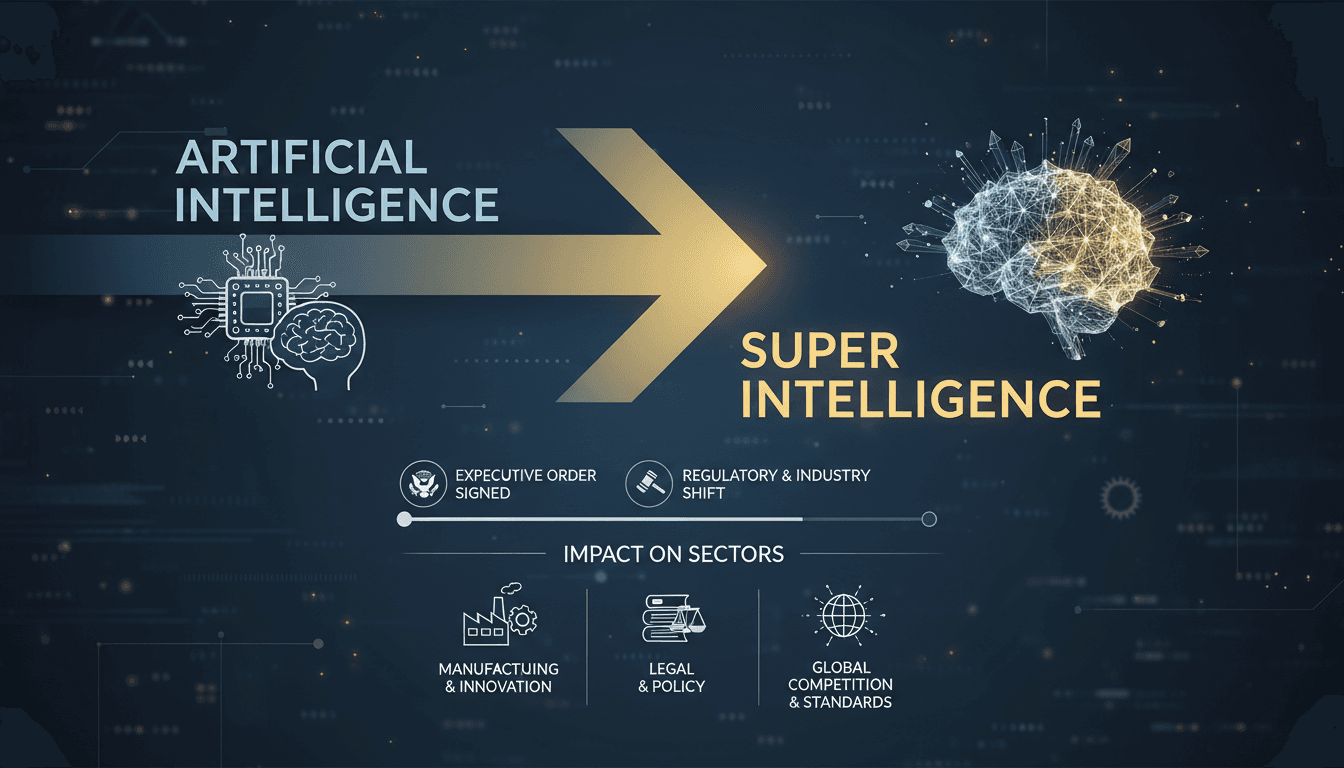
Why it matters
This executive order signals a significant shift in the U.S. government's approach to advanced technologies, potentially influencing global standards and practices.
What happened (in 30 seconds)
- On September 29, 2026, President Trump signed an executive order mandating the use of 'Super Intelligence' and 'SI' in federal communications.
- A 60-day review process has been initiated to propose a new federal definition for these terms while retaining existing definitions of AI.
- Major tech firms have signed a voluntary accord to enhance internal oversight and audits related to Super Intelligence.
The context you actually need
- Terminology shift: The change from 'Artificial Intelligence' to 'Super Intelligence' reflects a belief that current technologies surpass traditional definitions.
- Genesis Mission: This order is part of a broader initiative, the Genesis Mission, aimed at leveraging Super Intelligence for advancements in various fields, backed by $5 billion in federal funding.
- Global competition: The U.S. is positioning itself in the global race for advanced AI technologies, which may influence international standards and practices.
What's really happening
The executive order signed by President Trump on September 29, 2026, represents a strategic pivot in how the U.S. government communicates about advanced technologies. By mandating the use of 'Super Intelligence' and 'SI,' the administration aims to redefine the narrative surrounding AI, suggesting that current technologies are far more advanced than what the term 'artificial intelligence' implies. This shift is not merely semantic; it reflects a broader understanding of the capabilities and potential of these technologies.
The order initiates a 60-day review process to establish a new federal definition for Super Intelligence, while explicitly retaining the existing statutory definitions of AI. This dual approach allows for a more nuanced conversation about the implications of these technologies without disrupting existing legal frameworks. The administration's view is that the term 'artificial intelligence' does not adequately capture the advancements being made, particularly in areas such as machine learning, neural networks, and autonomous systems.
In conjunction with this order, major technology firms, including Google, Meta, and OpenAI, have signed a voluntary White House Accord on Super Intelligence. This accord emphasizes the importance of internal controls, audits, and oversight, indicating a collective recognition of the need for responsible development and deployment of these technologies. The collaboration between the government and private sector is crucial, as it sets a precedent for how these entities will work together to ensure safety and accountability in the rapidly evolving landscape of AI.
The implications of this executive order extend beyond U.S. borders. As the U.S. seeks to lead in the global competition for advanced AI technologies, the terminology and definitions adopted domestically may influence international standards and practices. Countries and organizations around the world will be watching closely to see how this shift impacts regulatory frameworks and technological development.
Moreover, the $5 billion allocated for the Genesis Mission underscores the administration's commitment to harnessing Super Intelligence for breakthroughs in critical areas such as science, medicine, energy, and manufacturing. This funding is expected to drive innovation and research, potentially leading to significant advancements that could reshape industries and economies.
Who feels it first (and how)
- Tech companies: Firms involved in AI development will need to adapt their communications and possibly their product strategies to align with the new terminology.
- Government agencies: Federal agencies will update their documentation and communications, impacting how they interact with the public and private sectors.
- Researchers and academics: Those studying AI will need to adjust their frameworks and discussions to incorporate the new definitions and implications of Super Intelligence.
What to watch next
- Legislative developments: Keep an eye on the outcomes of the 60-day review process and any proposed changes to federal definitions of Super Intelligence.
- Industry responses: Monitor how major tech firms implement the voluntary accord and whether it leads to standardized practices across the industry.
- Global reactions: Watch for how other countries respond to the U.S. shift in terminology and whether they adopt similar frameworks in their own AI policies.
The executive order mandates a terminology change for U.S. federal communications regarding AI.
The new terminology will influence how technology firms and researchers communicate about AI, potentially leading to broader industry standards.
The long-term effects of this shift on international AI regulations and practices remain uncertain.
Frequently Asked Questions
- Why it matters?
- This executive order signals a significant shift in the U.S. government's approach to advanced technologies, potentially influencing global standards and practices.
- What happened (in 30 seconds)?
- On September 29, 2026, President Trump signed an executive order mandating the use of 'Super Intelligence' and 'SI' in federal communications. A 60-day review process has been initiated to propose a new federal definition for these terms while retaining existing definitions of AI. Major tech firms have signed a voluntary accord to enhance internal oversight and audits related to Super Intelligence.
- What's really happening?
- The executive order signed by President Trump on September 29, 2026, represents a strategic pivot in how the U.S. government communicates about advanced technologies. By mandating the use of 'Super Intelligence' and 'SI,' the administration aims to redefine the narrative surrounding AI, suggesting that current technologies are far more advanced than what the term 'artificial intelligence' implies. This shift is not merely semantic; it reflects a broader understanding of the capabilities and pote
- Who feels it first (and how)?
- Tech companies: Firms involved in AI development will need to adapt their communications and possibly their product strategies to align with the new terminology. Government agencies: Federal agencies will update their documentation and communications, impacting how they interact with the public and private sectors. Researchers and academics: Those studying AI will need to adjust their frameworks and discussions to incorporate the new definitions and implications of Super Intelligence.
- What to watch next?
- Legislative developments: Keep an eye on the outcomes of the 60-day review process and any proposed changes to federal definitions of Super Intelligence. Industry responses: Monitor how major tech firms implement the voluntary accord and whether it leads to standardized practices across the industry. Global reactions: Watch for how other countries respond to the U.S. shift in terminology and whether they adopt similar frameworks in their own AI policies.
News and guidance for IT pros on AI adoption.
"Enterprise-focused tips, explainers, and news for professionals."
— A47 Editor
Trump Signs ‘Super Intelligence’ Order: What Actually Changes for AI
President Trump signed an executive order directing federal agencies to adopt the term 'Super Intelligence' in place of artificial intelligence (AI), marking a significant shift in the terminology used by the U.S. government. This order aims to redef...
Business and tech news excluding paywalled content.
"High-volume business/tech outlet with frequent AI coverage."
— A47 Editor
Donald Trump orders federal agencies to rename AI ‘Super Intelligence’
President Donald Trump has ordered federal agencies to rebrand artificial intelligence (AI) as 'Super Intelligence,' a move announced during a gathering with technology CEOs. This initiative is part of an executive order aimed at addressing public co...
Consumer tech and culture with frequent AI coverage.
"Influential tech outlet covering AI products and policy."
— A47 Editor
Trump orders US government to call AI ‘Super Intelligence’
President Donald Trump has issued an executive order mandating that the U.S. government will no longer refer to 'artificial intelligence' but instead use the term 'Super Intelligence' in all official communications. This change reflects Trump's prefe...
Tech news, reviews, and analysis of consumer electronics, science, art, and culture.
"The Verge is a technology-focused media outlet known for in-depth reporting, product reviews, and coverage of the intersection between technology and culture."
— A47 Editor
Trump orders US government to call AI ‘Super Intelligence’
President Donald Trump has issued an executive order mandating that the U.S. government will no longer refer to 'artificial intelligence' but instead use the term 'Super Intelligence' in all official communications. This change reflects Trump's prefe...
Curated tech headlines including AI stories.
"Influential aggregator surfacing the day’s top tech/AI links."
— A47 Editor
President Trump signs an executive order requiring federal government agencies to refer to AI as "Super Intelligence" or "SI" in all official communications (Michael Shepard/Bloomberg)
President Donald Trump has signed an executive order mandating that federal government agencies refer to artificial intelligence (AI) as "Super Intelligence" or "SI" in all official communications. This decision is part of Trump's broader strategy to...
Technology business news, market impacts, and innovation trends.
"Bloomberg is a premier financial and tech news provider, respected for its in-depth reporting and analytical rigor."
— A47 Editor
Trump Responds to AI Backlash With ‘Super Intelligence’ Rebrand
President Donald Trump has announced a rebranding initiative for artificial intelligence (AI), proposing that the U.S. government officially adopt the term 'Super Intelligence' in all communications. This move is part of an executive order aimed at a...
Technology business and AI-related headlines.
"Data-driven tech newsroom with global scope."
— A47 Editor
Trump Responds to AI Backlash With ‘Super Intelligence’ Rebrand
President Donald Trump has announced a rebranding initiative for artificial intelligence (AI), proposing that the U.S. government officially adopt the term 'Super Intelligence' in all communications. This move is part of an executive order aimed at a...