
U.S. Defense Department to Livestream Firing Squad Execution of Nidal Hasan
Why it matters
This unprecedented move could reshape the discourse around capital punishment and military justice in the U.S.
What happened (in 30 seconds)
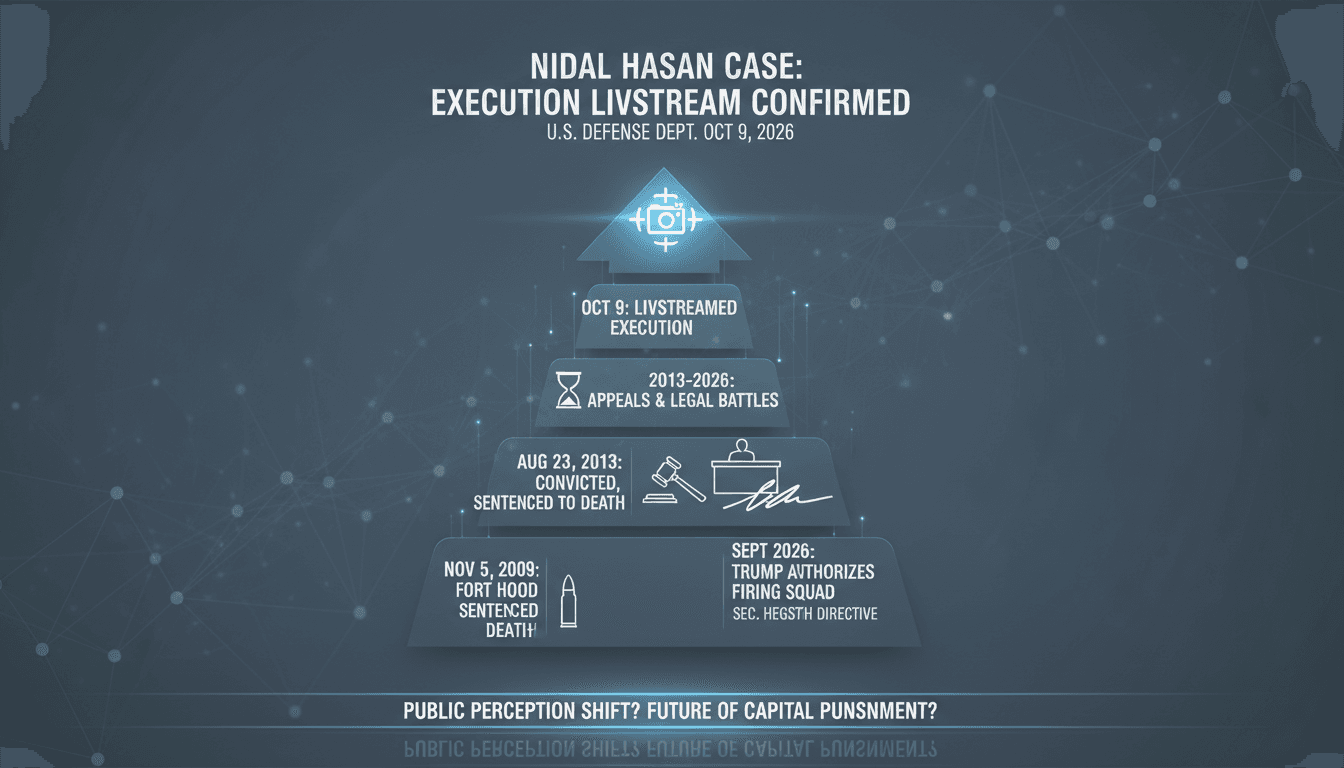
- On October 9, 2026, the U.S. Department of Defense confirmed plans to livestream the execution of Nidal Hasan, scheduled for December 3, 2026.
- Defense Secretary Pete Hegseth announced the decision, which has drawn bipartisan condemnation from lawmakers and international observers.
- President Donald Trump approved the use of a firing squad method, marking the first military execution since 1961.
The context you actually need
- Nidal Hasan was convicted in 2013 for a mass shooting at Fort Hood in 2009, resulting in 13 deaths and 32 injuries.
- The U.S. military has not executed anyone since 1961, and the last firing squad execution occurred in 1945.
- The geopolitical climate in 2026 reflects a broader push by the Trump administration to expand capital punishment methods.
What's really happening
The decision to livestream Nidal Hasan's execution is a significant departure from traditional military practices and raises complex ethical and legal questions. Historically, the U.S. military has refrained from public executions, with the last instance occurring over 80 years ago. This shift is not merely procedural; it reflects a broader cultural and political landscape that is increasingly polarized on issues of justice and punishment.
The announcement by Defense Secretary Pete Hegseth came during an interview where he emphasized the need for transparency and accountability in military justice. However, the choice to broadcast the execution has been met with fierce criticism. Lawmakers from both parties have condemned the plan, arguing that it could serve as a spectacle that glorifies violence and potentially aids terrorist recruitment. The United Nations has also expressed concerns, suggesting that the public nature of the execution could amount to torture, further complicating the U.S.'s standing on human rights.
The decision to use a firing squad, a method not employed by the military for decades, signals a potential shift in how the U.S. approaches capital punishment. This could set a precedent for future cases, particularly as the Trump administration has shown a willingness to expand the use of capital punishment. The implications of this decision extend beyond the immediate context of Hasan's execution; it may influence public opinion on the death penalty and military justice, potentially leading to increased scrutiny of how such cases are handled in the future.
Moreover, the livestreaming aspect introduces a new layer of media engagement with capital punishment. In an age where social media and instant broadcasting dominate, the execution could become a focal point for debates on morality, justice, and the role of the state in administering death. This could lead to a cultural shift in how society perceives executions, potentially normalizing the idea of public executions in a way that has not been seen in modern U.S. history.
As the date approaches, the execution will likely become a flashpoint for protests and discussions around the ethics of capital punishment, military justice, and the implications of public executions. The ramifications of this decision will be felt not only in the U.S. but also internationally, as observers watch how this aligns with global human rights standards.
Who feels it first (and how)
- Lawmakers: Facing pressure to respond to public sentiment and ethical concerns.
- Military personnel: May experience shifts in morale and public perception of their roles.
- Human rights organizations: Will likely ramp up advocacy efforts against capital punishment.
- Media outlets: Will cover the execution extensively, influencing public discourse.
What to watch next
- Public opinion polls: Monitoring shifts in attitudes toward capital punishment and military justice.
- Legislative responses: Watch for potential bills aimed at restricting or regulating capital punishment methods.
- International reactions: Observers will assess how this decision impacts U.S. relations with countries focused on human rights.
The execution is scheduled for December 3, 2026, and will be livestreamed.
Increased public debate and potential legislative action regarding capital punishment.
The long-term impact on U.S. military justice and public perception of executions.
Frequently Asked Questions
- Why it matters?
- This unprecedented move could reshape the discourse around capital punishment and military justice in the U.S.
- What happened (in 30 seconds)?
- On October 9, 2026, the U.S. Department of Defense confirmed plans to livestream the execution of Nidal Hasan, scheduled for December 3, 2026. Defense Secretary Pete Hegseth announced the decision, which has drawn bipartisan condemnation from lawmakers and international observers. President Donald Trump approved the use of a firing squad method, marking the first military execution since 1961.
- What's really happening?
- The decision to livestream Nidal Hasan's execution is a significant departure from traditional military practices and raises complex ethical and legal questions. Historically, the U.S. military has refrained from public executions, with the last instance occurring over 80 years ago. This shift is not merely procedural; it reflects a broader cultural and political landscape that is increasingly polarized on issues of justice and punishment. The announcement by Defense Secretary Pete Hegseth came
- Who feels it first (and how)?
- Lawmakers: Facing pressure to respond to public sentiment and ethical concerns. Military personnel: May experience shifts in morale and public perception of their roles. Human rights organizations: Will likely ramp up advocacy efforts against capital punishment. Media outlets: Will cover the execution extensively, influencing public discourse.
- What to watch next?
- Public opinion polls: Monitoring shifts in attitudes toward capital punishment and military justice. Legislative responses: Watch for potential bills aimed at restricting or regulating capital punishment methods. International reactions: Observers will assess how this decision impacts U.S. relations with countries focused on human rights.
Top international stories selected by The Guardian editors.
"The Guardian is known for its progressive editorial stance and in-depth analysis."
— A47 Editor
‘Barbaric’ firing squad livestream ordered by Pete Hegseth - The Latest
The Pentagon has announced that the execution of Nidal Hasan, a former U.S. Army psychiatrist convicted of killing 13 people during the 2009 Fort Hood shooting, will be conducted by firing squad and livestreamed on December 3, 2026. This decision, le...
International coverage from The Guardian's global desks.
"The Guardian is known for its progressive editorial stance and in-depth analysis."
— A47 Editor
Pete Hegseth’s plan to livestream execution puts US in dubious company
The Pentagon has announced that the execution of Nidal Hasan, the former U.S. Army psychiatrist convicted of killing 13 people during the 2009 Fort Hood shooting, will be conducted by firing squad and livestreamed on December 3, 2026. This decision, ...
News across North, Central, and South America including politics and economics.
"France 24 is viewed as a globally focused outlet with balanced coverage and a European perspective."
— A47 Editor
Hegseth says Fort Hood shooter's military execution will be 'livestreamed'
U.S. Secretary of Defense Pete Hegseth announced that the military execution of Nidal Malik Hasan, the Fort Hood shooter, will be livestreamed, marking a significant event in U.S. military history. The execution is scheduled for December 3, 2026, and...