
CFTC Redefines Swaps to Include Event Contracts on Prediction Markets
Why it matters
This redefinition clarifies federal oversight of prediction markets, potentially stabilizing a fragmented regulatory landscape.
What happened (in 30 seconds)
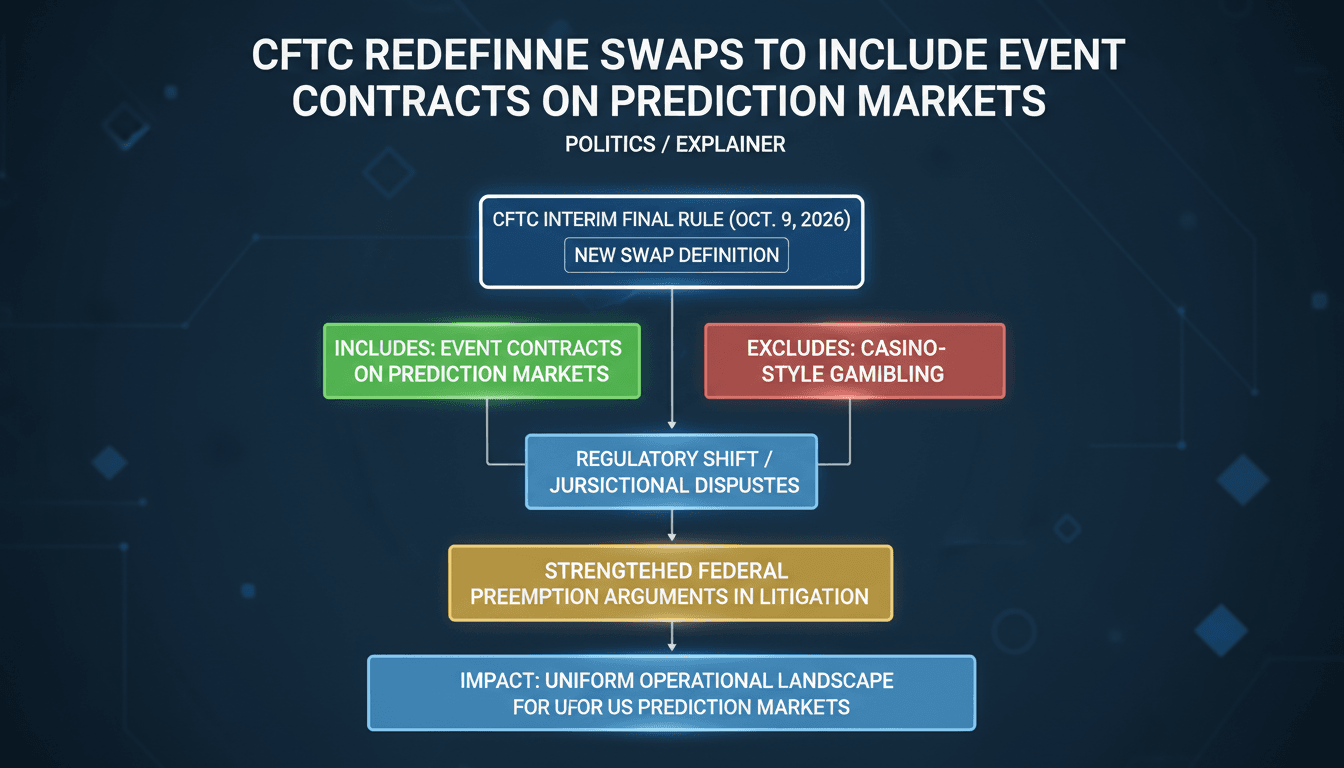
- On October 9, 2026, the CFTC issued an Interim Final Rule redefining 'swap' to include event contracts on prediction markets.
- Casino-style gambling products are explicitly excluded from this definition, aiming to differentiate regulated markets from illegal gambling.
- Public comments on the proposed rule are open for 30 days, inviting feedback from stakeholders.
The context you actually need
- Prediction markets have faced legal challenges from various states, complicating their operational landscape and leading to lawsuits.
- The CFTC has historically claimed jurisdiction over these markets, but state-level gambling laws have created conflicts and uncertainty.
- Trading volume on major prediction markets reached $24 billion in April 2026, highlighting the significant economic activity at stake.
What's really happening
The U.S. Commodity Futures Trading Commission (CFTC) is taking decisive action to clarify its jurisdiction over prediction markets by redefining the term 'swap' under the Commodity Exchange Act. This move comes in response to ongoing jurisdictional disputes between federal authorities and various states, which have challenged the legality of prediction markets like Kalshi and Polymarket. By classifying event contracts related to sports, politics, culture, and weather as swaps, the CFTC aims to establish a clear regulatory framework that preempts state gambling laws.
The Interim Final Rule, effective upon publication in the Federal Register, explicitly excludes casino-style gambling products, such as traditional sports betting and casino games, from the swap definition. This distinction is crucial as it delineates the boundaries between regulated prediction markets and unregulated gambling activities. The CFTC's actions are designed to protect the integrity of prediction markets while ensuring that they operate under federal oversight, thus providing a more stable environment for traders and investors.
The CFTC's decision to submit these rules to the White House Office of Information and Regulatory Affairs on September 28, 2026, indicates a proactive approach to regulatory clarity. The proposed rule is open for public comment for 30 days, allowing stakeholders—including prediction market platforms, state officials, and exchanges—to voice their opinions. This feedback period is critical as it may influence the final adoption of the rules and the future landscape of prediction markets.
As the CFTC seeks to solidify its jurisdiction, it also aims to strengthen its arguments in ongoing litigation regarding federal preemption. The outcome of this regulatory shift could have far-reaching implications, potentially leading to a Supreme Court review of the jurisdictional conflicts that have arisen. While no immediate market closures or significant price movements have been reported, the clarity provided by the CFTC may encourage more participants to engage in prediction markets, knowing they are operating within a defined legal framework.
Who feels it first (and how)
- Prediction market platforms like Kalshi and Polymarket will need to adapt their operations to comply with new regulations.
- Traders and investors in prediction markets may experience changes in available products and trading conditions.
- State regulators will have to reassess their enforcement strategies regarding prediction markets in light of federal jurisdiction.
What to watch next
- Public comments: The feedback received during the 30-day comment period will shape the final rules and could influence market operations.
- Litigation outcomes: Ongoing lawsuits regarding state versus federal jurisdiction may lead to significant legal precedents affecting prediction markets.
- Market reactions: Watch for shifts in trading volumes and platform adaptations as the regulatory landscape becomes clearer.
The CFTC has redefined 'swap' to include event contracts on prediction markets.
Increased federal oversight will stabilize the prediction market landscape and may lead to more participants.
The long-term impact on state-level gambling laws and how they will interact with federal regulations remains to be seen.
Frequently Asked Questions
- Why it matters?
- This redefinition clarifies federal oversight of prediction markets, potentially stabilizing a fragmented regulatory landscape.
- What happened (in 30 seconds)?
- On October 9, 2026, the CFTC issued an Interim Final Rule redefining 'swap' to include event contracts on prediction markets. Casino-style gambling products are explicitly excluded from this definition, aiming to differentiate regulated markets from illegal gambling. Public comments on the proposed rule are open for 30 days, inviting feedback from stakeholders.
- What's really happening?
- The U.S. Commodity Futures Trading Commission (CFTC) is taking decisive action to clarify its jurisdiction over prediction markets by redefining the term 'swap' under the Commodity Exchange Act. This move comes in response to ongoing jurisdictional disputes between federal authorities and various states, which have challenged the legality of prediction markets like Kalshi and Polymarket. By classifying event contracts related to sports, politics, culture, and weather as swaps, the CFTC aims to e
- Who feels it first (and how)?
- Prediction market platforms like Kalshi and Polymarket will need to adapt their operations to comply with new regulations. Traders and investors in prediction markets may experience changes in available products and trading conditions. State regulators will have to reassess their enforcement strategies regarding prediction markets in light of federal jurisdiction.
- What to watch next?
- Public comments: The feedback received during the 30-day comment period will shape the final rules and could influence market operations. Litigation outcomes: Ongoing lawsuits regarding state versus federal jurisdiction may lead to significant legal precedents affecting prediction markets. Market reactions: Watch for shifts in trading volumes and platform adaptations as the regulatory landscape becomes clearer.
Research, news, and analysis on blockchain startups, DeFi, and regulations.
"Crypto Briefing provides research, news, and analysis on blockchain startups, DeFi, and crypto regulations with investor-focused coverage."
— A47 Editor
CFTC proposes new swap definition to regulate prediction markets
The Commodity Futures Trading Commission (CFTC) has proposed a new definition for swaps aimed at regulating prediction markets, which could significantly alter their operational landscape and jurisdiction. This proposal is part of a broader initiativ...
Covers blockchain, cryptocurrency news, project analysis, and market insights.
"CoinDesk is a well-established cryptocurrency and blockchain news provider, offering comprehensive insights, market data, and industry research."
— A47 Editor
U.S. CFTC moves to fold event contracts into swaps regulations as legal fight rages
The U.S. Commodity Futures Trading Commission (CFTC) is proposing a formal rule to classify certain event contracts traded on platforms like Kalshi as swaps, which would bring them under the agency's regulatory oversight. This move comes amid ongoing...
Markets desk coverage, trading insights, and investor updates.
"WSJ’s markets reporting provides in-depth analysis and context for investors."
— A47 Editor
CFTC Proposes to Expand Definition of Swaps to Include Prediction Markets Trading
The Commodity Futures Trading Commission (CFTC) has proposed an expansion of the definition of swaps to include prediction markets trading, which would cover event contracts related to sports, politics, culture, and weather events. This change aims t...