
US Military to Execute Nidal Hasan by Firing Squad with Proposed Livestream Amid Widespread Condemnation
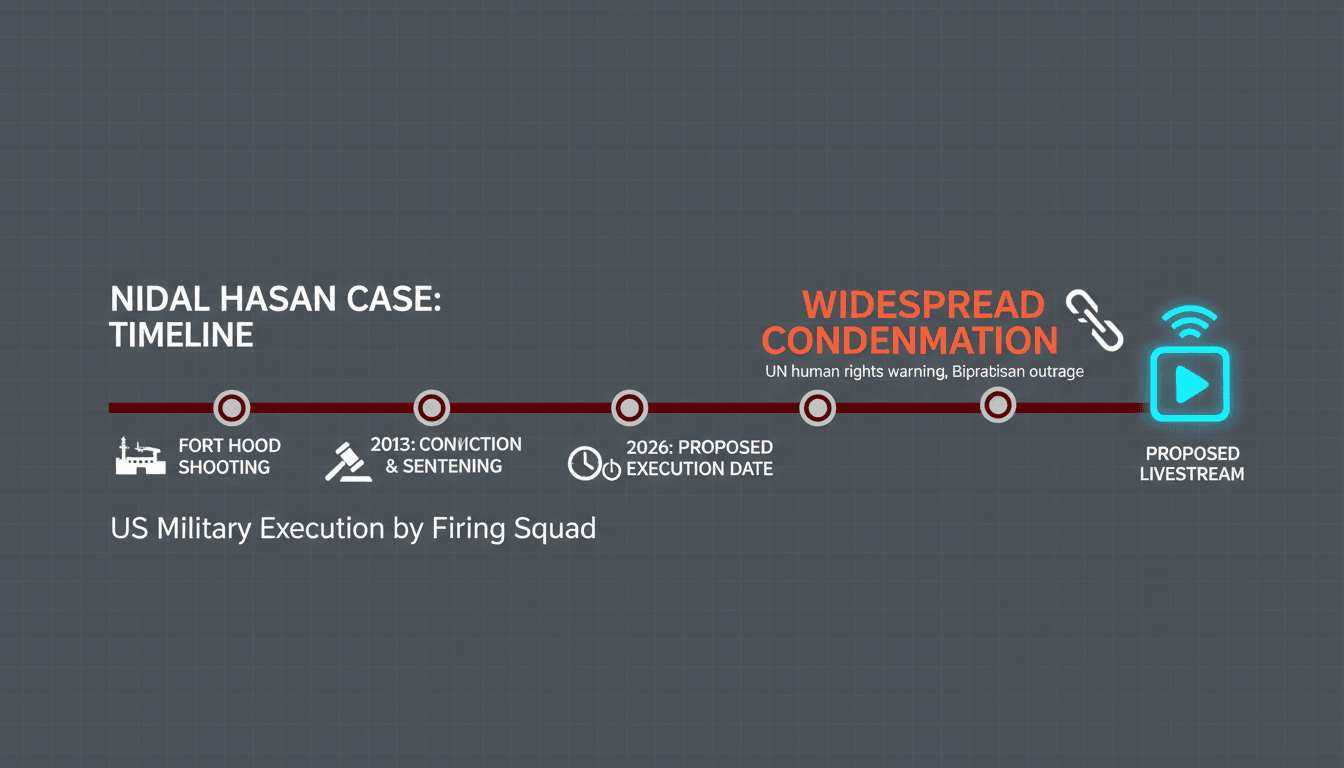
Why it matters
This execution could set a precedent for military justice and public executions, influencing international norms around capital punishment.
What happened (in 30 seconds)
- The Pentagon announced plans to execute Nidal Hasan by firing squad on December 3, 2026, at Fort Hood, Texas.
- President Trump approved the execution and a proposed livestream, aiming to deter future attacks.
- Bipartisan backlash erupted, with lawmakers and the UN condemning the potential broadcast as a violation of human rights.
The context you actually need
- Nidal Hasan was convicted in 2013 for the 2009 Fort Hood shooting, which killed 13 people and injured 32.
- This execution would be the first military execution in the U.S. since 1961, reviving the firing squad method.
- Legal challenges are ongoing regarding the livestream, with social media platforms indicating they may refuse to host the content.
What's really happening
The U.S. military's decision to execute Nidal Hasan by firing squad and the proposal to livestream the event has ignited a firestorm of controversy. This situation is not merely about one individual; it reflects broader societal and ethical dilemmas surrounding capital punishment, particularly in a military context. The Pentagon's rationale for the livestream is rooted in a desire to deter future acts of violence, suggesting that public executions could serve as a warning to potential offenders. However, this approach raises significant moral questions about the nature of justice and the role of the state in administering punishment.
The backlash from both sides of the political aisle indicates a deep-seated concern about the implications of such a public execution. Critics argue that broadcasting an execution could be seen as a spectacle, akin to practices employed by authoritarian regimes, and could inadvertently serve as a recruitment tool for terrorist organizations. The United Nations has weighed in, asserting that the proposed livestream could constitute torture and violate international human rights standards. This condemnation highlights the potential for the U.S. to be viewed as undermining its own commitments to human rights.
Moreover, the execution's timing—scheduled for December 3, 2026, at 1 p.m., near the anniversary of the original attack—adds a layer of symbolic significance that could amplify public interest and outrage. The decision to use a firing squad, a method not employed in the U.S. military for over six decades, further complicates the narrative. It raises questions about the evolving standards of military justice and the implications for future cases.
As the execution date approaches, legal challenges are likely to intensify. The final decision on whether the livestream will proceed remains pending, with various stakeholders, including social media platforms, expressing reluctance to host graphic content. This uncertainty adds a layer of complexity to an already fraught situation, as public opinion continues to shift in response to the unfolding events.
Who feels it first (and how)
- Human rights advocates: They are concerned about the implications for global human rights standards and the potential normalization of public executions.
- Military personnel: Those involved in the execution process may face ethical dilemmas and psychological impacts from participating in such a high-profile case.
- Political leaders: Lawmakers from both parties are feeling pressure to respond to constituents' concerns about the morality and legality of the execution and its broadcast.
What to watch next
- Legal challenges: Watch for ongoing court cases that may impact the execution and the proposed livestream, as these could set significant legal precedents.
- Public opinion shifts: Monitor how public sentiment evolves as the execution date approaches, particularly in response to media coverage and political discourse.
- International reactions: Keep an eye on how foreign governments and human rights organizations respond, as their reactions could influence U.S. policy and international relations.
Nidal Hasan was convicted for the 2009 Fort Hood shooting, resulting in 13 deaths.
Legal challenges to the livestream will continue, potentially delaying or altering the execution plans.
The final decision on whether the livestream will occur remains uncertain amid ongoing political and legal debates.
Frequently Asked Questions
- Why it matters?
- This execution could set a precedent for military justice and public executions, influencing international norms around capital punishment.
- What happened (in 30 seconds)?
- The Pentagon announced plans to execute Nidal Hasan by firing squad on December 3, 2026, at Fort Hood, Texas. President Trump approved the execution and a proposed livestream, aiming to deter future attacks. Bipartisan backlash erupted, with lawmakers and the UN condemning the potential broadcast as a violation of human rights.
- What's really happening?
- The U.S. military's decision to execute Nidal Hasan by firing squad and the proposal to livestream the event has ignited a firestorm of controversy. This situation is not merely about one individual; it reflects broader societal and ethical dilemmas surrounding capital punishment, particularly in a military context. The Pentagon's rationale for the livestream is rooted in a desire to deter future acts of violence, suggesting that public executions could serve as a warning to potential offenders.
- Who feels it first (and how)?
- Human rights advocates: They are concerned about the implications for global human rights standards and the potential normalization of public executions. Military personnel: Those involved in the execution process may face ethical dilemmas and psychological impacts from participating in such a high-profile case. Political leaders: Lawmakers from both parties are feeling pressure to respond to constituents' concerns about the morality and legality of the execution and its broadcast.
- What to watch next?
- Legal challenges: Watch for ongoing court cases that may impact the execution and the proposed livestream, as these could set significant legal precedents. Public opinion shifts: Monitor how public sentiment evolves as the execution date approaches, particularly in response to media coverage and political discourse. International reactions: Keep an eye on how foreign governments and human rights organizations respond, as their reactions could influence U.S. policy and international relations.
Jordanian news and regional updates.
"Roya News is a Jordanian outlet focused on breaking news and local affairs."
— A47 Editor
إعدام بالرصاص وبث مباشر.. خطة بث إعدام نضال حسن تشعل غضبا سياسيا وأمميا في واشنطن
The planned live broadcast of the execution of Nidal Hassan has sparked significant political and international outrage in Washington, highlighting the contentious nature of capital punishment and its implications for human rights. The announcement h...
Arabic-language sports reporting covering UAE competitions and major international events.
"Emarat Al Youm sports coverage is mainstream and accessible, with strong emphasis on UAE and regional sport."
— A47 Editor
كان طبيباً نفسياً وضابطاً في الجيش .. أمريكا تقرر إعدام "نضال حسن" في بث مباشر على التلفزيون كان طبيباً نفسياً وضابطاً في الجيش .. أمريكا تقرر إعدام "نضال حسن" في بث مباشر على التلفزيون
The U.S. Department of Defense announced the execution of Nidal Malik Hasan, a former army officer and psychiatrist, who was convicted of killing 13 people in a shooting at Fort Hood. The execution is set to be broadcast live on television, marking a...
Arabic-language coverage of political affairs and current events.
"Okaz political coverage typically follows mainstream Saudi framing on national and regional affairs."
— A47 Editor
البنتاغون يعلن بث إعدام منفذ هجوم «فورت هود» رمياً بالرصاص
The Pentagon announced that the execution of Nidal Malik Hasan, convicted for the 2009 Fort Hood shooting, will be broadcast live, raising legal and ethical questions about public executions. Hasan, a former Army psychiatrist, is set to become the fi...
Arabic-language coverage of international news and geopolitics.
"RT Arabic is a Russian state-funded outlet often criticized for promoting Kremlin-aligned narratives."
— A47 Editor
الجيش الأميركي يعتزم بث تنفيذ حكم الإعدام بحق نضال حسن على الهواء مباشرة
The U.S. Army plans to broadcast the execution of U.S. Army Major Nidal Hasan, who was convicted of killing 13 people at Fort Hood, Texas, in 2009, live online on December 3. This decision marks a significant moment in the ongoing discourse surroundi...