
US Department of Defense Plans Livestreamed Execution of Nidal Hasan Amid Backlash
Why it matters
This unprecedented move by the US Department of Defense could redefine the boundaries of military justice and public accountability.
What happened (in 30 seconds)
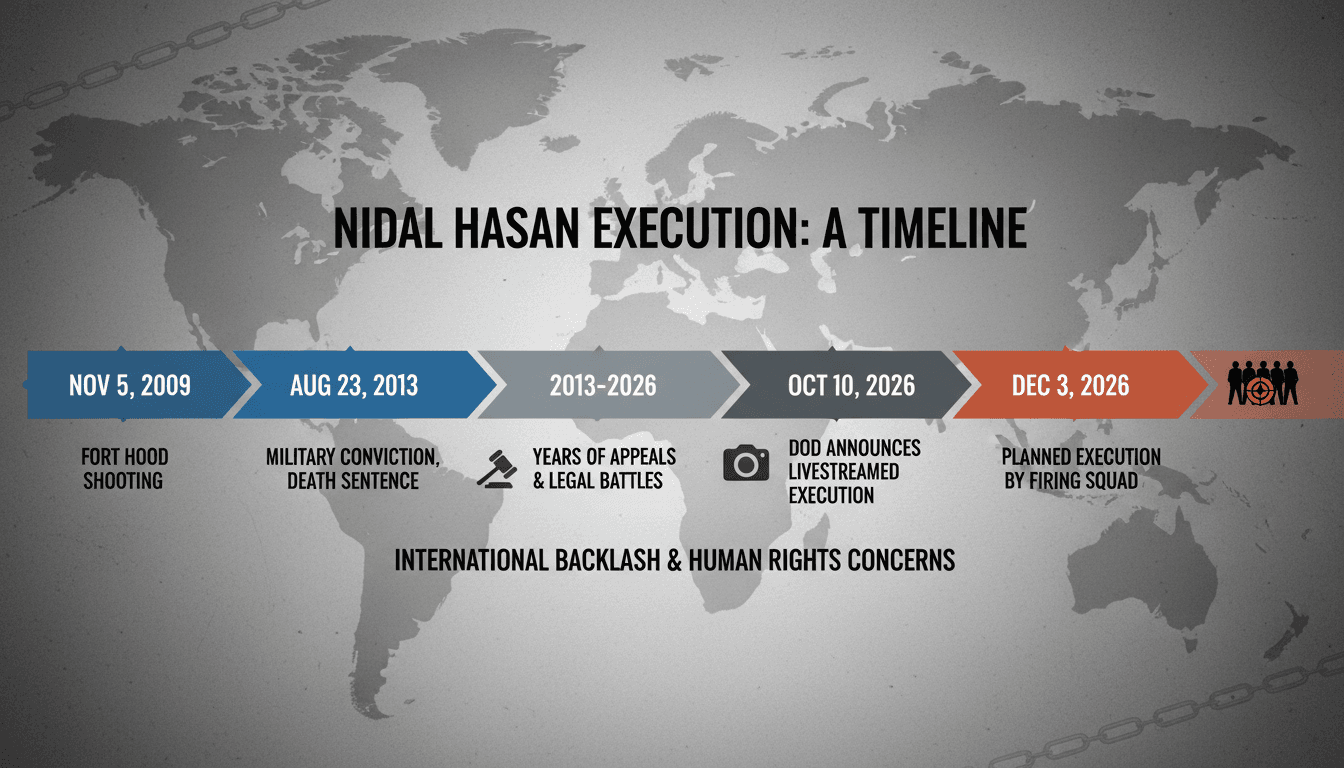
- On October 9, 2026, the US Department of Defense announced plans to execute Nidal Hasan by firing squad on December 3, 2026, at Fort Hood, Texas.
- The execution will be livestreamed, a decision that has sparked bipartisan backlash and condemnation from human rights organizations.
- Hasan was convicted in 2013 for the 2009 Fort Hood shooting, which resulted in 13 deaths and 32 injuries.
The context you actually need
- Nidal Hasan's case is significant as it marks the first military execution in the US since 1961, highlighting a shift in military justice practices.
- The livestreaming aspect is unprecedented and raises concerns about the desensitization to violence and the ethical implications of public executions.
- Bipartisan opposition from US lawmakers indicates a growing unease about the implications of such a public spectacle on the perception of justice.
What's really happening
The announcement of Nidal Hasan's execution by firing squad, coupled with plans for a livestream, marks a significant departure from traditional methods of capital punishment in the US military. Historically, the military has not conducted executions since 1961, and the last firing squad execution occurred during World War II. This shift reflects a broader trend within the military justice system, where the Pentagon is increasingly willing to adopt more public and potentially sensational methods of punishment.
Defense Secretary Pete Hegseth's endorsement of the livestream is framed as a deterrent against future attacks, suggesting that the military seeks to leverage the execution as a symbolic act of justice. However, this rationale has been met with immediate bipartisan criticism. Lawmakers from both parties have condemned the decision, labeling it as barbaric and reminiscent of authoritarian regimes. The UN High Commissioner for Human Rights has also warned that the public nature of the execution could breach international prohibitions against torture and inhumane treatment.
The decision to livestream the execution raises ethical questions about the role of media in capital punishment. Social media platforms have indicated they may refuse to host graphic content, which could complicate the Pentagon's plans. This situation reflects a growing tension between the military's desire for transparency and accountability and the public's right to be shielded from graphic violence.
Moreover, the execution's timing, set to coincide with the anniversary of the 2009 Fort Hood shooting, adds a layer of complexity. It serves as a reminder of the tragic event while also potentially reopening wounds for victims' families and the broader community. The backlash from human rights organizations and legal experts underscores the potential for this execution to set a dangerous precedent in how justice is administered and perceived.
As the execution date approaches, legal challenges are likely to arise, further complicating the Pentagon's plans. The bipartisan opposition suggests that there may be significant political ramifications, potentially influencing future policies on capital punishment within the military and beyond.
Who feels it first (and how)
- US lawmakers: Facing pressure to respond to public sentiment and human rights concerns.
- Human rights organizations: Engaging in advocacy against the execution and its public nature.
- Military personnel: Grappling with the implications of a public execution on military ethics and justice.
- Victims' families: Re-experiencing trauma associated with the original shooting and the execution's public nature.
What to watch next
- Legal challenges: Monitor any court rulings that could delay or halt the execution, which would impact public and political discourse.
- Public opinion shifts: Watch for changes in public sentiment regarding capital punishment as the execution date approaches, particularly in response to the livestreaming aspect.
- International reactions: Keep an eye on how global human rights organizations respond, as their actions could influence US policy on capital punishment.
Nidal Hasan is scheduled for execution on December 3, 2026, pending legal challenges.
Bipartisan opposition will continue to grow, potentially influencing future military justice policies.
The final decision on whether the execution will be livestreamed remains pending, as social media platforms may refuse to host the content.
Frequently Asked Questions
- Why it matters?
- This unprecedented move by the US Department of Defense could redefine the boundaries of military justice and public accountability.
- What happened (in 30 seconds)?
- On October 9, 2026, the US Department of Defense announced plans to execute Nidal Hasan by firing squad on December 3, 2026, at Fort Hood, Texas. The execution will be livestreamed, a decision that has sparked bipartisan backlash and condemnation from human rights organizations. Hasan was convicted in 2013 for the 2009 Fort Hood shooting, which resulted in 13 deaths and 32 injuries.
- What's really happening?
- The announcement of Nidal Hasan's execution by firing squad, coupled with plans for a livestream, marks a significant departure from traditional methods of capital punishment in the US military. Historically, the military has not conducted executions since 1961, and the last firing squad execution occurred during World War II. This shift reflects a broader trend within the military justice system, where the Pentagon is increasingly willing to adopt more public and potentially sensational methods
- Who feels it first (and how)?
- US lawmakers: Facing pressure to respond to public sentiment and human rights concerns. Human rights organizations: Engaging in advocacy against the execution and its public nature. Military personnel: Grappling with the implications of a public execution on military ethics and justice. Victims' families: Re-experiencing trauma associated with the original shooting and the execution's public nature.
- What to watch next?
- Legal challenges: Monitor any court rulings that could delay or halt the execution, which would impact public and political discourse. Public opinion shifts: Watch for changes in public sentiment regarding capital punishment as the execution date approaches, particularly in response to the livestreaming aspect. International reactions: Keep an eye on how global human rights organizations respond, as their actions could influence US policy on capital punishment.
Jordanian news and regional updates.
"Roya News is a Jordanian outlet focused on breaking news and local affairs."
— A47 Editor
إعدام بالرصاص وبث مباشر.. خطة بث إعدام نضال حسن تشعل غضبا سياسيا وأمميا في واشنطن
The planned live broadcast of the execution of Nidal Hassan has sparked significant political and international outrage in Washington, highlighting the contentious nature of capital punishment and its implications for human rights. The announcement h...
Arabic-language sports reporting covering UAE competitions and major international events.
"Emarat Al Youm sports coverage is mainstream and accessible, with strong emphasis on UAE and regional sport."
— A47 Editor
كان طبيباً نفسياً وضابطاً في الجيش .. أمريكا تقرر إعدام "نضال حسن" في بث مباشر على التلفزيون كان طبيباً نفسياً وضابطاً في الجيش .. أمريكا تقرر إعدام "نضال حسن" في بث مباشر على التلفزيون
The U.S. Department of Defense announced the execution of Nidal Malik Hasan, a former army officer and psychiatrist, who was convicted of killing 13 people in a shooting at Fort Hood. The execution is set to be broadcast live on television, marking a...
Arabic-language coverage of international news and geopolitics.
"RT Arabic is a Russian state-funded outlet often criticized for promoting Kremlin-aligned narratives."
— A47 Editor
الجيش الأميركي يعتزم بث تنفيذ حكم الإعدام بحق نضال حسن على الهواء مباشرة
The U.S. Army plans to broadcast the execution of U.S. Army Major Nidal Hasan, who was convicted of killing 13 people at Fort Hood, Texas, in 2009, live online on December 3. This decision marks a significant moment in the ongoing discourse surroundi...