
US Military to Execute Nidal Hasan by Firing Squad in First Public Execution Since 1936
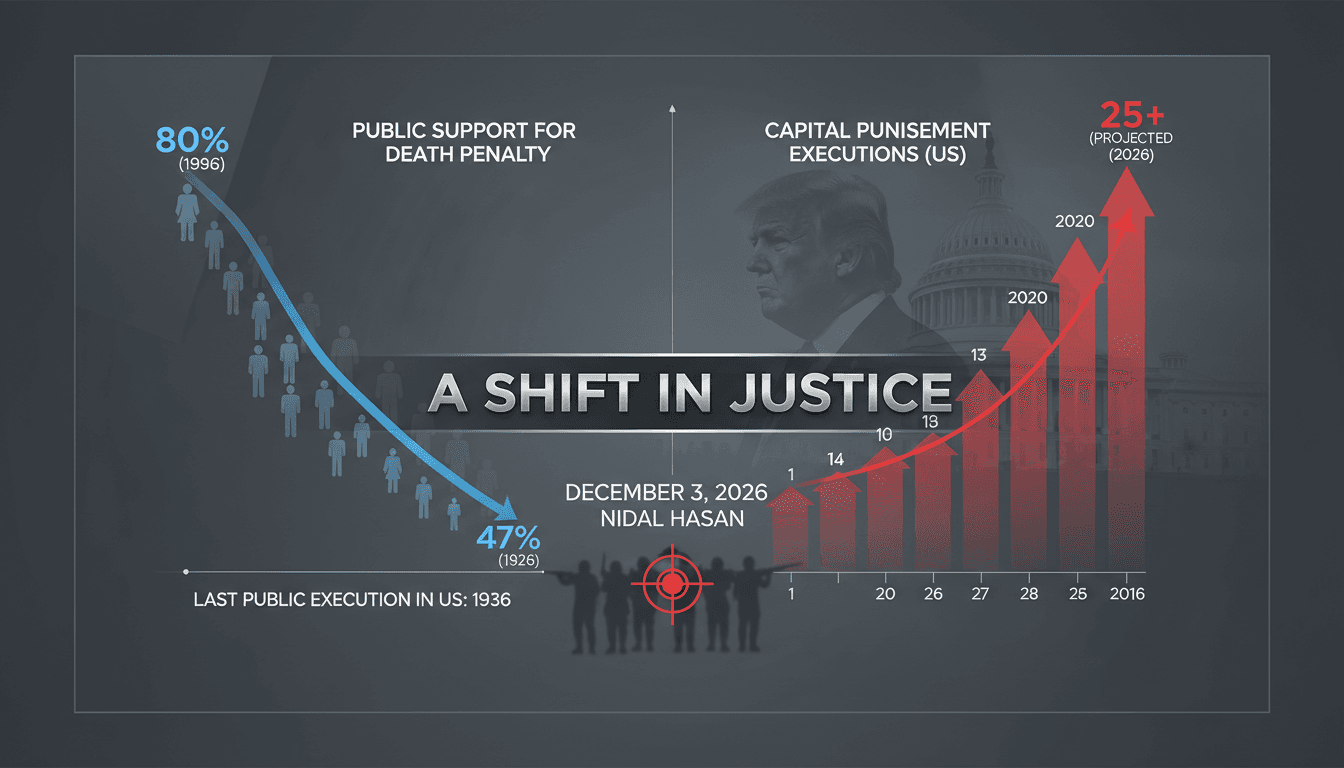
Why it matters
This decision marks a significant shift in the U.S. approach to capital punishment, reflecting deeper societal divisions and the evolving role of the military in public life.
What happened (in 30 seconds)
- On October 9-11, 2026, U.S. Defense Secretary Pete Hegseth announced the execution of Nidal Hasan by firing squad, scheduled for December 3, 2026.
- This will be the first public execution in the U.S. since 1936, with plans to livestream the event, raising ethical and legal concerns.
- The announcement coincides with a broader resurgence of capital punishment under the second Trump administration, amid increasing political polarization.
The context you actually need
- Public executions in the U.S. largely ended in the 1930s as states moved towards more humane methods of execution.
- Support for the death penalty has declined from approximately 80% in 1994 to 52% currently, indicating shifting public sentiment.
- The execution of Hasan follows a rise in executions during Trump's second term, highlighting a renewed emphasis on capital punishment as a deterrent.
What's really happening
The decision to execute Nidal Hasan publicly is rooted in a complex interplay of political, social, and legal factors. Hasan, a former U.S. Army major, was convicted for the 2009 Fort Hood shooting that resulted in 13 deaths and numerous injuries. His case has remained a focal point in discussions about military justice and the implications of violent acts against service members.
The announcement by Defense Secretary Pete Hegseth reflects a broader strategy by the Trump administration to reinforce a tough stance on crime and violence, particularly in a politically polarized environment. By choosing to livestream the execution, the military aims to underscore the consequences of such violent acts, potentially appealing to a segment of the population that supports capital punishment as a deterrent.
However, this move has sparked significant backlash. Critics, including religious leaders and human rights organizations, have condemned the decision as barbaric and inhumane. The United Nations has raised concerns that livestreaming the execution could constitute cruel and degrading treatment. This criticism highlights the ethical dilemmas surrounding public executions and the potential for them to be perceived as entertainment rather than a solemn judicial process.
The execution is also expected to face legal challenges regarding its constitutionality and the implications of broadcasting such an event. The Pentagon's confirmation of the livestream indicates a willingness to navigate these challenges, suggesting a shift in how the military perceives its role in public life and justice.
As public sentiment towards the death penalty continues to evolve, the implications of this execution extend beyond the immediate case of Hasan. It raises questions about the future of capital punishment in the U.S., the role of the military in civilian justice, and the societal values that underpin these decisions. The decision to revive public executions could set a precedent that influences how justice is administered and perceived in the years to come.
Who feels it first (and how)
- Military personnel: Increased scrutiny on military justice and its public perception.
- Legal professionals: Potential shifts in capital punishment laws and practices.
- Human rights advocates: Heightened activism against capital punishment and public executions.
- General public: Varied reactions based on personal beliefs about justice and punishment.
What to watch next
- Legal challenges: Monitor court cases that may arise regarding the constitutionality of the execution and its broadcast. These could set important precedents for future capital punishment cases.
- Public opinion shifts: Watch for changes in public sentiment towards the death penalty as this execution unfolds, particularly in response to the livestreaming aspect.
- Political responses: Observe how political figures and parties react to the execution and its implications, which could influence future legislation on capital punishment.
The execution of Nidal Hasan is scheduled for December 3, 2026, and will be livestreamed.
Legal challenges will emerge regarding the execution's constitutionality and the ethics of broadcasting it.
The long-term impact on public opinion regarding capital punishment and military justice remains uncertain.
Frequently Asked Questions
- Why it matters?
- This decision marks a significant shift in the U.S. approach to capital punishment, reflecting deeper societal divisions and the evolving role of the military in public life.
- What happened (in 30 seconds)?
- On October 9-11, 2026, U.S. Defense Secretary Pete Hegseth announced the execution of Nidal Hasan by firing squad, scheduled for December 3, 2026. This will be the first public execution in the U.S. since 1936, with plans to livestream the event, raising ethical and legal concerns. The announcement coincides with a broader resurgence of capital punishment under the second Trump administration, amid increasing political polarization.
- What's really happening?
- The decision to execute Nidal Hasan publicly is rooted in a complex interplay of political, social, and legal factors. Hasan, a former U.S. Army major, was convicted for the 2009 Fort Hood shooting that resulted in 13 deaths and numerous injuries. His case has remained a focal point in discussions about military justice and the implications of violent acts against service members. The announcement by Defense Secretary Pete Hegseth reflects a broader strategy by the Trump administration to rein
- Who feels it first (and how)?
- Military personnel: Increased scrutiny on military justice and its public perception. Legal professionals: Potential shifts in capital punishment laws and practices. Human rights advocates: Heightened activism against capital punishment and public executions. General public: Varied reactions based on personal beliefs about justice and punishment.
- What to watch next?
- Legal challenges: Monitor court cases that may arise regarding the constitutionality of the execution and its broadcast. These could set important precedents for future capital punishment cases. Public opinion shifts: Watch for changes in public sentiment towards the death penalty as this execution unfolds, particularly in response to the livestreaming aspect. Political responses: Observe how political figures and parties react to the execution and its implications, which could influence fut
Arabic-language reporting on global and regional news.
"BBC Arabic is part of the BBC, generally regarded for editorial standards and broad international coverage."
— A47 Editor
لماذا يعود الإعدام العلني إلى الولايات المتحدة بعد نحو قرن من إيقافه؟
The announcement by the U.S. Secretary of Defense regarding a live-streamed execution of Nidal Hasan has sparked significant criticism and controversy, marking a potential return of public executions in the United States nearly a century after they w...
Pan-Arab political news and analysis.
"Al-Quds Al-Arabi is a London-based Arabic newspaper known for political coverage."
— A47 Editor
استياء متصاعد من خطة لبث مباشر لعملية إعدام رميا بالرصاص ينفذها الجيش الأمريكي
Rising discontent has emerged regarding U.S. plans to publicly execute Nidal Hassan by firing squad, following Vice President J.D. Vance's skepticism about the proposed live broadcast of the event. Vance stated he would not watch the execution, refle...
Jordanian news and regional updates.
"Roya News is a Jordanian outlet focused on breaking news and local affairs."
— A47 Editor
إعدام بالرصاص وبث مباشر.. خطة بث إعدام نضال حسن تشعل غضبا سياسيا وأمميا في واشنطن
The planned live broadcast of the execution of Nidal Hassan has sparked significant political and international outrage in Washington, highlighting the contentious nature of capital punishment and its implications for human rights. The announcement h...