
U.S. Government Assumes Control Over SpaceX's Starshield Satellite Network
Why it matters
Starshield's control by the U.S. government signals a shift in how national security and commercial satellite services intersect.
What happened (in 30 seconds)
- On October 15, 2026, the Wall Street Journal reported on Starshield, SpaceX's secure satellite network for U.S. government use.
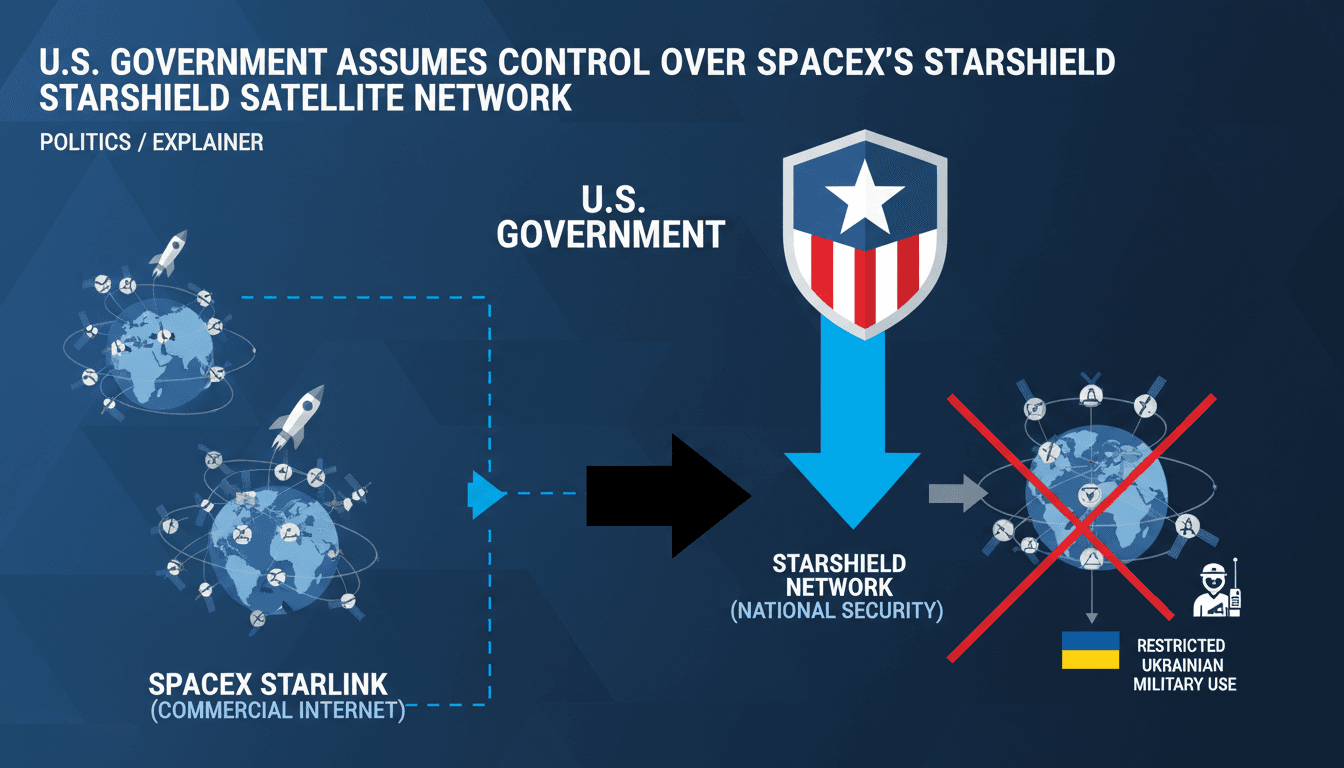
- The U.S. government asserts ownership and operational control, implementing restrictions on Ukrainian military access.
- Starshield utilizes adapted Starlink technology for secure communications and reconnaissance missions.
The context you actually need
- Starshield emerged after the 2022 Ukraine invasion, evolving from commercial Starlink services to a classified government program.
- Musk clarified that the U.S. government controls Starshield, with military authorities dictating usage limits.
- The network supports various applications, including secure communications and Earth observation, in collaboration with defense contractors.
What's really happening
Starshield represents a significant evolution in the relationship between commercial satellite technology and government oversight. Initially launched as part of SpaceX's Starlink project in 2019, the system was designed to provide broadband services to consumers. However, the geopolitical landscape shifted dramatically following Russia's invasion of Ukraine in 2022. Ukrainian forces leveraged Starlink terminals for critical communications, which highlighted the potential of satellite technology in modern warfare.
In response to these developments, Starshield was created as a distinct program tailored for classified government applications. This transition involved enhancing security features and separating procurement processes from the commercial Starlink offerings. The U.S. government now asserts ownership and operational control over Starshield, which has led to recent restrictions on its use, particularly concerning Ukrainian military operations.
In mid-October 2026, the Pentagon and White House directed limitations on terminal speeds for Ukrainian systems, reducing them to under 100 mph. This decision was framed as a necessary measure to maintain operational security and prevent misuse of the technology. Musk's public statements emphasized that these restrictions were not at his discretion but were mandated by U.S. military authorities.
The implications of this shift are profound. Starshield's architecture allows for secure communications, Earth observation, and missile-warning capabilities, all of which are critical for national security. The network operates through user terminals that communicate with low-Earth-orbit satellites, which then relay data to secure ground stations. This structure ensures that sensitive information is protected and only accessible to authorized government networks.
Moreover, the operational control by the U.S. government raises questions about the future of commercial satellite services. As Starshield becomes more entrenched in national security operations, the distinction between commercial and government-controlled satellite services may blur. This could lead to increased scrutiny and regulation of commercial satellite technologies, impacting businesses that rely on these services for their operations.
The market response to Starshield's governance will likely involve discussions about the balance between security and accessibility. As the U.S. government tightens its grip on satellite communications, companies and organizations that depend on these technologies must adapt to a new reality where government oversight is paramount.
Who feels it first (and how)
- Defense contractors: Companies like Northrop Grumman involved in satellite technology will need to navigate new compliance and operational frameworks.
- Ukrainian military: Restrictions on Starshield usage directly impact their operational capabilities in the ongoing conflict.
- Commercial satellite users: Businesses relying on satellite communications may face increased regulations and limitations on service availability.
What to watch next
- Future restrictions: Monitor any further limitations imposed on Starshield's usage, particularly regarding international military operations.
- Market adaptations: Watch how commercial satellite providers adjust their offerings in response to government control over Starshield.
- Geopolitical developments: Keep an eye on how the situation in Ukraine evolves and its impact on U.S. satellite policy.
Starshield is operational and controlled by the U.S. government.
Further restrictions on Starshield usage will emerge as geopolitical tensions continue.
The long-term impact on commercial satellite services and market dynamics remains to be seen.
Frequently Asked Questions
- Why it matters?
- Starshield's control by the U.S. government signals a shift in how national security and commercial satellite services intersect.
- What happened (in 30 seconds)?
- On October 15, 2026, the Wall Street Journal reported on Starshield, SpaceX's secure satellite network for U.S. government use. The U.S. government asserts ownership and operational control, implementing restrictions on Ukrainian military access. Starshield utilizes adapted Starlink technology for secure communications and reconnaissance missions.
- What's really happening?
- Starshield represents a significant evolution in the relationship between commercial satellite technology and government oversight. Initially launched as part of SpaceX's Starlink project in 2019, the system was designed to provide broadband services to consumers. However, the geopolitical landscape shifted dramatically following Russia's invasion of Ukraine in 2022. Ukrainian forces leveraged Starlink terminals for critical communications, which highlighted the potential of satellite technology
- Who feels it first (and how)?
- Defense contractors: Companies like Northrop Grumman involved in satellite technology will need to navigate new compliance and operational frameworks. Ukrainian military: Restrictions on Starshield usage directly impact their operational capabilities in the ongoing conflict. Commercial satellite users: Businesses relying on satellite communications may face increased regulations and limitations on service availability.
- What to watch next?
- Future restrictions: Monitor any further limitations imposed on Starshield's usage, particularly regarding international military operations. Market adaptations: Watch how commercial satellite providers adjust their offerings in response to government control over Starshield. Geopolitical developments: Keep an eye on how the situation in Ukraine evolves and its impact on U.S. satellite policy.
Tech business coverage, major deals, product launches, and Silicon Valley trends.
"WSJ’s tech section offers authoritative reporting on the intersection of technology and business, including exclusive industry analysis."
— A47 Editor
How Does Starshield Work and Who Controls It?
SpaceX has developed Starshield, a secure network designed for government use, which plays a crucial role in supporting Ukraine's war efforts. This system offers various services that enhance communication and operational capabilities in conflict zon...
U.S. business news, corporate developments, and economy.
"The Wall Street Journal is respected for deep financial and economic reporting with a center-right editorial perspective."
— A47 Editor
How Does Starshield Work and Who Controls It?
SpaceX's Starshield, a secure satellite internet service, has been crucial for Ukraine's military communications amid the ongoing conflict with Russia. Recent reports indicate that the White House has directed SpaceX to limit its services in Ukraine,...
International stories from NPR’s global desk.
"NPR is an American public media organization known for thoughtful reporting and a slightly left-leaning editorial tone."
— A47 Editor
Ukraine says its Starshield access is back
Ukraine has announced that its access to SpaceX's Starshield system has been restored, which is crucial for its offensive drone operations against Russia. This development comes after a period of restricted access that had raised significant concerns...