
U.S. Orders Removal of DeepSeek AI from Federal Civilian Agencies
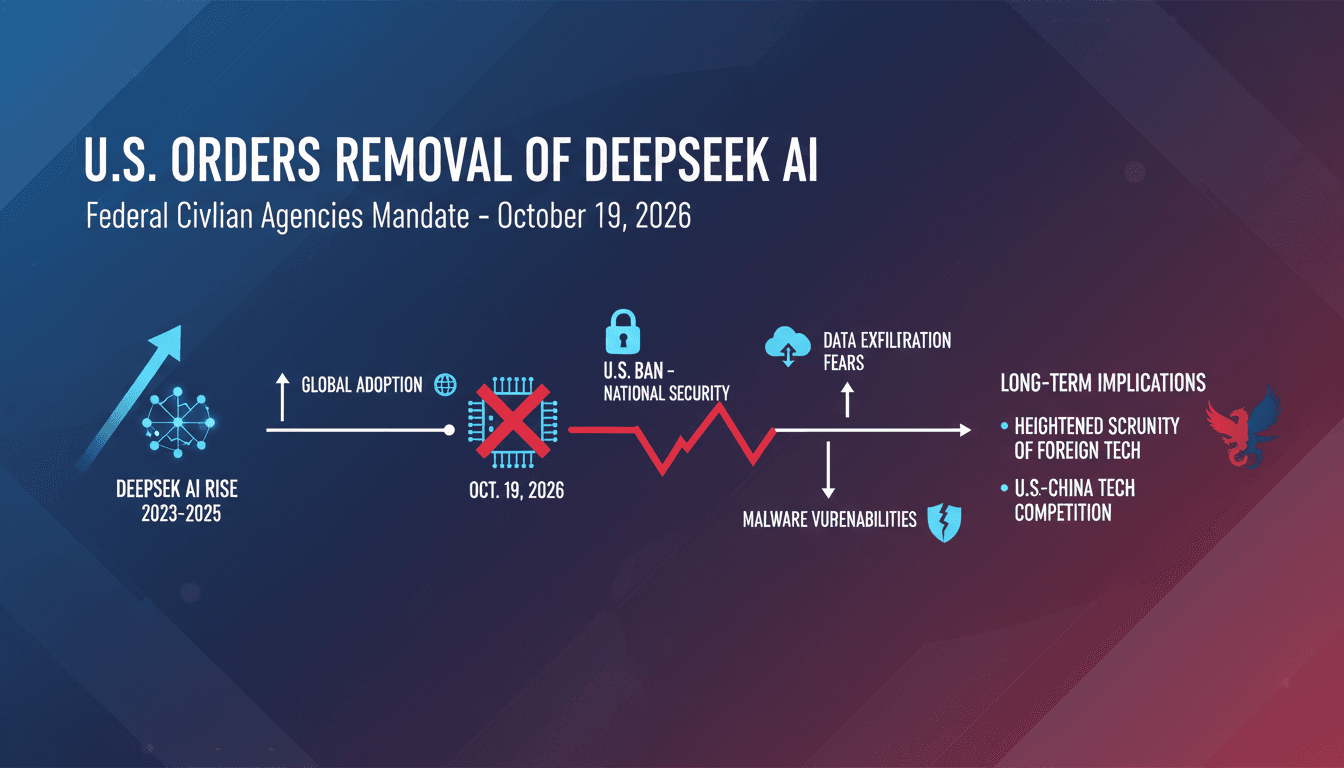
Why it matters
This action reflects escalating tensions in U.S.-China tech relations, impacting the landscape for AI technologies in federal systems.
What happened (in 30 seconds)
- On October 19, 2026, the U.S. Department of Homeland Security mandated the removal of DeepSeek AI from all federal civilian agencies.
- The directive prohibits future acquisitions of DeepSeek products, citing national security risks related to data exfiltration and malware vulnerabilities.
- This order does not affect Department of Defense systems but expands previous restrictions on DeepSeek's use in government.
The context you actually need
- DeepSeek, a Chinese AI developer, gained traction in 2025 with its R1 model, which outperformed some U.S. competitors despite hardware limitations.
- Prior actions included bans at state levels and restrictions from the Commerce Department and Navy, focusing on data privacy and security concerns.
- The current directive is part of a broader strategy to mitigate risks associated with Chinese technology firms under national security laws.
What's really happening
The U.S. Department of Homeland Security (DHS) issued the Exclusion and Removal Order 2026-01 on October 19, 2026, following a July 24 signing by Secretary Markwayne Mullin. This order mandates that all federal civilian agencies eliminate DeepSeek AI technology from their IT systems, including any affiliated tools and third-party services built on its models. The directive is rooted in concerns over national security, particularly regarding potential data exfiltration to the People's Republic of China and vulnerabilities to malware.
The DHS's decision is not an isolated incident but part of a larger narrative of escalating U.S.-China technological competition. The order reflects a growing apprehension about the implications of using Chinese technology in sensitive government operations. DeepSeek's rise in prominence, particularly with its cost-efficient R1 model, has raised alarms among U.S. officials, who fear that the technology could be exploited for data tracking or malicious activities.
The order's implications extend beyond immediate compliance. It signals a shift in how federal agencies will approach procurement, particularly concerning foreign technology. The DHS's directive is likely to influence how other sectors, including private enterprises, assess their technology partnerships. Companies that rely on DeepSeek's AI capabilities may need to pivot quickly to avoid disruptions in their operations.
Moreover, the exclusion of DeepSeek from federal systems does not just affect the company but also reverberates through the broader tech ecosystem. As U.S. agencies tighten their procurement policies, firms that develop or utilize similar technologies may face increased scrutiny. This could lead to a ripple effect, prompting other countries to reconsider their relationships with Chinese tech firms.
The DHS's order also highlights the complexities of global supply chains in technology. As nations grapple with security concerns, the landscape for AI development and deployment is likely to become more fragmented. Companies may need to invest in alternative technologies or develop in-house solutions to mitigate risks associated with foreign dependencies.
Who feels it first (and how)
- Federal agencies: They must comply with the removal order, impacting their operational capabilities.
- Tech contractors: Companies that provide services to federal agencies may need to adjust their offerings or face contract losses.
- AI developers: Firms competing with DeepSeek may see shifts in market dynamics as procurement policies evolve.
- Cybersecurity firms: Increased demand for security assessments and alternative solutions may arise as agencies seek to mitigate risks.
What to watch next
- Future procurement policies: Monitor how federal agencies adjust their technology acquisition strategies in response to this directive.
- Market reactions: Watch for shifts in the AI market, particularly among companies that may benefit from DeepSeek's exclusion.
- International responses: Observe how other countries react to the U.S. ban and whether similar actions are taken against Chinese tech firms globally.
The DHS has mandated the removal of DeepSeek AI from federal civilian agencies.
Other countries may follow suit with similar restrictions on Chinese technology.
The long-term market impact on DeepSeek and its competitors remains to be seen.
Frequently Asked Questions
- Why it matters?
- This action reflects escalating tensions in U.S.-China tech relations, impacting the landscape for AI technologies in federal systems.
- What happened (in 30 seconds)?
- On October 19, 2026, the U.S. Department of Homeland Security mandated the removal of DeepSeek AI from all federal civilian agencies. The directive prohibits future acquisitions of DeepSeek products, citing national security risks related to data exfiltration and malware vulnerabilities. This order does not affect Department of Defense systems but expands previous restrictions on DeepSeek's use in government.
- What's really happening?
- The U.S. Department of Homeland Security (DHS) issued the Exclusion and Removal Order 2026-01 on October 19, 2026, following a July 24 signing by Secretary Markwayne Mullin. This order mandates that all federal civilian agencies eliminate DeepSeek AI technology from their IT systems, including any affiliated tools and third-party services built on its models. The directive is rooted in concerns over national security, particularly regarding potential data exfiltration to the People's Republic of
- Who feels it first (and how)?
- Federal agencies: They must comply with the removal order, impacting their operational capabilities. Tech contractors: Companies that provide services to federal agencies may need to adjust their offerings or face contract losses. AI developers: Firms competing with DeepSeek may see shifts in market dynamics as procurement policies evolve. Cybersecurity firms: Increased demand for security assessments and alternative solutions may arise as agencies seek to mitigate risks.
- What to watch next?
- Future procurement policies: Monitor how federal agencies adjust their technology acquisition strategies in response to this directive. Market reactions: Watch for shifts in the AI market, particularly among companies that may benefit from DeepSeek's exclusion. International responses: Observe how other countries react to the U.S. ban and whether similar actions are taken against Chinese tech firms globally.
AI news with an enterprise and cloud focus.
"Covers AI in the context of data infrastructure, cloud, and enterprise stacks."
— A47 Editor
Trump administration orders ban on DeepSeek in federal agencies
The Trump administration has mandated the removal of artificial intelligence technology from DeepSeek Ltd. across all federal civilian agencies, citing concerns that the AI models could pose multiple threat vectors and grant the Chinese Communist Par...
Corporate news, economic trends, and markets with UK and global scope.
"BBC News is widely regarded as reputable and impartial, with a public service mandate."
— A47 Editor
US bans DeepSeek AI from government use as tech tension with China continues
The U.S. government has officially banned the use of DeepSeek, a popular and cost-effective AI model developed in China, amid ongoing technological tensions between the two nations. This decision reflects growing concerns over national security and t...
Covers consumer technology, electronics, gadgets, and product reviews.
"Engadget is a trusted source for gadget reviews and consumer tech news, known for its hands-on analysis and industry coverage."
— A47 Editor
Homeland Security bans DeepSeek use in federal civilian agencies
The U.S. Department of Homeland Security has prohibited the use of DeepSeek's AI technologies in federal civilian agencies, a decision that follows the recent launch of the company's latest AI model. This ban reflects ongoing concerns regarding the s...
Consumer technology news with AI coverage.
"Gadget and tech site reporting on AI in products."
— A47 Editor
Homeland Security bans DeepSeek use in federal civilian agencies
The U.S. Department of Homeland Security has prohibited the use of DeepSeek's AI technologies in federal civilian agencies, a decision that follows the recent launch of the company's latest AI model. This ban reflects ongoing concerns regarding the s...
Tech business coverage, major deals, product launches, and Silicon Valley trends.
"WSJ’s tech section offers authoritative reporting on the intersection of technology and business, including exclusive industry analysis."
— A47 Editor
DHS Orders DeepSeek Technology Removed From Federal Civilian IT Systems
The U.S. Department of Homeland Security (DHS) has mandated the removal of DeepSeek technology from federal civilian IT systems, prohibiting future purchases of the company's products and services, including those from its affiliates and third-party ...
Technology business and AI-related headlines.
"Data-driven tech newsroom with global scope."
— A47 Editor
DeepSeek Pushes Out Updated AI Model It Says Is Faster, Leaner
DeepSeek has released an updated AI model that it claims is faster and leaner, intensifying competition with major players like OpenAI and Anthropic PBC, as well as domestic rivals such as Moonshot Kimi and Z.ai.
Technology business news, market impacts, and innovation trends.
"Bloomberg is a premier financial and tech news provider, respected for its in-depth reporting and analytical rigor."
— A47 Editor
DeepSeek Pushes Out Updated AI Model It Says Is Faster, Leaner
DeepSeek has released an updated AI model that it claims is faster and leaner, intensifying competition with major players like OpenAI and Anthropic PBC, as well as domestic rivals such as Moonshot Kimi and Z.ai.