
China Warns US Against Expanding Outbound Investment Curbs on Sensitive Technologies
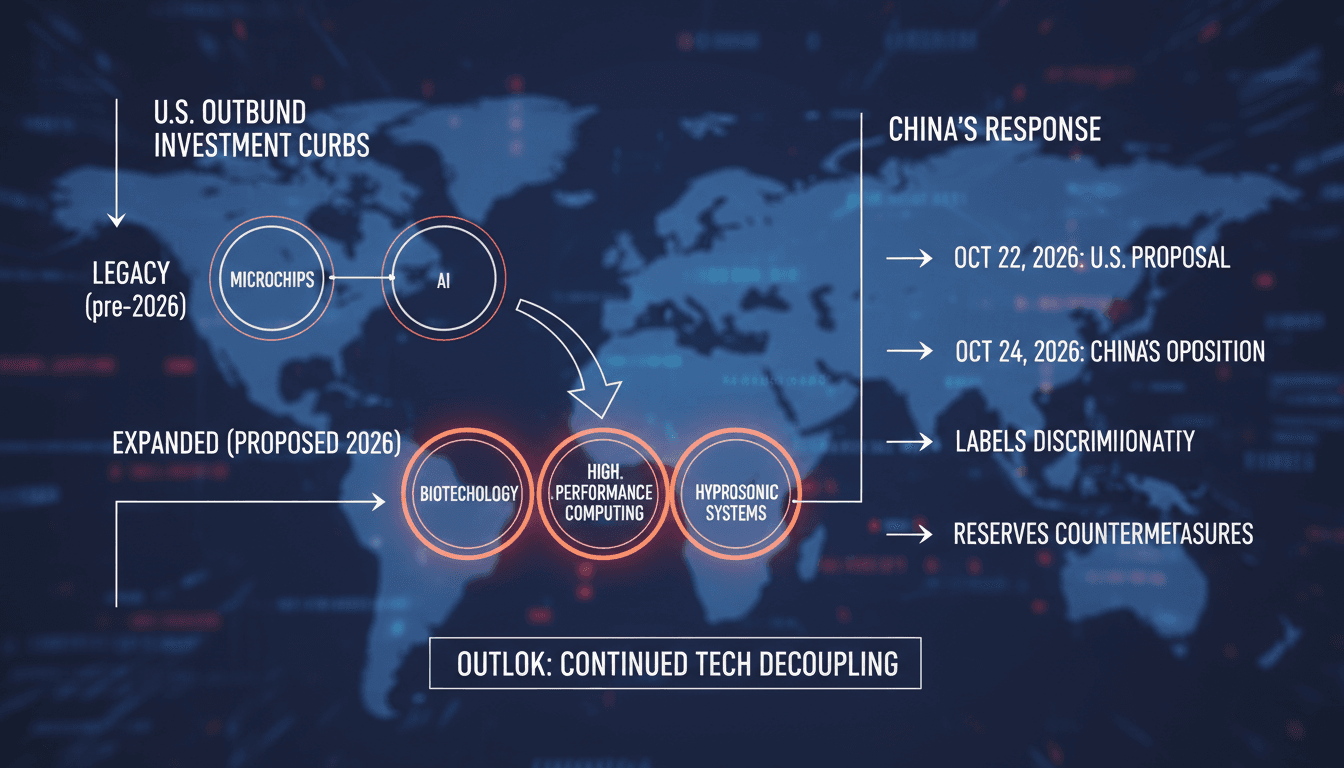
Why it matters
The regulatory perimeter for global tech financing is extending past digital hardware into biotechnology and aerospace, signaling a long-term shift toward scrutinizing dual-use capital flows.
What happened (in 30 seconds)
- The regulatory expansion: On October 22, 2026, the U.S. Department of the Treasury issued a proposal to update its outbound investment security program by adding biotechnology and broadening oversight of high-performance computing and hypersonic systems.
- The official response: On October 24–25, 2026, China's Ministry of Commerce issued a formal warning against the measure, describing the proposals as discriminatory, stating firm opposition, and reserving the right to implement unspecified countermeasures.
- The underlying justification: The U.S. position frames the program as a national security mechanism targeting dual-use technologies across designated countries of concern rather than exclusively targeting a single market.
The context you actually need
- Prior baseline restrictions: The U.S. outbound investment security framework initially established regulatory limits focusing on American capital targeting semiconductors, quantum computing, and artificial intelligence.
- Recent bilateral engagements: The two nations' presidents held two high-level meetings in the six months leading up to the October 2026 proposal, reaching consensus on bilateral economic cooperation that the new statement claims is contradicted by the draft rules.
- Current procedural status: As of late October 2026, the proposed expansion remains in a regulatory notice and public comment phase, with no immediate statutory implementation or documented trade retaliation active.
What's really happening
The Treasury Department’s move to incorporate biotechnology, hypersonic systems, and broader high-performance computing represents a structural shift in how cross-border capital security is defined. Rather than restricting trade in finished products, the policy focuses directly on intangible transfers: management expertise, venture networks, intellectual property development, and institutional prestige that accompany institutional investment.
For the outbound investment program, the inclusion of biotechnology marks a distinct departure from traditional computation barriers. While advanced microelectronics and quantum computing rely on discrete, trackable supply chain bottlenecks like extreme ultraviolet lithography or specialized fabrication plants, biotechnology operates across fragmented, distributed laboratories and dual-use research pipelines. High-performance computing and hypersonic systems present parallel regulatory challenges, as computational research clusters can seamlessly pivot between commercial modeling and defense applications. By widening the scope, regulators are signaling that software, infrastructure, and life science research now carry systemic strategic utility equivalent to hardware manufacturing.
From an incentive standpoint, Beijing’s response reflects the economic stakes of retaining access to private institutional funding. The Ministry of Commerce’s explicit reference to the two presidential meetings over the preceding six months underscores a diplomatic preference for economic predictability over sector-by-sector ringfencing. By categorizing the proposed rules as discriminatory and reserving rights to countermeasures, policymakers aim to preserve liquidity channels for domestic high-tech enterprises while discouraging further administrative expansion during the public consultation window.
For international allocators, this structural dynamic alters risk calculations. Even while the proposal remains open for public commentary without immediate enforcement, general partners and cross-border syndicates face heightened due diligence costs. The regulatory focus relies on incentive management: establishing clear disincentives for venture capital, private equity, and joint venture funding to touch technologies deemed dual-use. The consequence is an accelerating bifurcation of investment ecosystems, where capital pools must legally insulate their advanced computing and life science operations across separate jurisdictions to prevent regulatory contamination.
Who feels it first (and how)
- Venture capital and private equity general partners: Funds managing cross-border allocations in life sciences and computational infrastructure face expanded screening requirements and potential mandates to halt direct equity participation in specified markets.
- Biotechnology research founders: Early-stage life science ventures pursuing dual-use platforms risk losing access to specialized institutional investors that provide international governance and commercialization expertise.
- Corporate compliance officers: In-house legal and regulatory teams must expand screening mechanisms to evaluate whether advanced enterprise computation or computational biology platforms meet the expanded threshold of concern.
- Regional financial hubs: Intermediary capital centers, including Dubai and broader Gulf markets, face increased demand to monitor shifting regulatory definitions as global tech funds assess where to route non-restricted allocations.
What to watch next
- The public comment feedback cycle: The specific industry submissions filed during the U.S. Treasury's open comment period will indicate which biotechnology and high-performance computing sub-sectors lobby for narrower safe harbor exemptions.
- Formal retaliatory policy notices: Any formal regulatory instruments or trade notices released by China's Ministry of Commerce will clarify what administrative tools or economic countermeasures are deployed.
- Bilateral diplomatic track meetings: Follow-up discussions between economic working groups will test whether the consensus achieved during the prior two presidential meetings can withstand unilateral regulatory additions.
The U.S. Treasury Department proposed adding biotechnology and expanding rules on high-performance computing and hypersonic systems on October 22, 2026; China’s Ministry of Commerce opposed the move on October 24–25, 2026, reserving the right to respond.
Cross-border venture and private equity deal volumes in computational life sciences will experience administrative pauses or extended due diligence timelines while draft rules remain under review.
The exact regulatory definitions that will delineate standard medical biotechnology from restricted dual-use applications, as well as the specific form and timing of any potential countermeasures from Beijing.
Frequently Asked Questions
- Why it matters?
- The regulatory perimeter for global tech financing is extending past digital hardware into biotechnology and aerospace, signaling a long-term shift toward scrutinizing dual-use capital flows.
- What happened (in 30 seconds)?
- The regulatory expansion: On October 22, 2026, the U.S. Department of the Treasury issued a proposal to update its outbound investment security program by adding biotechnology and broadening oversight of high-performance computing and hypersonic systems. The official response: On October 24–25, 2026, China's Ministry of Commerce issued a formal warning against the measure, describing the proposals as discriminatory, stating firm opposition, and reserving the right to implement unspecified counte
- What's really happening?
- The Treasury Department’s move to incorporate biotechnology, hypersonic systems, and broader high-performance computing represents a structural shift in how cross-border capital security is defined. Rather than restricting trade in finished products, the policy focuses directly on intangible transfers: management expertise, venture networks, intellectual property development, and institutional prestige that accompany institutional investment. For the outbound investment program, the inclusion o
- Who feels it first (and how)?
- Venture capital and private equity general partners: Funds managing cross-border allocations in life sciences and computational infrastructure face expanded screening requirements and potential mandates to halt direct equity participation in specified markets. Biotechnology research founders: Early-stage life science ventures pursuing dual-use platforms risk losing access to specialized institutional investors that provide international governance and commercialization expertise. Corporate compl
- What to watch next?
- The public comment feedback cycle: The specific industry submissions filed during the U.S. Treasury's open comment period will indicate which biotechnology and high-performance computing sub-sectors lobby for narrower safe harbor exemptions. Formal retaliatory policy notices: Any formal regulatory instruments or trade notices released by China's Ministry of Commerce will clarify what administrative tools or economic countermeasures are deployed. Bilateral diplomatic track meetings: Follow-up dis
Sports reporting with a focus on Saudi and regional competitions.
"Okaz sports coverage is broad and audience-friendly, with strong attention to Saudi teams and leagues."
— A47 Editor
الصين تحذر أمريكا من توسيع قيود الاستثمارات في التقنيات الحساسة
China's Ministry of Commerce has warned the United States against expanding restrictions on American investments in China, stating that new US proposals targeting sensitive technologies would harm bilateral economic and trade relations. The warning f...
Sports reporting with a focus on Saudi and regional competitions.
"Okaz sports coverage is broad and audience-friendly, with strong attention to Saudi teams and leagues."
— A47 Editor
بكين تعارض توسيع القيود الأمريكية على الاستثمارات في الصين
The Chinese Ministry of Commerce announced its opposition to a U.S. proposal aimed at expanding restrictions on American investments in China, warning that such a move could harm economic and trade relations between the two countries. The proposal se...
Capitol Hill news, legislation, and policy insight.
"The Hill specializes in U.S. politics and policy, with a focus on Capitol Hill developments and a reputation for insider reporting."
— A47 Editor
China urges US Treasury to stop proposed restrictions on tech investments
Chinese officials have urged the U.S. Treasury to halt its proposed rule aimed at further restricting American investments in China's tech sector, arguing that such measures would disrupt trade relations between the two nations. The Treasury's propos...