
Student List Wins Parliamentary Majority in Serbia Snap Election as Vučić Concedes After 14-Year Rule
Why it matters
The transition breaks a 14-year political status quo through established electoral mechanisms, directly reshaping regional administrative priorities without creating immediate capital market or supply chain dislocations.
What happened (in 30 seconds)
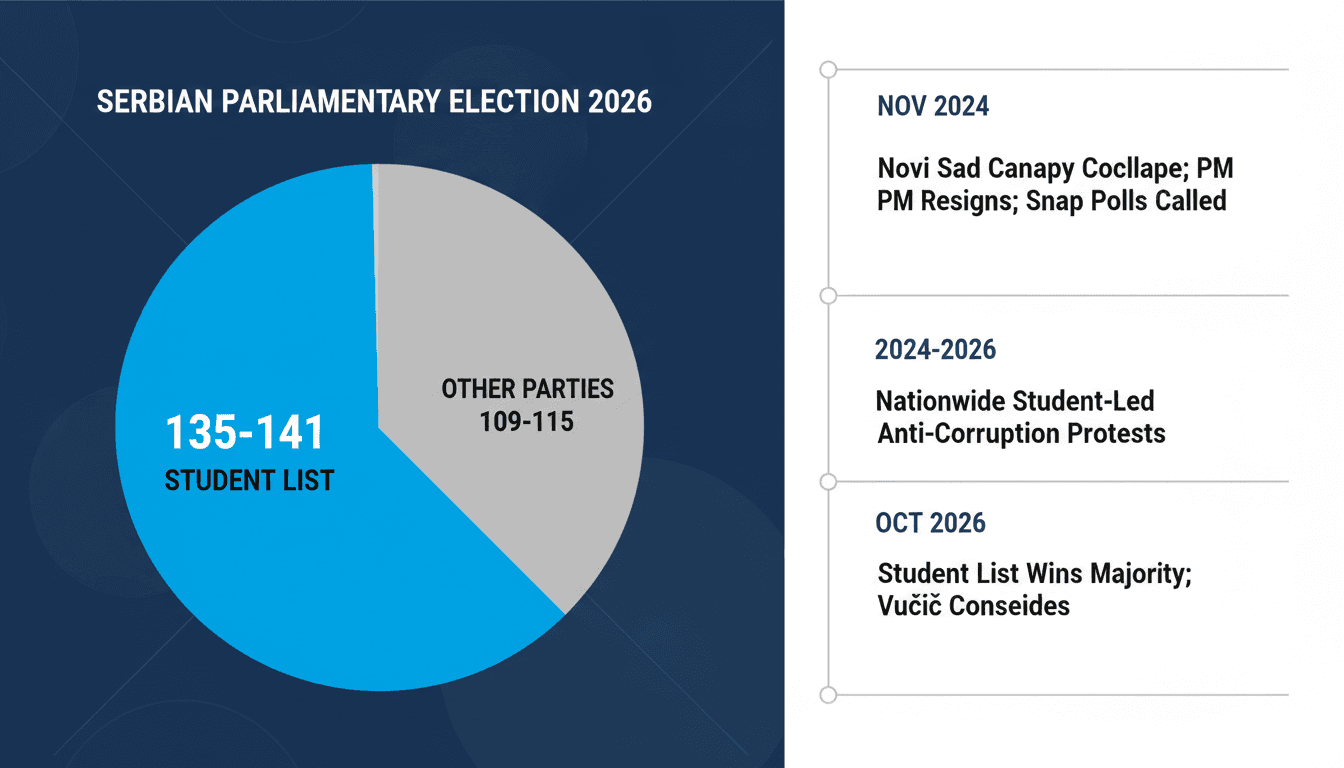
- The Student List secured a decisive parliamentary majority in Serbia’s October 25, 2026 snap election, winning 52.54% of the processed vote and an estimated 135 to 141 seats in the 250-seat assembly.
- The ruling Serbian Progressive Party conceded defeat, as Aleksandar Vučić acknowledged the outcome after his coalition captured approximately 39% of the vote amid a turnout near 70%.
- A slate of 250 non-student professionals—including doctors, professors, farmers, and actors vetted through civic assemblies—now controls the legislative mandate to form a new government within 90 days.
The context you actually need
- A deadly infrastructure failure catalyzed the cycle, after the November 2024 railway station canopy collapse in Novi Sad killed 16 individuals, setting off sustained public pushback centered on procurement oversight, transparency, and administrative liability.
- Two years of organized civic pressure forced early balloting, accelerating when the incumbent prime minister resigned under public scrutiny, prompting Vučić to dissolve parliament and call elections in September 2026.
- The challenger movement utilized open plenums, designing a governance model where student coordinators deliberately nominated non-political professionals rather than placing student leaders directly onto the national ballot.
What's really happening
The mechanics behind the October 2026 Serbian election reflect a deliberate transformation of sustained street-level mobilization into an organized legislative machine. Rather than forming a traditional political party with entrenched hierarchies, student assemblies built a decentralized vetting process across university plenums. Their strategic decision to exclude active students from the 250-seat candidate slate neutralized conventional counter-arguments about administrative inexperience. By nominating established domain experts—such as cardiologist Ilija Srdanović, alongside tenured academics, medical practitioners, cultural figures, and agricultural operators—the movement presented an institutional alternative focused primarily on procurement integrity, judicial autonomy, and regulatory enforcement.
This incentive framework altered voter behavior across standard demographic divisions. A turnout reaching approximately 70% demonstrated broad participation beyond traditional metropolitan student districts. The platform deliberately centered on rule-of-law benchmarks, domestic education modernizations, and streamlined European Union harmonizations. By keeping the campaign anchored to systemic governance rather than contentious ideological issues, the movement captured 52.54% of the vote.
For the Serbian Progressive Party (SNS), the cost-benefit analysis shifted immediately upon seeing preliminary polling returns showing a 13-point deficit. Prolonging contestation threatened to destabilize existing economic networks and institutional credibility. Vučić’s rapid public concession within hours of sample releases—positioning his party as an organized parliamentary opposition—mitigated capital flight and maintained currency and sovereign debt stability. No immediate market disruptions or trade holdups were registered in the aftermath.
The underlying structural challenge now shifts from electoral cohesion to executive execution. The Student List must translate a heterogeneous coalition of independent professionals into a functioning cabinet capable of managing daily state operations. European Union alignment requirements demand rigorous adjustments to public sector tendering, state subsidies, and judicial processing. Because the movement ran on an anti-corruption and professionalization mandate, its legislative majority faces high structural incentives to revise infrastructure procurement pipelines and audit pending public-private partnerships, fundamentally changing operational counterparty risk for foreign and regional firms.
Who feels it first (and how)
- State procurement and infrastructure contractors: Engineering, construction, and logistics firms face immediate operational pauses as incoming administrators review existing tendering processes and contracts following the 2024 Novi Sad collapse.
- Healthcare, academic, and civil service leadership: Public sector professionals will experience structural changes in department oversight, as the incoming majority prioritizes depoliticized civil service appointments.
- Regional corporate legal and compliance teams: Cross-border operators navigating Balkan supply chains must adapt to revised administrative standards as domestic regulations accelerate harmonization with European Union statutory frameworks.
- Opposition and municipal party apparatuses: Outgoing Serbian Progressive Party networks must reposition their internal resources for legislative opposition work, altering established regional patronage channels.
What to watch next
- The formal nomination of the prime minister designate: Monitor whether the Student List selects Ilija Srdanović or another technical professional to lead the executive, which will reveal whether the incoming cabinet operates as a technocratic body or a consensus coalition.
- The 90-day statutory government formation window: Watch the pace at which the 135-to-141-seat majority distributes ministerial portfolios to gauge internal legislative discipline across a non-traditional caucus.
- Initial sovereign debt and bond yield pricing: Track international debt auctions and credit rating agency notes over the coming fiscal quarter to evaluate how external institutional capital assesses Serbia’s regulatory shifts.
The Student List achieved 52.54% of processed votes; Aleksandar Vučić publicly conceded; the movement holds a projected absolute majority of 135 to 141 parliamentary seats; a government must form within 90 days of parliament convening.
The incoming administration will prioritize public procurement transparency legislation, civil service restructuring, and judicial alignment initiatives required for European Union integration milestones.
The exact composition of the executive cabinet remains unresolved, as does the long-term voting discipline of 250 non-career politicians who hold differing sectoral perspectives.
Frequently Asked Questions
- Why it matters?
- The transition breaks a 14-year political status quo through established electoral mechanisms, directly reshaping regional administrative priorities without creating immediate capital market or supply chain dislocations.
- What happened (in 30 seconds)?
- The Student List secured a decisive parliamentary majority in Serbia’s October 25, 2026 snap election, winning 52.54% of the processed vote and an estimated 135 to 141 seats in the 250-seat assembly. The ruling Serbian Progressive Party conceded defeat, as Aleksandar Vučić acknowledged the outcome after his coalition captured approximately 39% of the vote amid a turnout near 70%. A slate of 250 non-student professionals—including doctors, professors, farmers, and actors vetted through civic asse
- What's really happening?
- The mechanics behind the October 2026 Serbian election reflect a deliberate transformation of sustained street-level mobilization into an organized legislative machine. Rather than forming a traditional political party with entrenched hierarchies, student assemblies built a decentralized vetting process across university plenums. Their strategic decision to exclude active students from the 250-seat candidate slate neutralized conventional counter-arguments about administrative inexperience. By n
- Who feels it first (and how)?
- State procurement and infrastructure contractors: Engineering, construction, and logistics firms face immediate operational pauses as incoming administrators review existing tendering processes and contracts following the 2024 Novi Sad collapse. Healthcare, academic, and civil service leadership: Public sector professionals will experience structural changes in department oversight, as the incoming majority prioritizes depoliticized civil service appointments. Regional corporate legal and compli
- What to watch next?
- The formal nomination of the prime minister designate: Monitor whether the Student List selects Ilija Srdanović or another technical professional to lead the executive, which will reveal whether the incoming cabinet operates as a technocratic body or a consensus coalition. The 90-day statutory government formation window: Watch the pace at which the 135-to-141-seat majority distributes ministerial portfolios to gauge internal legislative discipline across a non-traditional caucus. Initial sovere
Editor-curated FT homepage stories spanning markets, business, world, and opinion.
"The Financial Times is a globally respected business publication with a centrist/center-left tone and strong markets focus."
— A47 Editor
Who are the students set to govern Serbia?
Serbia's former president Aleksandar Vučić has conceded defeat in a parliamentary election to the grassroots Student List, a newcomer movement that has yet to nominate a prime minister candidate, leaving its path to government unsettled.
Conservative-leaning political and national coverage.
"The Washington Times is a conservative-leaning newspaper known for its political coverage and advocacy of right-of-center viewpoints."
— A47 Editor
Serbian strongman Vucic defeated in weekend election after more than a decade in power
Longtime Serbian President Aleksandar Vucic lost a consequential parliamentary election on Sunday to the grassroots Student List party, ending more than a decade of his dominance in Serbian politics. The vote followed nearly two years of protests aga...
International coverage from The Guardian's global desks.
"The Guardian is known for its progressive editorial stance and in-depth analysis."
— A47 Editor
‘Door to EU is open’ new Serbian government told after Vučić concedes election – Europe live as it happened
Serbian President Aleksandar Vučić conceded defeat in the snap parliamentary election held on October 25, 2026, after the student-led Student List movement was projected to win 141 seats, well clear of the 126 needed for a majority. Turnout by late a...
International coverage of politics, culture, and current affairs.
"BBC News is widely regarded as a reputable international news organization, known for its impartial tone and public service mandate."
— A47 Editor
Early reports suggest record high turnout in Serbia elections
Serbia recorded early reports of record high turnout in parliamentary elections as a student-led movement attempted to oust longtime populist leader Aleksandar Vučić, whose party has dominated Serbian politics for years. The vote was called as snap e...
International stories from NPR’s global desk.
"NPR is an American public media organization known for thoughtful reporting and a slightly left-leaning editorial tone."
— A47 Editor
European student protests take aim at Serbia's elections
Students across Europe are protesting, with significant demonstrations in Serbia as they prepare for parliamentary elections on October 25, 2026, aiming to end the 14-year rule of President Aleksandar Vučić. The protests have gained traction over the...