
Mass Protests Erupt Across Europe Over Cost of Living and Education Funding
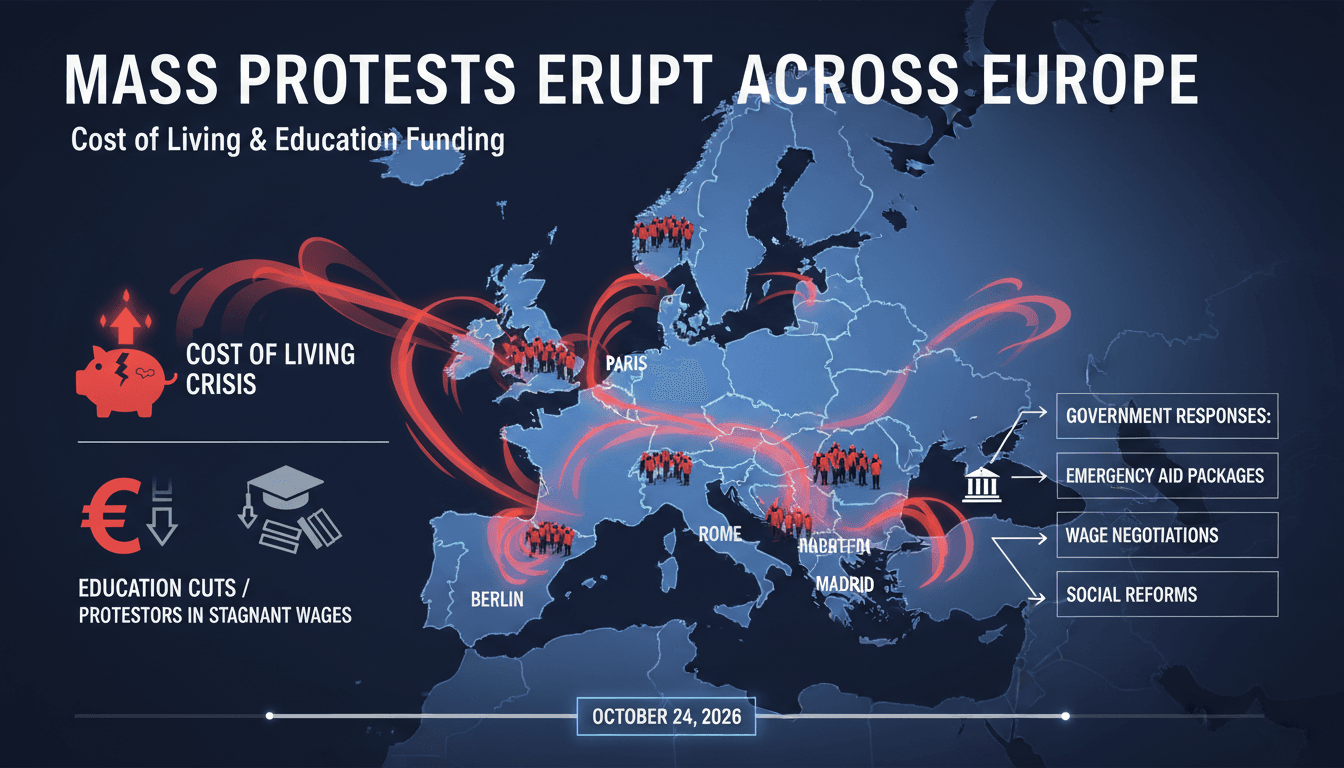
Why it matters
The escalating protests reflect deep-rooted economic challenges that could influence global markets and policy decisions.
What happened (in 30 seconds)
- Widespread protests occurred across Europe on October 24, 2026, with hundreds of thousands demonstrating primarily in France.
- Key grievances included rising living costs, insufficient education funding, and housing shortages, leading to both peaceful marches and violent clashes.
- Authorities responded with heightened security measures, including the deployment of 70,000 police officers in France and new penalties for violent participation in Italy.
The context you actually need
- Protests began in France in late September 2026, initially driven by student-led actions over education funding.
- Economic pressures such as stagnant wages and soaring living costs have fueled discontent across multiple European nations.
- Demonstrations have spread to Italy, Albania, Spain, and Portugal, indicating a continental crisis that transcends national borders.
What's really happening
The protests that erupted across Europe on October 24, 2026, are not merely spontaneous outbursts of discontent; they are the culmination of systemic economic pressures that have been building for years. In France, the initial spark was ignited by students protesting inadequate funding for education, but as the cost of living soared—driven by inflation and stagnant wages—these protests quickly morphed into broader demonstrations against the government’s handling of economic issues.
The protests are emblematic of a larger trend across Europe, where citizens are increasingly frustrated with the perceived inadequacies of public services. Housing shortages, particularly in urban areas, have exacerbated feelings of disenfranchisement. As people struggle to make ends meet, the demand for better public services and economic relief has intensified. This has led to a significant mobilization of various groups, including labor unions and anti-government activists, who are uniting under a common banner of economic justice.
The response from authorities has been swift and severe. In France, the deployment of approximately 70,000 police officers and the imposition of localized curfews reflect a government that is both concerned about public safety and unwilling to concede to the demands of the protesters. The arrests of over 1,000 individuals during these demonstrations indicate a hardline approach that could further inflame tensions. Meanwhile, in Italy, new security measures have been enacted, including penalties for violent participation, signaling a broader crackdown on dissent.
The implications of these protests extend beyond the immediate context of public unrest. They highlight a growing divide between citizens and their governments, which could lead to significant political shifts in the coming months. As economic pressures continue to mount, governments may be forced to reconsider their policies, potentially leading to economic relief measures that could reshape the financial landscape across Europe and beyond.
Who feels it first (and how)
- Students and educators: Directly impacted by funding cuts and educational policies.
- Low- to middle-income families: Struggling with rising living costs and housing shortages.
- Labor unions: Mobilizing to protect workers' rights and advocate for better wages.
- Government officials: Facing pressure to respond to public discontent and implement policy changes.
What to watch next
- Government responses: Monitor how European governments react to the protests, particularly regarding economic relief measures. This could set a precedent for similar actions in other regions.
- Market reactions: Watch for shifts in financial markets as investor sentiment may be influenced by the stability of European economies amid unrest.
- Public sentiment: Keep an eye on opinion polls and social media trends to gauge how public sentiment evolves in response to ongoing protests and government actions.
Protests are ongoing, with significant participation across multiple European nations.
Governments will implement some form of economic relief measures in response to public pressure.
The long-term impact on political stability and economic policies across Europe remains uncertain.
Frequently Asked Questions
- Why it matters?
- The escalating protests reflect deep-rooted economic challenges that could influence global markets and policy decisions.
- What happened (in 30 seconds)?
- Widespread protests occurred across Europe on October 24, 2026, with hundreds of thousands demonstrating primarily in France. Key grievances included rising living costs, insufficient education funding, and housing shortages, leading to both peaceful marches and violent clashes. Authorities responded with heightened security measures, including the deployment of 70,000 police officers in France and new penalties for violent participation in Italy.
- What's really happening?
- The protests that erupted across Europe on October 24, 2026, are not merely spontaneous outbursts of discontent; they are the culmination of systemic economic pressures that have been building for years. In France, the initial spark was ignited by students protesting inadequate funding for education, but as the cost of living soared—driven by inflation and stagnant wages—these protests quickly morphed into broader demonstrations against the government’s handling of economic issues. The protests
- Who feels it first (and how)?
- Students and educators: Directly impacted by funding cuts and educational policies. Low- to middle-income families: Struggling with rising living costs and housing shortages. Labor unions: Mobilizing to protect workers' rights and advocate for better wages. Government officials: Facing pressure to respond to public discontent and implement policy changes.
- What to watch next?
- Government responses: Monitor how European governments react to the protests, particularly regarding economic relief measures. This could set a precedent for similar actions in other regions. Market reactions: Watch for shifts in financial markets as investor sentiment may be influenced by the stability of European economies amid unrest. Public sentiment: Keep an eye on opinion polls and social media trends to gauge how public sentiment evolves in response to ongoing protests and government
National headlines across the United States including breaking stories and societal issues.
"NBC News is a mainstream media outlet known for comprehensive national and international news coverage with a centrist to slightly left-leaning editorial tone."
— A47 Editor
Widespread protests expand across Europe as thousands take to streets
Hundreds of thousands of people marched across France on Saturday, protesting against inadequate school funding and escalating living costs. The demonstrations began peacefully but escalated into clashes, leading to significant unrest and over 2,400 ...
International coverage from The Guardian's global desks.
"The Guardian is known for its progressive editorial stance and in-depth analysis."
— A47 Editor
Hundreds of thousands march in France as protests take place across Europe – as it happened
Hundreds of thousands of people marched across France and other European countries, including Italy, Spain, and Albania, in response to rising living costs and deteriorating public services. French police reported 1,000 arrests during the protests, w...
International coverage from The Guardian's global desks.
"The Guardian is known for its progressive editorial stance and in-depth analysis."
— A47 Editor
Hundreds of thousands march across France in protests over schools and policing
Hundreds of thousands of protesters took to the streets across France on Saturday, demanding better funding for schools and addressing the rising cost of living. The demonstrations were largely peaceful, although clashes with police in Paris resulted...
Global coverage of politics, crises, and international affairs.
"HuffPost provides progressive-oriented reporting on international developments, often focusing on humanitarian and social justice issues."
— A47 Editor
More Than 400,000 Protest Across France, Challenging Macron As Paris Clashes Erupt
More than 400,000 people protested across France, with significant clashes reported in Paris and other cities such as Lyon, Clermont-Ferrand, and Strasbourg. The demonstrations were sparked by rising living costs and dissatisfaction with public servi...
News and current affairs from across Europe.
"The Guardian is known for its progressive editorial stance and in-depth analysis."
— A47 Editor
Major protests in Paris and other French cities in challenge to Macron – in pictures
Major protests erupted in Paris and other French cities, with police estimating around 110,000 participants marching against inadequate school funding and rising living costs. The demonstrations, which began peacefully, escalated into clashes with po...