
Burnham Opens Cabinet-Backed Debate on Reversing EU Free Movement Restrictions
Why it matters
Reopening discussions on European Union labor mobility challenges the post-2020 regulatory settlement, linking economic expansion strategies directly to cross-border workforce availability.
What happened (in 30 seconds)
* A formal debate initiated: On October 25, 2026, UK Prime Minister Andy Burnham proposed an evidence-based public review regarding the potential return to EU free movement to support national economic growth. * Cabinet lines divided: Deputy Prime Minister Angela Rayner framed the review as practical economic management, with Foreign Secretary Ed Miliband endorsing closer ties, while Home Secretary Shabana Mahmood emphasized policy trade-offs. * Core parameters defined: Burnham explicitly excluded joining the Schengen zone or adopting the euro, positioning the inquiry strictly around labor mobility and market integration ahead of a November 20 summit in Brussels.
The context you actually need
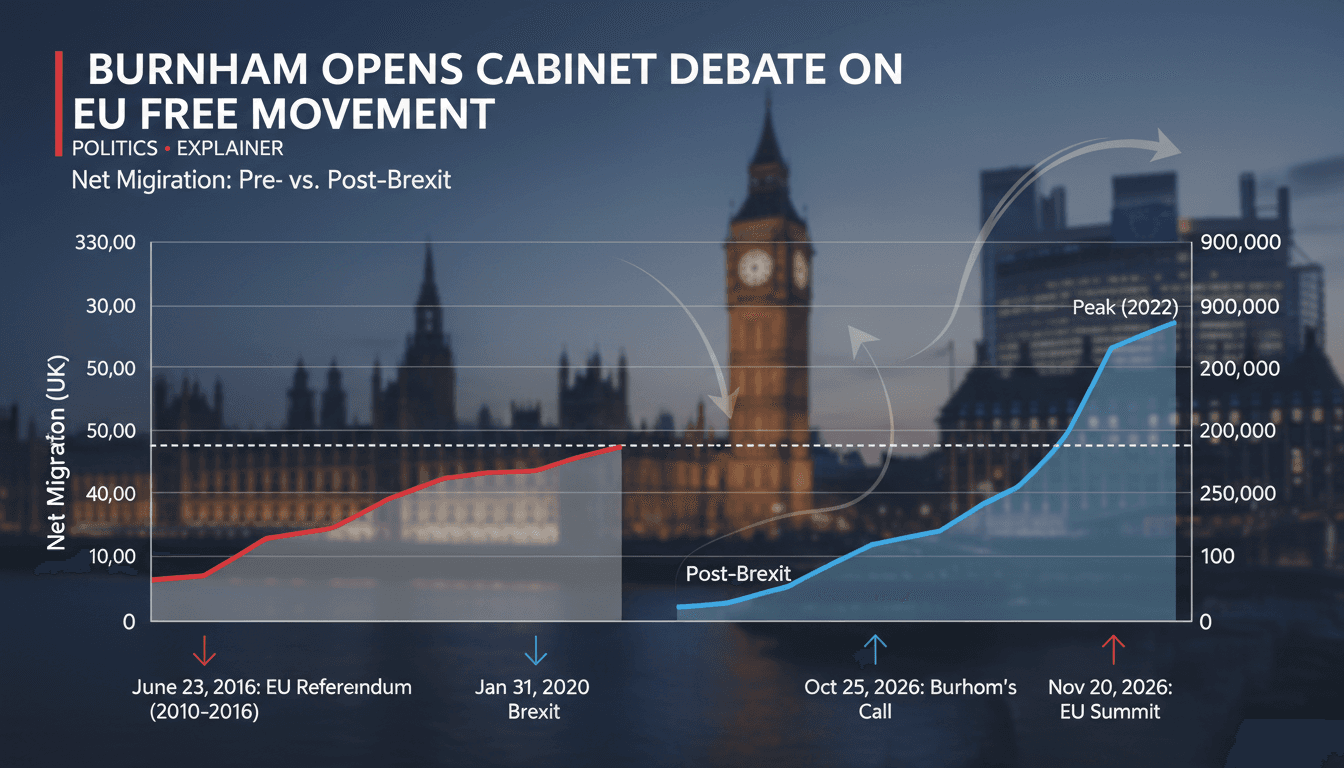
* Post-Brexit baseline shifted: Following the 2016 referendum and formal exit in 2020, Labour’s 2024 manifesto established firm restrictions against re-entering the single market, customs union, or restoring free movement. * Net migration figures surged: Under the post-exit points-based immigration structure, UK net migration reached an apex of 900,000 in January 2020, significantly higher than the 330,000 recorded prior to the 2016 referendum. * Diplomatic timeline set: The policy conversation emerged weeks before a scheduled bilateral conference in Brussels on November 20, 2026, creating an immediate test of cross-Channel negotiating leverage.
What's really happening
The initiative to reconsider free movement reflects structural tensions between domestic labor constraints and post-Brexit immigration metrics. When the UK transitioned away from EU rules, the objective was to regain operational control over territorial borders through a points-based system. The numerical outcome diverged from initial administrative projections: annual net migration accelerated to 900,000 under the points regime, compared to 330,000 during the pre-referendum era.
This numerical reality altered the incentive structure inside Whitehall. Rather than curtailing inflow volumes, the points-based framework changed the geographical composition and legal terms of arrivals, creating distinct regulatory burdens for employers. Burnham’s positioning leverages this data point to argue that previous European migration operated as a dynamic, "revolving-door" mechanism—where seasonal and cyclical labor entered and exited fluidly—contrasting with the longer-term residency patterns observed under post-2020 frameworks.
The economic mechanism rests on productivity and workforce flexibility. Re-establishing reciprocal mobility aims to resolve labor imbalances across service and industrial sectors without requiring a complete political re-integration into the European project. By explicitly ruling out Schengen zone membership and currency adoption, the prime minister is attempting to uncouple targeted labor mobility from broader political federation.
However, the political costs are concentrated. Parliamentary representatives in industrial constituencies—frequently categorized as the red wall—view movement concessions as a departure from manifesto guarantees established during the 2024 campaign. Concurrently, opposition leadership under Kemi Badenoch and Nigel Farage have framed the exercise as a retreat from territorial autonomy. Consequently, the government faces an acute trade-off: maintaining the strict separation from European institutions established over the last six years, or reintroducing regulatory flexibility to alleviate structural drag on macroeconomic output ahead of the 2029 electoral cycle.
Who feels it first (and how)
* Corporate talent acquisition leaders: Multinational operators face potential future restructuring of visa processing protocols, cross-border deployment budgets, and intra-company transfer compliance between the UK and EU. * Red wall parliamentary delegations: Regional legislators encounter immediate friction from constituents who link domestic electoral commitments to rigid border restrictions. * European policy negotiators: Brussels diplomats gain new negotiating leverage to demand broader regulatory alignment in exchange for any bespoke labor market concessions during upcoming bilateral meetings. * UK border compliance and legal teams: Immigration advisory firms must prepare for potential dual-track scenarios balancing the existing points-based architecture against prospective reciprocal mobility treaties.
What to watch next
* The November 20 Brussels summit: Direct interactions between Burnham and European counterparts will confirm whether EU officials demand single market obligations in exchange for mobility rights. * Parliamentary voting blocs: The consolidation of red wall resistance against Home Office statements will indicate whether the cabinet can translate public proposals into formal policy. * Whitehall migration data releases: Updated tracking of net arrivals will dictate whether the government retains data-driven justification for revising points-based employment policies.
Prime Minister Andy Burnham launched a public push to evaluate restoring free movement, backed publicly by Deputy Prime Minister Angela Rayner but contested across opposition benches and within his own party.
The EU will maintain its established negotiating stance that elements of the single market cannot be accessed without accepting core regulatory obligations.
Whether internal Labour Party consensus can survive sustained opposition pushback ahead of the 2029 general election campaign without fracturing cabinet discipline.
Frequently Asked Questions
- Why it matters?
- Reopening discussions on European Union labor mobility challenges the post-2020 regulatory settlement, linking economic expansion strategies directly to cross-border workforce availability.
- What happened (in 30 seconds)?
- A formal debate initiated: On October 25, 2026, UK Prime Minister Andy Burnham proposed an evidence-based public review regarding the potential return to EU free movement to support national economic growth. Cabinet lines divided: Deputy Prime Minister Angela Rayner framed the review as practical economic management, with Foreign Secretary Ed Miliband endorsing closer ties, while Home Secretary Shabana Mahmood emphasized policy trade-offs. Core parameters defined: Burnham explicitly excluded joi
- What's really happening?
- The initiative to reconsider free movement reflects structural tensions between domestic labor constraints and post-Brexit immigration metrics. When the UK transitioned away from EU rules, the objective was to regain operational control over territorial borders through a points-based system. The numerical outcome diverged from initial administrative projections: annual net migration accelerated to 900,000 under the points regime, compared to 330,000 during the pre-referendum era. This numerica
- Who feels it first (and how)?
- Corporate talent acquisition leaders: Multinational operators face potential future restructuring of visa processing protocols, cross-border deployment budgets, and intra-company transfer compliance between the UK and EU. Red wall parliamentary delegations: Regional legislators encounter immediate friction from constituents who link domestic electoral commitments to rigid border restrictions. European policy negotiators: Brussels diplomats gain new negotiating leverage to demand broader regulato
- What to watch next?
- The November 20 Brussels summit: Direct interactions between Burnham and European counterparts will confirm whether EU officials demand single market obligations in exchange for mobility rights. Parliamentary voting blocs: The consolidation of red wall resistance against Home Office statements will indicate whether the cabinet can translate public proposals into formal policy. Whitehall migration data releases: Updated tracking of net arrivals will dictate whether the government retains data-dri
UK and international business news, economics, and corporate coverage.
"The Guardian’s business section covers finance and markets with a progressive editorial tone."
— A47 Editor
Cabinet ministers back Burnham’s call for debate on return to free movement with EU
Prime Minister Andy Burnham has called for an "honest discussion" about a possible return to EU free movement, telling the Sunday Times that staying out of it would no longer be a red line in talks with Brussels. Senior cabinet figures including Ange...
News and current affairs from across Europe.
"The Guardian is known for its progressive editorial stance and in-depth analysis."
— A47 Editor
Cabinet ministers back Burnham’s call for debate on return to free movement with EU
Prime Minister Andy Burnham has called for an "honest discussion" about a possible return to EU free movement, telling the Sunday Times that staying out of it would no longer be a red line in talks with Brussels. Senior cabinet figures including Ange...
United Kingdom-focused news including local politics, business, and social issues.
"BBC News is widely regarded as a reputable international news organization, known for its impartial tone and public service mandate."
— A47 Editor
Newscast
UK Prime Minister Andy Burnham has said he wants an honest, evidence-based discussion with the public about a possible return to EU free movement, according to BBC News. The stance, reported as coming ahead of a planned UK-EU summit on November 20, s...
Macro commentary, policy analysis, growth/inflation themes, and global outlooks.
"Contextual macro coverage that complements day-to-day market headlines."
— A47 Editor
UK’s Rayner says no Brexit reopening as Burnham floats EU free movement
UK Foreign Secretary Angela Rayner, speaking on the Brexit question, ruled out reopening the terms of the UK's exit from the EU, even as Prime Minister Andy Burnham floated a possible return to EU free movement as part of future talks with Brussels, ...
Comprehensive coverage of Middle Eastern and global issues.
"Al Jazeera is a prominent voice from the Global South, especially the Middle East, with an emphasis on underreported stories."
— A47 Editor
UK PM Burnham says he wants to discuss a return to EU freedom of movement
UK Prime Minister Andy Burnham has said Britain should have an 'honest discussion' about how immigration has changed since Brexit, including a possible return to EU freedom of movement, as the government prepares for a UK-EU summit in November.
Global news coverage with extensive reporting on Middle Eastern conflicts and geopolitics.
"Al Jazeera is a Qatar-based broadcaster known for wide regional coverage and alternative perspectives."
— A47 Editor
UK PM Burnham says he wants to discuss a return to EU freedom of movement
UK Prime Minister Andy Burnham has said Britain should have an 'honest discussion' about how immigration has changed since Brexit, including a possible return to EU freedom of movement, as the government prepares for a UK-EU summit in November.
United Kingdom-focused news including local politics, business, and social issues.
"BBC News is widely regarded as a reputable international news organization, known for its impartial tone and public service mandate."
— A47 Editor
Burnham open to 'honest discussion' on EU free movement
Prime Minister Andy Burnham has said he wants a factual, evidence-based and honest discussion with the public about returning to free movement between Britain and the EU, according to BBC News. The stance comes as the government prepares for a UK-EU ...
Political developments, elections, and policy issues in the UK.
"Sky News is a UK-based 24-hour channel known for fast-breaking news and political coverage."
— A47 Editor
PM open to 'honest discussion' about return to EU free movement
Prime Minister Andy Burnham has said an "honest discussion" is needed with the public about readopting the EU's free movement rules, according to Sky News, as the government prepares for a UK-EU summit. The stance marks a shift in tone on Brexit-era ...