
DOJ Lawsuit Seeks to Block Alaska Senate Certification Over Duplicate Sullivan Ballot Listing
Why it matters
The legal move tests constitutional boundaries governing federal oversight of state election mechanics in a race where a single seat could dictate the legislative balance of power in Washington.
What happened (in 30 seconds)
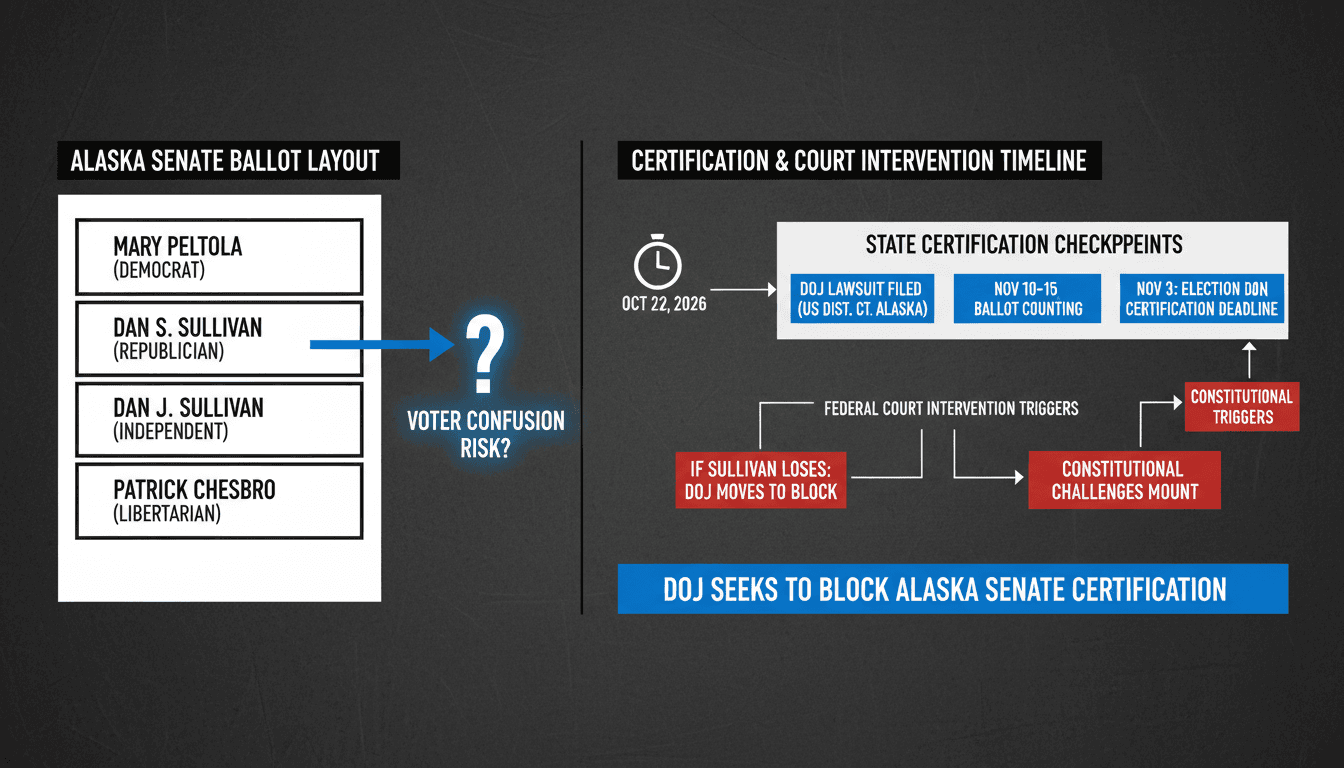
- The Department of Justice filed a federal lawsuit on October 22, 2026, seeking an order to bar the certification of Alaska's Senate election results if incumbent Republican Dan S. Sullivan loses to Democrat Mary Peltola.
- The legal claim centers on ballot confusion, arguing that the inclusion of an additional Republican candidate named Dan J. Sullivan creates an administrative distortion that could skew voter intent.
- Attorney General Todd Blanche publicly defended the action on October 25, 2026, stating on national television that the federal filing is intended to preserve ballots for post-election review rather than predetermine the race's outcome.
The context you actually need
- Alaska's Supreme Court already addressed the ballot lineup, ruling in June 2026 that both candidates named Dan Sullivan could appear, leading the state to add specific labels and "Jr." to distinguish them.
- The political stakes involve a razor-thin Senate majority, with the Alaska contest functioning as a pivotal toss-up race where Mary Peltola led Dan S. Sullivan by nearly 7 percentage points in an early October 2026 New York Times/Siena College poll.
- The filing generated immediate bipartisan pushback, with Alaska's senior Republican Senator Lisa Murkowski publicly rejecting the intervention, asserting that federal authorities should not interfere with state-administered processes.
What's really happening
The Department of Justice's legal maneuvering represents an institutional tension between state authority over election administration and federal executive intervention. Under Article I of the United States Constitution, individual states retain primary constitutional authority to regulate the times, places, and manner of holding elections for senators and representatives. By entering the Alaska federal court ahead of the November 3, 2026 election, the Department of Justice is introducing a legal posture designed to preserve legal remedies prior to official certification rather than relying strictly on post-election contest procedures established under state statute.
The practical mechanism relies on an assertion of ballot confusion. In Alaska's open primary held in August 2026, four candidates advanced to the general election ballot: incumbent Senator Dan S. Sullivan, Democratic challenger Mary Peltola, and a second Republican named Dan J. Sullivan. The presence of two visually and phonetically similar candidate names on a single ballot created a rare ballot design condition. While the Alaska Division of Elections sought to mitigate voter error by explicitly designating Dan S. Sullivan as the incumbent and styling Dan J. Sullivan with "Jr.," the federal complaint argues that these administrative remedies remain insufficient to prevent vote splitting or intentional misdirection.
From an incentive standpoint, the lawsuit functions as a hedge against a narrow loss. The primary legal objective outlined in the October 22 complaint does not seek to invalidate the election outright prior to voting; instead, it petitions the court to withhold certification specifically if Dan S. Sullivan is defeated while demonstrating that the aggregate votes cast across both Sullivans would have altered the final margin. This conditional framing indicates that the executive branch is seeking to establish an evidentiary basis for voter intent challenges before state election officials formally transmit certified results to the Senate.
Furthermore, the legal challenge targets the mechanics of the certification timeline itself. By requesting federal court oversight over state certification, the filing creates an avenue to delay the final seating of Alaska's senator. In a chamber governed by a narrow majority, any disruption or procedural pause in swearing in members can alter voting majorities, delay committee assignments, and stall executive nominations. While legal observers highlight significant constitutional hurdles regarding standing and federal jurisdiction, the presence of the litigation forces state administrators to account for federal court compliance alongside statutory canvassing deadlines.
Who feels it first (and how)
- Alaska election administrators, who must balance state statutory deadlines and ballot-counting requirements against pending federal court orders and possible preservation mandates.
- Congressional leadership and legislative strategists, who face delayed visibility into the operational majority of the Senate ahead of the upcoming legislative session.
- Corporate regulatory affairs directors, whose legislative tracking and compliance projections depend on predictable confirmations and committee leadership assignments.
- Campaign legal counsel across key battleground districts, who must assess whether pre-certification ballot design litigation will establish a legal model for other competitive races.
What to watch next
- The US District Court's initial ruling: Whether the Alaska federal court dismisses the suit on procedural and jurisdictional grounds or allows discovery and ballot preservation directives to proceed.
- Post-election vote spreads on November 3: The exact numerical gap between Mary Peltola and Dan S. Sullivan relative to the total vote tally recorded by Dan J. Sullivan.
- The timeline for state certification: Whether state officials encounter legal injunctions before the formal submission of Alaska's certified electoral certificate to Congress.
The DOJ filed a federal lawsuit on October 22, 2026, to halt certification under specific loss conditions, authorized by President Trump and defended by Attorney General Todd Blanche on October 25.
The lawsuit will encounter severe jurisdictional scrutiny in federal court, given established precedents limiting federal pre-emption of state election administration without concrete statutory civil rights claims.
Whether the legal challenge will successfully prevent Alaska from certifying its senatorial winner within statutory deadlines if Mary Peltola maintains her polling lead on election night.
Frequently Asked Questions
- Why it matters?
- The legal move tests constitutional boundaries governing federal oversight of state election mechanics in a race where a single seat could dictate the legislative balance of power in Washington.
- What happened (in 30 seconds)?
- The Department of Justice filed a federal lawsuit on October 22, 2026, seeking an order to bar the certification of Alaska's Senate election results if incumbent Republican Dan S. Sullivan loses to Democrat Mary Peltola. The legal claim centers on ballot confusion, arguing that the inclusion of an additional Republican candidate named Dan J. Sullivan creates an administrative distortion that could skew voter intent. Attorney General Todd Blanche publicly defended the action on October 25, 2026,
- What's really happening?
- The Department of Justice's legal maneuvering represents an institutional tension between state authority over election administration and federal executive intervention. Under Article I of the United States Constitution, individual states retain primary constitutional authority to regulate the times, places, and manner of holding elections for senators and representatives. By entering the Alaska federal court ahead of the November 3, 2026 election, the Department of Justice is introducing a leg
- Who feels it first (and how)?
- Alaska election administrators, who must balance state statutory deadlines and ballot-counting requirements against pending federal court orders and possible preservation mandates. Congressional leadership and legislative strategists, who face delayed visibility into the operational majority of the Senate ahead of the upcoming legislative session. Corporate regulatory affairs directors, whose legislative tracking and compliance projections depend on predictable confirmations and committee leader
- What to watch next?
- The US District Court's initial ruling: Whether the Alaska federal court dismisses the suit on procedural and jurisdictional grounds or allows discovery and ballot preservation directives to proceed. Post-election vote spreads on November 3: The exact numerical gap between Mary Peltola and Dan S. Sullivan relative to the total vote tally recorded by Dan J. Sullivan. The timeline for state certification: Whether state officials encounter legal injunctions before the formal submission of Alaska's
Comprehensive coverage of Middle Eastern and global issues.
"Al Jazeera is a prominent voice from the Global South, especially the Middle East, with an emphasis on underreported stories."
— A47 Editor
US Attorney General Todd Blanche defends Alaska Senate election lawsuit
US Attorney General Todd Blanche defended a Justice Department pre-emptive lawsuit seeking to block certification of Alaska's US Senate election results if incumbent Republican Dan Sullivan loses, a move that critics say aims to block a Democratic vi...
Global news coverage with extensive reporting on Middle Eastern conflicts and geopolitics.
"Al Jazeera is a Qatar-based broadcaster known for wide regional coverage and alternative perspectives."
— A47 Editor
US Attorney General Todd Blanche defends Alaska Senate election lawsuit
US Attorney General Todd Blanche defended a Justice Department pre-emptive lawsuit seeking to block certification of Alaska's US Senate election results if incumbent Republican Dan Sullivan loses, a move that critics say aims to block a Democratic vi...
Public radio coverage of American news and issues.
"NPR is an American public media organization known for thoughtful reporting and a slightly left-leaning editorial tone."
— A47 Editor
Blanche defends DOJ lawsuit blocking Alaska Senate results if Republican loses
Attorney General Todd Blanche defended a Justice Department lawsuit in Alaska that seeks to block certification of the state's Senate results if Republican Sen. Dan Sullivan loses, speaking in a CNN interview.
Insights and news on social issues, policy, and political movements across the United States.
"The Wall Street Journal is known for its deep political coverage, especially at the intersection of policy, regulation, and social dynamics."
— A47 Editor
Attorney General Todd Blanche on Sunday offered a combative defense of the Justice Department’s lawsuit seeking to block certification of Alaska’s Senate race if the Republican candidate loses
Attorney General Todd Blanche defended a Justice Department lawsuit seeking to block certification of Alaska's U.S. Senate results if the Republican candidate, incumbent Sen. Dan Sullivan, loses, offering a combative defense in Sunday interviews. The...
Capitol Hill news, legislation, and policy insight.
"The Hill specializes in U.S. politics and policy, with a focus on Capitol Hill developments and a reputation for insider reporting."
— A47 Editor
Blanche accuses 'Face the Nation' host of 'misleading' description of Alaska election lawsuit
Attorney General Todd Blanche accused CBS News's "Face the Nation" host Margaret Brennan of giving a "misleading" description of a Justice Department lawsuit in Alaska, where two candidates with similar names, including incumbent Republican Sen. Dan ...
Top international stories selected by The Guardian editors.
"The Guardian is known for its progressive editorial stance and in-depth analysis."
— A47 Editor
Blanche defends DoJ’s pre-emptive suit to block Alaska Senate results certification
Attorney General Todd Blanche defended the Justice Department's pre-emptive lawsuit seeking to block certification of Alaska's US Senate results if incumbent Republican Dan Sullivan loses, dismissing a CNN host's question about a possible January 6-s...
News from the United States including domestic politics, society, and culture.
"The Guardian is known for its progressive editorial stance and in-depth analysis, often advocating for social justice, environmental issues, and liberal values."
— A47 Editor
Blanche defends DoJ’s pre-emptive suit to block Alaska Senate results certification
Attorney General Todd Blanche defended the Justice Department's pre-emptive lawsuit seeking to block certification of Alaska's US Senate results if incumbent Republican Dan Sullivan loses, dismissing a CNN host's question about a possible January 6-s...
Capitol Hill news, legislation, and policy insight.
"The Hill specializes in U.S. politics and policy, with a focus on Capitol Hill developments and a reputation for insider reporting."
— A47 Editor
Blanche: Alaska Senate race is 'not a fair fight' to Trump
Attorney General Todd Blanche said on CNN on Sunday that President Trump considers Alaska's Senate race "not a fair fight" because a candidate with the same name as incumbent Sen. Dan Sullivan (R) appears on the ballot, which he argued could confuse ...
Capitol Hill news, legislation, and policy insight.
"The Hill specializes in U.S. politics and policy, with a focus on Capitol Hill developments and a reputation for insider reporting."
— A47 Editor
Blanche: DOJ lawsuit not trying to 'stop the certification of Alaska's election'
Attorney General Todd Blanche clarified that the Justice Department's recent lawsuit is not aimed at halting the certification of Alaska's election results, despite claims made in the legal filing intended to protect electoral integrity. The lawsuit ...