
DOJ Moves to Block Alaska Senate Certification Over Sullivan Name Confusion as Republican Control Hangs in Balance
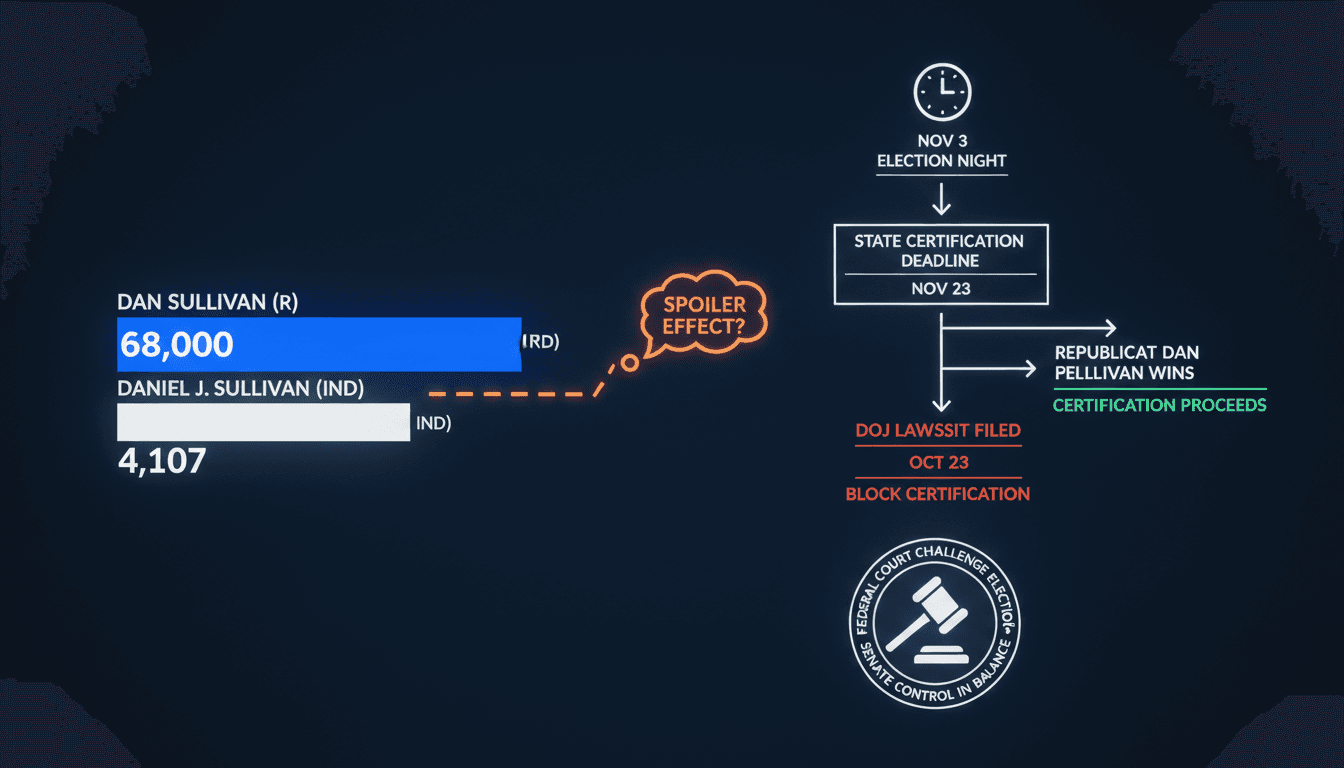
Heightened legal challenges over federal legislative seats introduce jurisdictional uncertainty for cross-border institutions modeling long-term U.S. regulatory and fiscal policy.
Why it matters
Federal intervention in state-level ballot administration tests the standard mechanics of legislative certification, directly influencing the balance of power in the U.S. Senate.
What happened (in 30 seconds)
- The Justice Department filed a federal lawsuit on October 23, 2026, seeking to prevent Alaska election officials from automatically certifying the state’s U.S. Senate race results if Republican incumbent Dan Sullivan is defeated by Democrat Mary Peltola.
- The legal claim hinges on potential voter confusion caused by independent candidate Daniel J. Sullivan Jr., whose similar name remains on the November 3, 2026, general election ballot alongside the incumbent.
- Attorney General Todd Blanche defended the litigation on October 25, 2026, stating the action enforces the National Voter Registration Act, following statements from President Donald Trump confirming he directed the filing.
The context you actually need
- Prior judicial review upheld the ballot lineup, with both Alaska state courts and the U.S. Supreme Court previously rejecting legal petitions aimed at removing Daniel J. Sullivan Jr. from the ballot.
- Primary vote distributions showed significant separation, as Sen. Dan Sullivan secured 68,000 votes in the August 2026 primary, compared to 4,107 votes recorded for Daniel J. Sullivan Jr.
- State election authorities implemented differentiation measures, applying designated party labels and utilizing Alaska's ranked-choice voting framework to help voters distinguish between the candidates.
What's really happening
The lawsuit targeting Alaska’s Senate race highlights an operational pivot toward preemptive federal litigation over state-administered election mechanics. At the center of the dispute is the presence of two candidates sharing a surname: incumbent Republican Dan S. Sullivan and independent candidate Daniel J. Sullivan Jr., a retired schoolteacher. The Department of Justice argues that identical surnames create an operational defect under the National Voter Registration Act, requesting that federal courts block certification if the incumbent loses a margin smaller than the total tally secured by the independent candidate.
The structural incentive driving this litigation is the narrow margin of control in the U.S. Senate. In a tightly contested legislative landscape, the outcome of a single seat determines procedural leadership, committee majorities, and statutory approval power over executive appointments. By intervening before ballots are cast and tallied on November 3, the executive branch establishes an administrative mechanism to challenge outcomes conditioned specifically on an incumbent loss.
The legal strategy faces established institutional barriers. Alaska's administrative framework relies on ranked-choice voting, an electoral design engineered to absorb multiple candidates by letting voters express secondary and tertiary preferences. Furthermore, state courts and the federal Supreme Court previously evaluated the ballot configuration and declined to remove the independent candidate. Because election administration is constitutionally decentralized to state authorities, deploying federal statutory claims to block state-level certification requires establishing direct federal injury—a standard legal analysts characterize as difficult to substantiate on the merits.
Simultaneously, the dispute exposes intra-party policy divergence. Alaska’s senior senator, Lisa Murkowski, publicly opposed the Justice Department's intervention, noting that state election administrators had already implemented sufficient ballot distinctions. The public friction between congressional incumbents and the executive branch underscores how federal litigation strategies can alter operational coordination within legislative delegations.
For international observers and strategic planners monitoring U.S. policy vectors, these procedural disputes reflect a broader structural trend: election outcomes are increasingly subject to post-voting legal containment, extending timelines for confirmed legislative control and delaying policy clarity.
Who feels it first (and how)
- Alaska state election administrators, who face potential federal injunctions and conflicting administrative directives while managing the ranked-choice tabulation process.
- U.S. legislative strategy offices and corporate affairs teams, who must factor prolonged certification timelines and delayed majority determinations into their policy projections.
- Campaign legal counsel and political committees, who are forced to reallocate capital and operational resources toward post-election federal court interventions.
What to watch next
- Federal district court preliminary rulings, which will determine whether the DOJ's statutory theory warrants an emergency injunction before the November 3 election date.
- Tabulation margins on election night, specifically whether the gap between Mary Peltola and Dan Sullivan is narrower than the votes cast for Daniel J. Sullivan Jr.
- State administrative certification schedules, which govern the legal deadlines Alaska officials must meet under state statutes to transmit official results.
The DOJ filed a federal lawsuit invoking the National Voter Registration Act to block certification if Dan Sullivan loses, which Attorney General Blanche defended on October 25, 2026.
The lawsuit will encounter significant procedural challenges in federal court, given prior state and Supreme Court decisions upholding the ballot configuration.
Whether federal judges will consider granting temporary injunctive relief that alters state certification timelines prior to the final counting of ranked-choice ballots.
Frequently Asked Questions
- Why it matters?
- Federal intervention in state-level ballot administration tests the standard mechanics of legislative certification, directly influencing the balance of power in the U.S. Senate.
- What happened (in 30 seconds)?
- The Justice Department filed a federal lawsuit on October 23, 2026, seeking to prevent Alaska election officials from automatically certifying the state’s U.S. Senate race results if Republican incumbent Dan Sullivan is defeated by Democrat Mary Peltola. The legal claim hinges on potential voter confusion caused by independent candidate Daniel J. Sullivan Jr., whose similar name remains on the November 3, 2026, general election ballot alongside the incumbent. Attorney General Todd Blanche defend
- What's really happening?
- The lawsuit targeting Alaska’s Senate race highlights an operational pivot toward preemptive federal litigation over state-administered election mechanics. At the center of the dispute is the presence of two candidates sharing a surname: incumbent Republican Dan S. Sullivan and independent candidate Daniel J. Sullivan Jr., a retired schoolteacher. The Department of Justice argues that identical surnames create an operational defect under the National Voter Registration Act, requesting that feder
- Who feels it first (and how)?
- Alaska state election administrators, who face potential federal injunctions and conflicting administrative directives while managing the ranked-choice tabulation process. U.S. legislative strategy offices and corporate affairs teams, who must factor prolonged certification timelines and delayed majority determinations into their policy projections. Campaign legal counsel and political committees, who are forced to reallocate capital and operational resources toward post-election federal court i
- What to watch next?
- Federal district court preliminary rulings, which will determine whether the DOJ's statutory theory warrants an emergency injunction before the November 3 election date. Tabulation margins on election night, specifically whether the gap between Mary Peltola and Dan Sullivan is narrower than the votes cast for Daniel J. Sullivan Jr. State administrative certification schedules, which govern the legal deadlines Alaska officials must meet under state statutes to transmit official results.
Public radio coverage of American news and issues.
"NPR is an American public media organization known for thoughtful reporting and a slightly left-leaning editorial tone."
— A47 Editor
Blanche defends DOJ lawsuit blocking Alaska Senate results if Republican loses
Attorney General Todd Blanche defended a Justice Department lawsuit in Alaska that seeks to block certification of the state's Senate results if Republican Sen. Dan Sullivan loses, speaking in a CNN interview.
Insights and news on social issues, policy, and political movements across the United States.
"The Wall Street Journal is known for its deep political coverage, especially at the intersection of policy, regulation, and social dynamics."
— A47 Editor
Attorney General Todd Blanche on Sunday offered a combative defense of the Justice Department’s lawsuit seeking to block certification of Alaska’s Senate race if the Republican candidate loses
Attorney General Todd Blanche defended a Justice Department lawsuit seeking to block certification of Alaska's U.S. Senate results if the Republican candidate, incumbent Sen. Dan Sullivan, loses, offering a combative defense in Sunday interviews. The...
Capitol Hill news, legislation, and policy insight.
"The Hill specializes in U.S. politics and policy, with a focus on Capitol Hill developments and a reputation for insider reporting."
— A47 Editor
Blanche accuses 'Face the Nation' host of 'misleading' description of Alaska election lawsuit
Attorney General Todd Blanche accused CBS News's "Face the Nation" host Margaret Brennan of giving a "misleading" description of a Justice Department lawsuit in Alaska, where two candidates with similar names, including incumbent Republican Sen. Dan ...
News from the United States including domestic politics, society, and culture.
"The Guardian is known for its progressive editorial stance and in-depth analysis, often advocating for social justice, environmental issues, and liberal values."
— A47 Editor
Blanche defends DoJ’s pre-emptive suit to block Alaska Senate results certification
Attorney General Todd Blanche defended the Justice Department's pre-emptive lawsuit seeking to block certification of Alaska's US Senate results if incumbent Republican Dan Sullivan loses, dismissing a CNN host's question about a possible January 6-s...
Top international stories selected by The Guardian editors.
"The Guardian is known for its progressive editorial stance and in-depth analysis."
— A47 Editor
Blanche defends DoJ’s pre-emptive suit to block Alaska Senate results certification
Attorney General Todd Blanche defended the Justice Department's pre-emptive lawsuit seeking to block certification of Alaska's US Senate results if incumbent Republican Dan Sullivan loses, dismissing a CNN host's question about a possible January 6-s...
Right-of-center views on political news.
"The Washington Times is a conservative-leaning newspaper known for its political coverage and advocacy of right-of-center viewpoints."
— A47 Editor
Are Alaska voters confused by two Dan Sullivans? DOJ sues to find out, Blanche says
The Trump administration filed a federal lawsuit in Alaska seeking to prevent certification of the state's U.S. Senate results if Republican incumbent Dan Sullivan loses, with Attorney General Todd Blanche defending the move in Sunday interviews by s...