
DOJ Defends Lawsuit Seeking to Block Alaska Senate Certification Over Duplicate Sullivan Candidate Dispute
Why it matters
Federal intervention in state-level ballot certification tests the established boundaries between local election administration and federal executive oversight, injecting institutional uncertainty into an already tight Senate balance of power.
What happened (in 30 seconds)
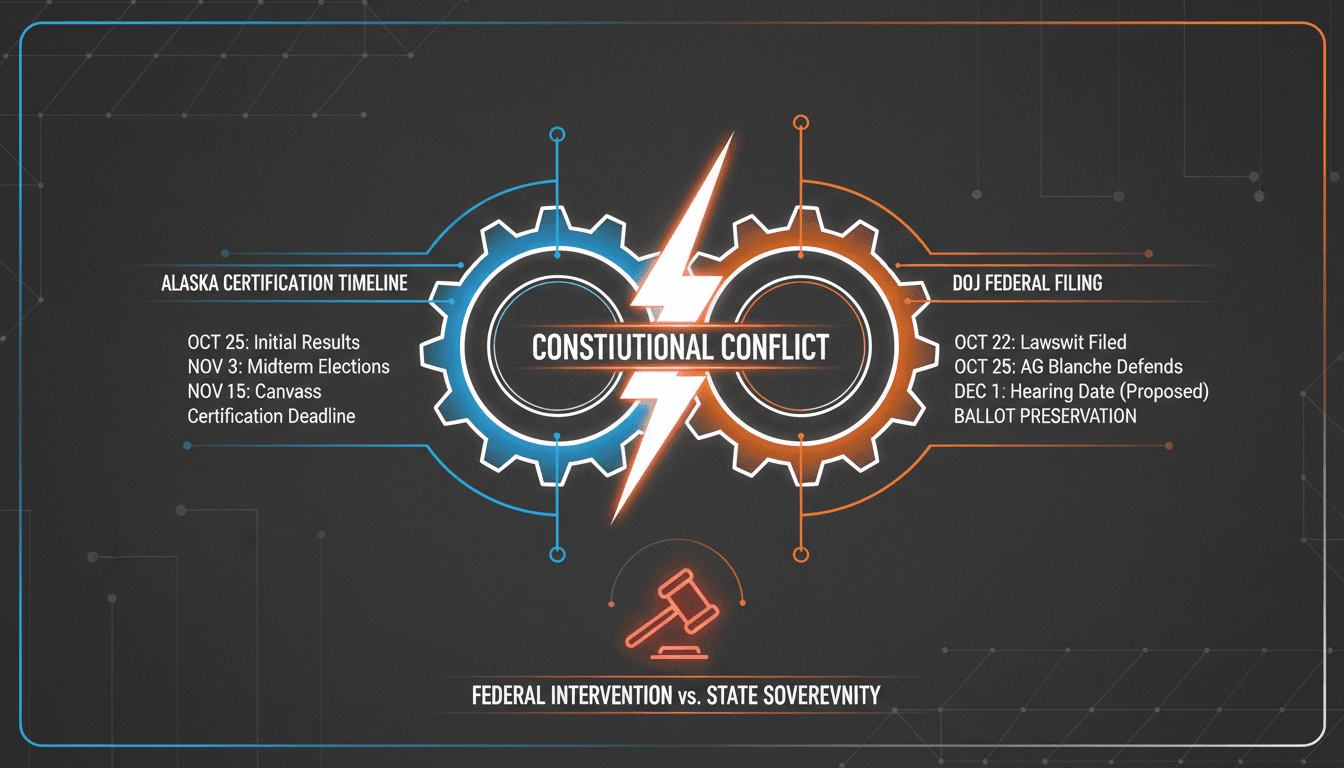
- The Department of Justice filed a federal lawsuit on October 22, 2026, seeking an order to preserve ballots and potentially block certification of Alaska’s Senate election if voter confusion between two similarly named candidates taints the outcome.
- US Attorney General Todd Blanche mounted a public defense of the filing on October 25, 2026, stating the action targets deliberate voter confusion and aims to preserve evidence rather than preemptively halt voting.
- The action prompted immediate cross-party pushback, with critics and legal observers highlighting constitutional limits on federal involvement in state certification processes ahead of the November 3, 2026, midterms.
The context you actually need
- Alaska's primary produced two candidates sharing a name, advancing Republican incumbent Dan S. Sullivan, Republican challenger Daniel J. Sullivan, and Democratic candidate Mary Peltola to the November general election ballot.
- State judicial and administrative bodies intervened early, with the Alaska Supreme Court ruling in June 2026 that both candidates could appear, prompting state administrators to add an incumbent label and a "Jr." designation to mitigate confusion.
- Polling margins have tightened the stakes, as an early October 2026 New York Times/Siena College survey placed Mary Peltola ahead of incumbent Dan S. Sullivan by nearly 7 percentage points in a race critical to determining the chamber's majority.
What's really happening
The operational friction in Alaska exposes how tight legislative margins incentivize preemptive federal legal strategies. Republicans entered the 2026 midterms holding a slim majority in the US Senate. In high-stakes legislative chambers, a shift of a single seat directly dictates committee control, judicial confirmation timelines, and regulatory review powers under federal statutes. Consequently, any dynamic that threatens an incumbent seat commands elevated scrutiny.
The structural complication began during Alaska’s August 2026 primaries. Under Alaska’s election framework, multiple candidates from the same party can advance to the general election. When both incumbent Senator Dan S. Sullivan and challenger Daniel J. Sullivan advanced, the Alaska Division of Elections faced an administrative hurdle. The Alaska Supreme Court addressed this scenario in June 2026, ruling that Daniel J. Sullivan possessed the legal right to remain on the ballot. To address voter confusion, the state adopted practical visual differentiators: printing the word "incumbent" next to Dan S. Sullivan and appending "Jr." to the secondary candidate.
The Department of Justice’s intervention on October 22, 2026, bypassed those state-level remedies by taking the matter to the US District Court in Alaska. The lawsuit argues that the presence of two nearly identical names on the ballot risks corrupting the outcome, asserting that certification should be declared unlawful if voter confusion demonstrably alters the tally. In public remarks on October 24, President Donald Trump stated that he directed the legal action.
During his October 25 appearances on national television networks, Attorney General Todd Blanche framed the filing as an evidentiary safeguard rather than an attempt to invalidate the voting process. Blanche argued that the legal measure was intended to preserve ballot records for post-election forensic review, contending that the presence of the second candidate was an intentional attempt to dilute the incumbent’s vote.
However, legal analysts note that the lawsuit confronts substantial constitutional hurdles. The US Constitution establishes that individual states, rather than the federal executive branch, hold primary responsibility for administering elections and certifying results. Because federal courts routinely require clear statutory authorization before interfering with state certification mechanisms, the filing establishes an institutional precedent: applying federal litigation pressure prior to election day to shape post-election certification parameters.
Who feels it first (and how)
- Alaska election administrators, who must manage dual-track responsibilities of administering election day procedures while responding to active federal district court filings.
- Federal legislative strategy teams, who must adjust their post-election majority scenarios to account for prolonged certification delays or post-vote ballot preservation disputes.
- State election directors across the US, who face a new baseline where localized ballot-design disputes may draw pre-election federal legal intervention.
What to watch next
- US District Court emergency rulings: Monitor early filings in the District of Alaska, which will determine whether the court dismisses the case on standing grounds or orders ballot preservation protocols before November 3.
- Post-election certification timeline: Watch the Alaska Division of Elections’ initial canvass dates to see if state officials encounter administrative challenges when finalizing results.
- Bipartisan congressional pushback: Track whether criticism from figures such as Senator Lisa Murkowski translates into formal legislative inquiries regarding executive intervention guidelines.
The DOJ filed a lawsuit on October 22, 2026, regarding Alaska's Senate race ballot confusion, which Attorney General Blanche defended publicly on October 25 following presidential direction.
The lawsuit faces steep procedural barriers in federal court, given established precedent that limits federal executive involvement in state-managed election certification.
Whether the margin between Dan S. Sullivan and Mary Peltola will be close enough on election night for the presence of Daniel J. Sullivan to become the deciding mathematical factor.
Frequently Asked Questions
- Why it matters?
- Federal intervention in state-level ballot certification tests the established boundaries between local election administration and federal executive oversight, injecting institutional uncertainty into an already tight Senate balance of power.
- What happened (in 30 seconds)?
- The Department of Justice filed a federal lawsuit on October 22, 2026, seeking an order to preserve ballots and potentially block certification of Alaska’s Senate election if voter confusion between two similarly named candidates taints the outcome. US Attorney General Todd Blanche mounted a public defense of the filing on October 25, 2026, stating the action targets deliberate voter confusion and aims to preserve evidence rather than preemptively halt voting. The action prompted immediate cross
- What's really happening?
- The operational friction in Alaska exposes how tight legislative margins incentivize preemptive federal legal strategies. Republicans entered the 2026 midterms holding a slim majority in the US Senate. In high-stakes legislative chambers, a shift of a single seat directly dictates committee control, judicial confirmation timelines, and regulatory review powers under federal statutes. Consequently, any dynamic that threatens an incumbent seat commands elevated scrutiny. The structural complicati
- Who feels it first (and how)?
- Alaska election administrators, who must manage dual-track responsibilities of administering election day procedures while responding to active federal district court filings. Federal legislative strategy teams, who must adjust their post-election majority scenarios to account for prolonged certification delays or post-vote ballot preservation disputes. State election directors across the US, who face a new baseline where localized ballot-design disputes may draw pre-election federal legal inter
- What to watch next?
- US District Court emergency rulings: Monitor early filings in the District of Alaska, which will determine whether the court dismisses the case on standing grounds or orders ballot preservation protocols before November 3. Post-election certification timeline: Watch the Alaska Division of Elections’ initial canvass dates to see if state officials encounter administrative challenges when finalizing results. Bipartisan congressional pushback: Track whether criticism from figures such as Senator Li
Comprehensive coverage of Middle Eastern and global issues.
"Al Jazeera is a prominent voice from the Global South, especially the Middle East, with an emphasis on underreported stories."
— A47 Editor
US Attorney General Todd Blanche defends Alaska Senate election lawsuit
US Attorney General Todd Blanche defended a Justice Department pre-emptive lawsuit seeking to block certification of Alaska's US Senate election results if incumbent Republican Dan Sullivan loses, a move that critics say aims to block a Democratic vi...
Global news coverage with extensive reporting on Middle Eastern conflicts and geopolitics.
"Al Jazeera is a Qatar-based broadcaster known for wide regional coverage and alternative perspectives."
— A47 Editor
US Attorney General Todd Blanche defends Alaska Senate election lawsuit
US Attorney General Todd Blanche defended a Justice Department pre-emptive lawsuit seeking to block certification of Alaska's US Senate election results if incumbent Republican Dan Sullivan loses, a move that critics say aims to block a Democratic vi...
Public radio coverage of American news and issues.
"NPR is an American public media organization known for thoughtful reporting and a slightly left-leaning editorial tone."
— A47 Editor
Blanche defends DOJ lawsuit blocking Alaska Senate results if Republican loses
Attorney General Todd Blanche defended a Justice Department lawsuit in Alaska that seeks to block certification of the state's Senate results if Republican Sen. Dan Sullivan loses, speaking in a CNN interview.
Insights and news on social issues, policy, and political movements across the United States.
"The Wall Street Journal is known for its deep political coverage, especially at the intersection of policy, regulation, and social dynamics."
— A47 Editor
Attorney General Todd Blanche on Sunday offered a combative defense of the Justice Department’s lawsuit seeking to block certification of Alaska’s Senate race if the Republican candidate loses
Attorney General Todd Blanche defended a Justice Department lawsuit seeking to block certification of Alaska's U.S. Senate results if the Republican candidate, incumbent Sen. Dan Sullivan, loses, offering a combative defense in Sunday interviews. The...
Capitol Hill news, legislation, and policy insight.
"The Hill specializes in U.S. politics and policy, with a focus on Capitol Hill developments and a reputation for insider reporting."
— A47 Editor
Blanche accuses 'Face the Nation' host of 'misleading' description of Alaska election lawsuit
Attorney General Todd Blanche accused CBS News's "Face the Nation" host Margaret Brennan of giving a "misleading" description of a Justice Department lawsuit in Alaska, where two candidates with similar names, including incumbent Republican Sen. Dan ...
Top international stories selected by The Guardian editors.
"The Guardian is known for its progressive editorial stance and in-depth analysis."
— A47 Editor
Blanche defends DoJ’s pre-emptive suit to block Alaska Senate results certification
Attorney General Todd Blanche defended the Justice Department's pre-emptive lawsuit seeking to block certification of Alaska's US Senate results if incumbent Republican Dan Sullivan loses, dismissing a CNN host's question about a possible January 6-s...
News from the United States including domestic politics, society, and culture.
"The Guardian is known for its progressive editorial stance and in-depth analysis, often advocating for social justice, environmental issues, and liberal values."
— A47 Editor
Blanche defends DoJ’s pre-emptive suit to block Alaska Senate results certification
Attorney General Todd Blanche defended the Justice Department's pre-emptive lawsuit seeking to block certification of Alaska's US Senate results if incumbent Republican Dan Sullivan loses, dismissing a CNN host's question about a possible January 6-s...
Capitol Hill news, legislation, and policy insight.
"The Hill specializes in U.S. politics and policy, with a focus on Capitol Hill developments and a reputation for insider reporting."
— A47 Editor
Blanche: Alaska Senate race is 'not a fair fight' to Trump
Attorney General Todd Blanche said on CNN on Sunday that President Trump considers Alaska's Senate race "not a fair fight" because a candidate with the same name as incumbent Sen. Dan Sullivan (R) appears on the ballot, which he argued could confuse ...
Capitol Hill news, legislation, and policy insight.
"The Hill specializes in U.S. politics and policy, with a focus on Capitol Hill developments and a reputation for insider reporting."
— A47 Editor
Blanche: DOJ lawsuit not trying to 'stop the certification of Alaska's election'
Attorney General Todd Blanche clarified that the Justice Department's recent lawsuit is not aimed at halting the certification of Alaska's election results, despite claims made in the legal filing intended to protect electoral integrity. The lawsuit ...
U.S. political news and right-leaning commentary.
"Fox News is a highly influential conservative news outlet known for right-leaning political commentary and coverage."
— A47 Editor
Blanche won't rule out DOJ blocking election certification in 'doomsday' scenario
Attorney General Todd Blanche has indicated that he will not rule out the possibility of the Department of Justice intervening in the certification of midterm elections, citing hypothetical 'doomsday' scenarios. This statement raises concerns about t...