
UK Declines DSRB Membership and Launches Separate Multilateral Defence Mechanism Alongside Canada Cooperation Framework
Why it matters
The bifurcation of multilateral defense finance creates parallel borrowing pools, directly impacting capital efficiency, bond yields, and sovereign balance-sheet leverage across NATO member states.
What happened (in 30 seconds)
- London declined to join Ottawa’s platform: On October 25, 2026, the United Kingdom formally opted out of the Canada-led Defence, Security and Resilience Bank (DSRB) following months of bilateral negotiations.
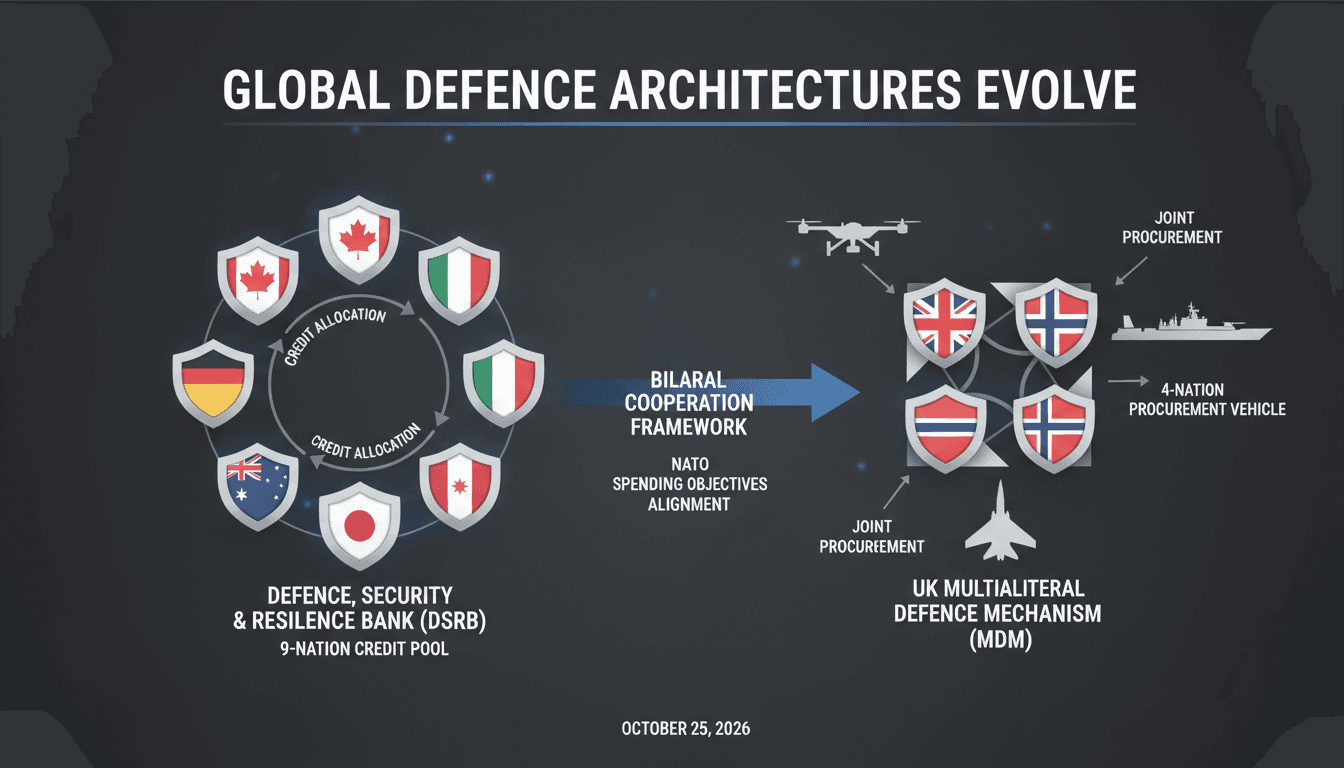
- The UK will build its own procurement vehicle: Prime Minister Andy Burnham and Chancellor John Healey announced that the UK will proceed independently with its Multilateral Defence Mechanism (MDM), backed by initial participation from the Netherlands, Poland, and Finland.
- Both states established a coordination pact: Canada and the UK issued a joint statement outlining a mutual cooperation framework to ensure the two distinct entities invest collaboratively rather than directly compete.
The context you actually need
- The baseline spending imperative: Conceived in 2024 following the 2022 invasion of Ukraine, the DSRB was designed to assist NATO members in meeting heightened defense spending targets through pooled borrowing.
- The Canadian balance-sheet play: Under Prime Minister Mark Carney, Canada sought to anchor the DSRB as a multilateral development-style bank that uses pooled sovereign credit ratings to drive down borrowing costs for all participants.
- The British procurement focus: First mapped out under former Chancellor Rachel Reeves, the UK's MDM was structured specifically around streamlined equipment procurement and national budget deficits rather than broad balance-sheet pooling.
What's really happening
The decision to run separate institutions reveals a fundamental divergence in institutional design and risk appetite among allied states. Canada’s DSRB operates on the traditional multilateral development bank model: nine founding nations—including Canada, Albania, Belgium, Greece, Latvia, Luxembourg, Romania, Turkey, and Ukraine—pool their sovereign credit strengths. By combining these credit profiles, the entity aims to issue debt at lower yields than lower-rated member states could achieve independently. For Ottawa, this approach spreads risk broadly across a wide geographic alliance and offers a mechanism to fund dual-use infrastructure and defense resilience over long horizons.
In contrast, the United Kingdom’s MDM is designed as a targeted procurement engine. By maintaining an independent vehicle with northern and eastern European partners—specifically the Netherlands, Poland, and Finland—the UK preserves tight control over industrial supply chains and procurement specifications. Merging with Canada’s broader group would have diluted London’s decision-making power over technical standards, manufacturing contracts, and debt covenants. The split reflects an intentional trade-off: London sacrificed the balance-sheet scale of a single global defense bank to avoid governance bottlenecks and preserve industrial policy sovereignty.
This structural divergence carries specific operational consequences. While both governments emphasize NATO alignment, international bond markets will now be asked to absorb debt issuances from two distinct multilateral defense entities instead of one consolidated issuer. Underwriters and institutional investors will price DSRB bonds against the pooled credit quality of its nine diverse members, whereas the UK-led MDM will trade on the fiscal alignment of its smaller, procurement-focused coalition. Because European defense figures have already raised concerns that procurement-linked mechanisms infringe on national sovereignty, the UK's framework faces scrutiny over how strictly its contracts bind member military choices. Conversely, Canada must prove that an institution containing economies with varying fiscal metrics can maintain low borrowing costs without the UK's sovereign balance sheet providing additional top-tier weight.
Who feels it first (and how)
- Sovereign debt syndication desks: Fixed-income desks will need to evaluate two separate multilateral debt structures with differing governance frameworks, liquidity pools, and underlying credit profiles.
- European defense contractors: Prime contractors in the UK, Poland, Finland, and the Netherlands gain direct access to targeted MDM procurement pipelines, while suppliers aligned with the 9 DSRB members must navigate Ottawa’s charter rules.
- Finance ministries across the 9 DSRB founding nations: Treasury teams in countries such as Turkey, Belgium, Romania, and Ukraine will carry the institutional underwriting obligations of the DSRB without British credit participation.
What to watch next
- The DSRB charter finalization: The official signing of the DSRB charter in late November 2026 will reveal the exact capital structure, paid-in capital ratios, and initial lending ceiling for the nine founding states.
- MDM capital commitments: Look for formal deployment targets from London, Warsaw, Amsterdam, and Helsinki to determine the initial financing volume of the UK-led vehicle.
- Credit agency ratings: Watch how credit rating agencies evaluate the DSRB's pooled structure relative to traditional multilateral development banks once its founding member list is locked.
The UK has declined DSRB membership, Canada is advancing the bank with 9 founding nations, and the UK will develop the MDM alongside the Netherlands, Poland, and Finland under a bilateral cooperation agreement.
The existence of two separate financing vehicles will lead to fragmented debt issuance schedules and differentiated borrowing costs across NATO's European and North American members.
Whether institutional fixed-income markets will grant the 9-member DSRB the low borrowing spreads Canada envisioned without the presence of the UK's sovereign balance sheet.
Frequently Asked Questions
- Why it matters?
- The bifurcation of multilateral defense finance creates parallel borrowing pools, directly impacting capital efficiency, bond yields, and sovereign balance-sheet leverage across NATO member states.
- What happened (in 30 seconds)?
- London declined to join Ottawa’s platform: On October 25, 2026, the United Kingdom formally opted out of the Canada-led Defence, Security and Resilience Bank (DSRB) following months of bilateral negotiations. The UK will build its own procurement vehicle: Prime Minister Andy Burnham and Chancellor John Healey announced that the UK will proceed independently with its Multilateral Defence Mechanism (MDM), backed by initial participation from the Netherlands, Poland, and Finland. Both states establ
- What's really happening?
- The decision to run separate institutions reveals a fundamental divergence in institutional design and risk appetite among allied states. Canada’s DSRB operates on the traditional multilateral development bank model: nine founding nations—including Canada, Albania, Belgium, Greece, Latvia, Luxembourg, Romania, Turkey, and Ukraine—pool their sovereign credit strengths. By combining these credit profiles, the entity aims to issue debt at lower yields than lower-rated member states could achieve in
- Who feels it first (and how)?
- Sovereign debt syndication desks: Fixed-income desks will need to evaluate two separate multilateral debt structures with differing governance frameworks, liquidity pools, and underlying credit profiles. European defense contractors: Prime contractors in the UK, Poland, Finland, and the Netherlands gain direct access to targeted MDM procurement pipelines, while suppliers aligned with the 9 DSRB members must navigate Ottawa’s charter rules. Finance ministries across the 9 DSRB founding nations: T
- What to watch next?
- The DSRB charter finalization: The official signing of the DSRB charter in late November 2026 will reveal the exact capital structure, paid-in capital ratios, and initial lending ceiling for the nine founding states. MDM capital commitments: Look for formal deployment targets from London, Warsaw, Amsterdam, and Helsinki to determine the initial financing volume of the UK-led vehicle. Credit agency ratings: Watch how credit rating agencies evaluate the DSRB's pooled structure relative to traditio
International coverage of politics, security, and social issues.
"Global News is a mainstream Canadian outlet with a centrist editorial stance, focusing on factual reporting."
— A47 Editor
U.K. won’t join Canada-led defence bank, but pledges cooperation
The United Kingdom has declined to join a defence bank led by Canada, but the two countries have pledged to "work in close partnership" on investment opportunities and challenges, according to a joint media statement.
Macro commentary, policy analysis, growth/inflation themes, and global outlooks.
"Contextual macro coverage that complements day-to-day market headlines."
— A47 Editor
Canada, UK to develop separate defense financing institutions
Canada and the United Kingdom have announced plans to develop separate defense financing institutions, according to a report published by Investing.com. The base coverage is brief and does not detail the structure, funding size, or timeline of either...
Macro commentary, policy analysis, growth/inflation themes, and global outlooks.
"Contextual macro coverage that complements day-to-day market headlines."
— A47 Editor
Britain will not join Canada’s defence bank, source says
Britain will not join Canada's proposed global defence bank, according to a source cited by Investing.com, marking a neutral development in the base story's account of the initiative. Earlier reporting indicated that UK officials had been in talks wi...