
Israeli Expatriates Required to Fly Home for In-Person Voting in October 27 2026 National Election
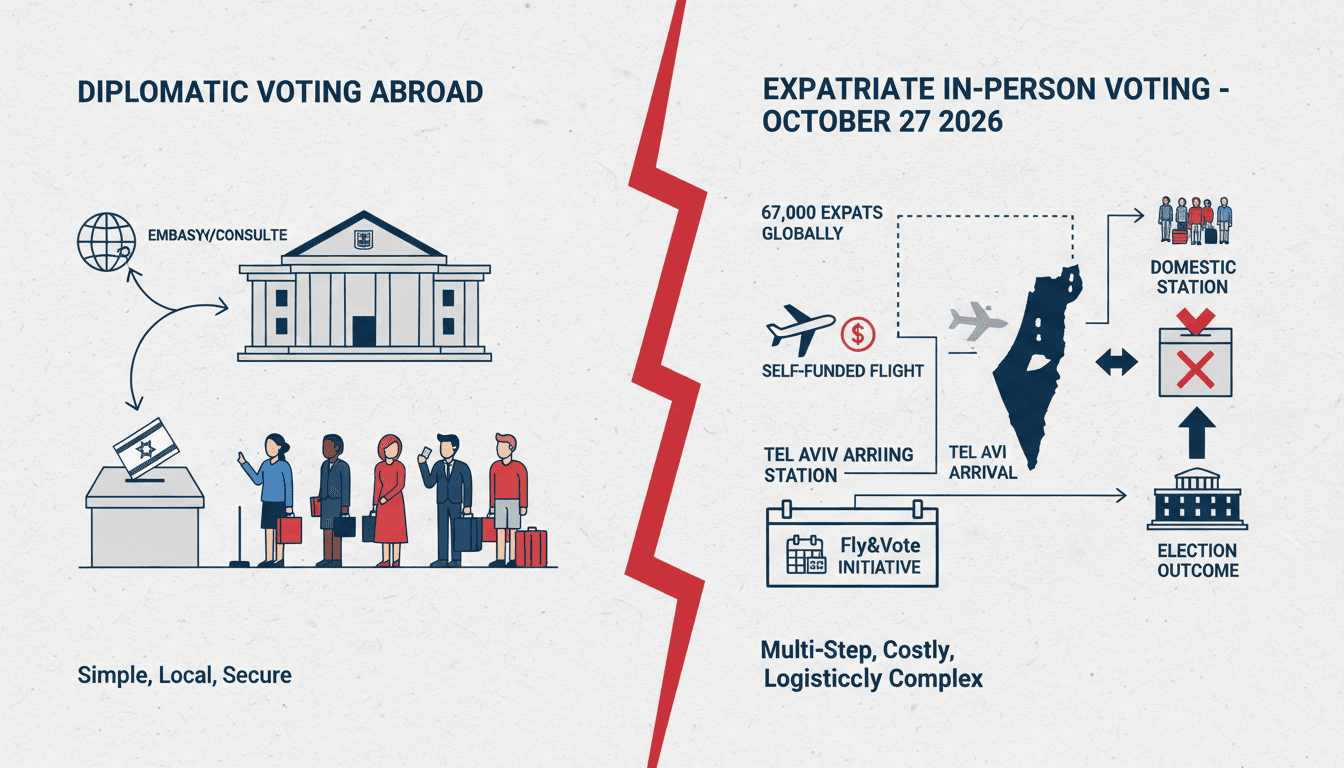
Cross-border mobility and personal logistics dictate participation thresholds when statutory systems refuse absentee mechanisms.
Why it matters
Strict physical residency requirements for balloting force citizens to weigh direct financial outlays against political representation, establishing turnout ceilings that alter tight parliamentary margins.
What happened (in 30 seconds)
- Mandatory domestic presence: Israeli law prohibits general mail-in or absentee ballots, compelling tens of thousands of citizens living abroad to travel home to vote in the October 27, 2026 national election.
- Grassroots logistical campaigns: Expatriate networks, including the Fly&Vote initiative, coordinated self-funded travel options, registering more than 35,000 participants and projecting total expat returns between 50,000 and 67,000.
- Petitions cleared: Legal actions brought by the Likud party claiming external procedural interference were withdrawn or dismissed by courts, clearing the path for inbound voter flights across late October.
The context you actually need
- A statutory outlier: Unlike most democratic peers that facilitate postal or consular voting, Israel limits overseas balloting strictly to diplomats, official emissaries, and select state workers abroad.
- High Court precedent: Legal petitions regarding voter roll classifications—notably non-resident registrations under "Code 51"—were dismissed by the High Court in September 2026, preserving strict in-country requirements.
- Tight coalition arithmetic: With observer projections noting that 50,000 to 67,000 returning voters represent the mathematical equivalent of one to two parliamentary seats, thin electoral margins elevate the influence of mobilized travelers.
What's really happening
The absence of a postal voting mechanism introduces a structural barrier based on friction, time, and private capital. When an electoral framework requires physical presence at a domestic ballot box, voting ceases to be merely a civic procedure; it becomes an international logistics exercise. For expatriates residing across North America, Europe, or the broader Middle East, exercising a franchise involves balancing personal schedules, route availability, and round-trip transport expenses.
This mechanical constraint alters the incentive structures of national campaigns. Under universal absentee access, political parties run cost-efficient international digital outreach to maximize overseas returns. Under mandatory domestic balloting, campaigns and grassroots organizations must evaluate whether their potential overseas voters possess the disposable resources, organizational support, and flexibility necessary to cross time zones on a designated Tuesday. In this context, coordinated entities such as the Fly&Vote coalition emerged to solve systemic coordination failures, providing aggregated flight information and group logistics rather than campaign subsidies, as participants covered their own costs.
At the legal level, this physical bottleneck generates institutional contention. The Likud party targeted these coordinated travel mechanisms through administrative and legal challenges, seeking to block operations on grounds of foreign influence. However, court dismissals verified that coordinating commercial air travel does not constitute improper electoral practice under current statutory rules.
Simultaneously, early data from official state emissaries indicated heightened overseas participation, registering turnout metrics 17 percentage points above 2022 levels. While state-sponsored personnel operate within protected, fully funded consular voting protocols, private citizens remain bound to self-financed physical returns. In an electoral contest where one to two seats can determine coalition building for the 26th Knesset, the presence of 67,000 self-funded travelers serves as a quantifiable variable. The friction-heavy voting system inadvertently turns private wealth, geographic proximity, and travel availability into decisive filters for electoral participation.
Who feels it first (and how)
- Long-haul expatriate professionals: Citizens based in secondary markets or locations lacking direct connections face multi-day travel commitments and peak airfares to register a single ballot.
- Commercial air carriers: Airlines operating direct trunk lines into Tel Aviv—such as newly restored long-haul routes from the US West Coast—absorb targeted demand spikes concentrated across mid-to-late October.
- Parliamentary coalition strategists: Party tacticians must factor an unpolled, cross-border cohort of up to 67,000 returnees into seat projections that usually rely entirely on domestic polling samples.
What to watch next
- Final border arrival tallies: Official border processing figures post-October 27 will demonstrate whether Fly&Vote's 50,000–67,000 projection materialized into actual domestic entries.
- Seat distribution threshold impact: The distribution of the final 1–2 Knesset seats will indicate whether expat return volumes were large enough to mathematically flip a coalition majority.
- Post-election voting reform debates: Whether subsequent legislative sessions review consular voting access or maintain strict in-person requirements to curb overseas voter mobilization.
Israeli electoral statutes mandate physical presence for all private citizens living abroad; judicial challenges against expat flight networks were formally dismissed.
Flight volumes concentrated in the 48 hours before October 27 will yield measurable shifts in voter turnout rates compared to previous cycles.
The exact political distribution of returning expat voters remains unverified, as self-selection bias and self-funded models make exit polling among this group unreliable.
Frequently Asked Questions
- Why it matters?
- Strict physical residency requirements for balloting force citizens to weigh direct financial outlays against political representation, establishing turnout ceilings that alter tight parliamentary margins.
- What happened (in 30 seconds)?
- Mandatory domestic presence: Israeli law prohibits general mail-in or absentee ballots, compelling tens of thousands of citizens living abroad to travel home to vote in the October 27, 2026 national election. Grassroots logistical campaigns: Expatriate networks, including the Fly&Vote initiative, coordinated self-funded travel options, registering more than 35,000 participants and projecting total expat returns between 50,000 and 67,000. Petitions cleared: Legal actions brought by the Likud part
- What's really happening?
- The absence of a postal voting mechanism introduces a structural barrier based on friction, time, and private capital. When an electoral framework requires physical presence at a domestic ballot box, voting ceases to be merely a civic procedure; it becomes an international logistics exercise. For expatriates residing across North America, Europe, or the broader Middle East, exercising a franchise involves balancing personal schedules, route availability, and round-trip transport expenses. This
- Who feels it first (and how)?
- Long-haul expatriate professionals: Citizens based in secondary markets or locations lacking direct connections face multi-day travel commitments and peak airfares to register a single ballot. Commercial air carriers: Airlines operating direct trunk lines into Tel Aviv—such as newly restored long-haul routes from the US West Coast—absorb targeted demand spikes concentrated across mid-to-late October. Parliamentary coalition strategists: Party tacticians must factor an unpolled, cross-border coho
- What to watch next?
- Final border arrival tallies: Official border processing figures post-October 27 will demonstrate whether Fly&Vote's 50,000–67,000 projection materialized into actual domestic entries. Seat distribution threshold impact: The distribution of the final 1–2 Knesset seats will indicate whether expat return volumes were large enough to mathematically flip a coalition majority. Post-election voting reform debates: Whether subsequent legislative sessions review consular voting access or maintain strict
European coverage of Middle East politics and security issues.
"France 24 offers international reporting with a European editorial perspective."
— A47 Editor
Israel election: unable to vote from abroad, expats have to fly home
Israelis abroad are unable to vote from overseas because Israel requires ballots to be cast in person, so tens of thousands of expatriates are expected to fly home for the October 27 general election. Supporters of opposition figure Gadi Eisenkot wer...
24/7 international news from a French perspective in multiple languages.
"France 24 is viewed as a globally focused outlet with balanced coverage and a European perspective."
— A47 Editor
Israel election: unable to vote from abroad, expats have to fly home
Israelis abroad are unable to vote from overseas because Israel requires ballots to be cast in person, so tens of thousands of expatriates are expected to fly home for the October 27 general election. Supporters of opposition figure Gadi Eisenkot wer...
European coverage of Middle East politics and security issues.
"France 24 offers international reporting with a European editorial perspective."
— A47 Editor
Tens of thousands of Israelis living abroad expected to fly in for pivotal vote
Tens of thousands of Israelis living abroad are flying home ahead of the October 27 general election, since expatriate citizens cannot vote from overseas. FRANCE 24's Noga Tarnopolsky met some of them at the airport as they travelled to cast their ba...
24/7 international news from a French perspective in multiple languages.
"France 24 is viewed as a globally focused outlet with balanced coverage and a European perspective."
— A47 Editor
Tens of thousands of Israelis living abroad expected to fly in for pivotal vote
Tens of thousands of Israelis living abroad are flying home ahead of the October 27 general election, since expatriate citizens cannot vote from overseas. FRANCE 24's Noga Tarnopolsky met some of them at the airport as they travelled to cast their ba...
Capitol Hill news, legislation, and policy insight.
"The Hill specializes in U.S. politics and policy, with a focus on Capitol Hill developments and a reputation for insider reporting."
— A47 Editor
Election season hits overdrive for thousands of Israeli Americans
Thousands of dual U.S.-Israeli citizens are preparing to travel to vote in two consequential elections in the coming days, as the U.S. permits absentee voting while Israel requires in-person voting. An estimated 67,000 Israelis worldwide are expected...
Global political, business, and cultural coverage from WSJ international desks.
"The Wall Street Journal offers extensive international reporting with a reputation for financial insight and a center-right editorial stance."
— A47 Editor
The Push to Oust Netanyahu Draws Thousands of Israeli Expats Home to Vote
The Wall Street Journal reports that thousands of Israeli expatriates are traveling home to vote in the October 27, 2026 general election, as Israel requires ballots to be cast in person and more than 60,000 voters are expected to make the trip, with...
Corporate leadership, finance, technology, and market trends.
"Fortune covers financial trends, leadership, and innovation with a pragmatic editorial approach."
— A47 Editor
Tens of thousands of Israelis living abroad are expected to fly home to vote in a close election after many anti-Netanyahu liberals left the country
Tens of thousands of Israelis living abroad are expected to fly home to vote in a close upcoming election, as Israeli law generally requires citizens to cast ballots in person within the country, with only narrow exceptions for diplomats and certain ...