
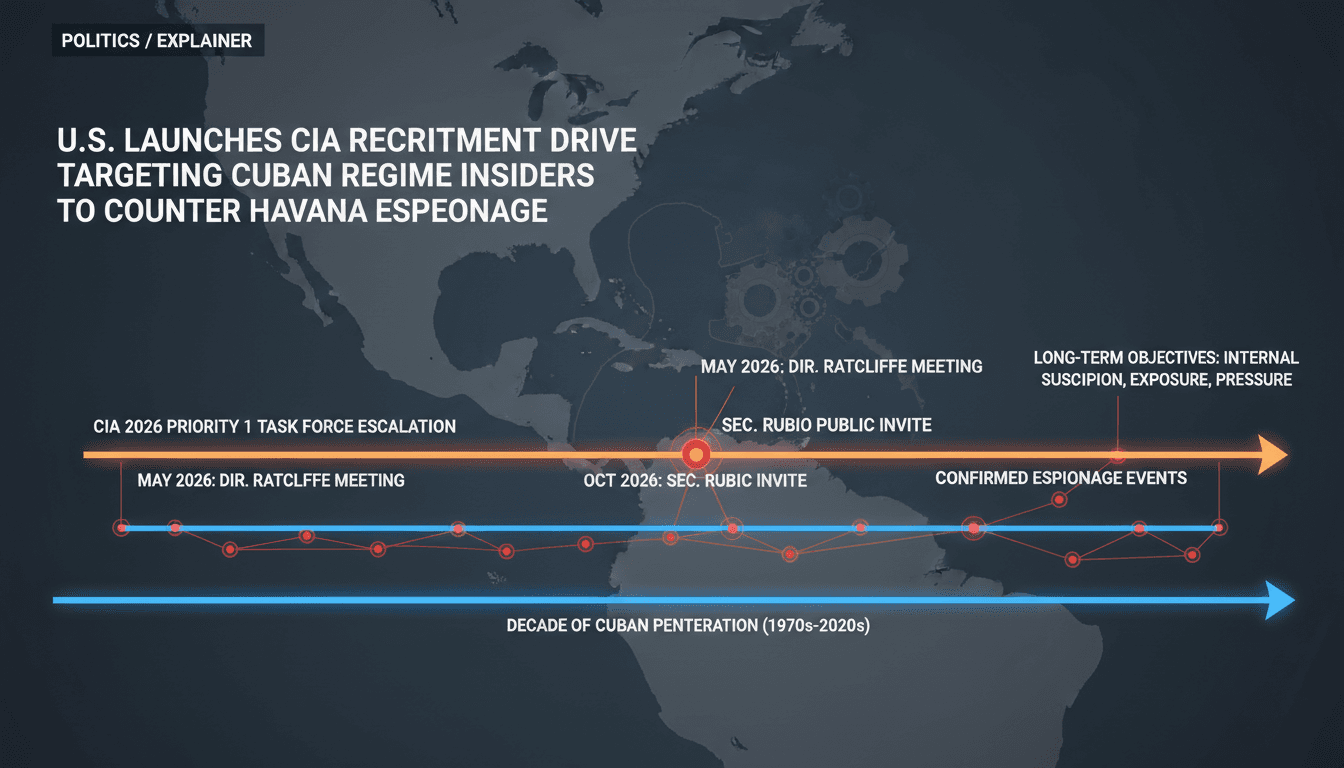
U.S. Launches CIA Recruitment Drive Targeting Cuban Regime Insiders to Counter Havana Espionage
Why it matters
The public intelligence offensive inverts a half-century asymmetric advantage held by Havana, creating operational and diplomatic friction for states relying on Cuban intelligence sharing.
What happened (in 30 seconds)
- Public call for assets: On October 25, 2026, U.S. Secretary of State Marco Rubio issued an overt invitation for Cuban dissidents and regime insiders to securely contact the Central Intelligence Agency (CIA).
- Institutional escalation: By summer 2026, the CIA elevated counter-Cuba efforts to a dedicated "Priority 1" task force following direct Havana meetings led by CIA Director John Ratcliffe in May 2026.
- Countermeasures deployed: The public messaging included Spanish-language operational security protocols from the CIA, supported by U.S. Southern Command messaging, prompting Havana to issue official interference accusations.
The context you actually need
- Decades of penetration: The Dirección de Inteligencia (DI) spent over 50 years compromising American national security, notably through former ambassador Victor Manuel Rocha—who operated undetected for five decades until his December 2023 arrest.
- Ideological recruitment architecture: High-level assets like Defense Intelligence Agency analyst Ana Belén Montes and State Department officials Kendall and Gwendolyn Myers were cultivated on ideological alignment rather than cash, giving Havana deep reach into U.S. policymaking.
- Adversary data routing: Cuban intelligence operations, including the historical Wasp Network, routinely funneled stolen American defense intelligence to global counterparts, including Moscow and Beijing, magnifying the tactical impact of its Washington compromises.
What's really happening
The shift from covert counterintelligence to open-air digital recruitment represents a calculated exploitation of Havana’s internal economic and institutional fragility. Historically, Cuba maintained an asymmetric counterintelligence surplus against Washington. By leveraging patient, ideologically driven recruitment within American universities and policy circles, the Dirección de Inteligencia penetrated institutions at senior levels. The revelation that Victor Manuel Rocha operated inside the U.S. foreign service and National Security Council for approximately 50 years demonstrated the operational depth of Cuba's program.
The economic and institutional incentives within Cuba have inverted. The Trump administration’s Priority 1 task force, formalized in summer 2026, recognizes that Havana’s governing apparatus faces acute resource deficits. Intelligence services function as the core survival instrument for the Communist regime. By publicizing direct, secure digital intake channels, the CIA is not merely fishing for actionable secrets; it is imposing systemic counterintelligence costs on Havana’s Ministry of the Interior.
When a superpower explicitly advertises encrypted communication pipelines directly to security officers and diplomatic insiders, every tier of the target state's hierarchy faces scrutiny. Havana must reallocate scarce operational resources from external intelligence gathering toward domestic internal vetting, background investigations, and counter-surveillance. The objective is to sow institutional paranoia. If regime managers suspect their peers or subordinates are actively communicating with Washington, horizontal coordination inside the apparatus degrades.
Furthermore, this operational shift aligns with a broader framework of diplomatic attrition. Following the public outreach, Washington executed supplemental sanctions against Cuban state entities, pursued Florida state-level arrest warrants against historical figures including Raúl Castro, and revoked legal status for alleged foreign influence operators on American soil. These moves deliberately dismantle the permissive operating environment Cuban intelligence historically enjoyed.
Rather than responding reactively to compromised files after decades of infiltration, the counterintelligence structure is designed to pre-empt adversarial sharing networks. Because Havana acts as an intelligence aggregator for external powers like Russia and China, puncturing Cuban security services strikes at the primary regional hub funneling Western defense data to foreign intelligence consumers.
Who feels it first (and how)
- Cuban security and interior ministry personnel: Face internal vetting, polygraphs, and communications monitoring as commanders attempt to insulate the service from recruitment outreach.
- U.S.-based influence and diplomatic operatives: Suffer legal jeopardy via targeted immigration revocations and state-level prosecution efforts designed to neutralize historical operational footholds.
- Sovereign risk analysts and international compliance teams: Must account for heightened diplomatic friction, expanding sanctions on Cuban entities, and aggressive monitoring of dual-use intelligence infrastructure in the Caribbean basin.
What to watch next
- Operational vetting leak cadence: Track whether U.S. enforcement agencies execute indictments tied to Priority 1 intelligence intake, which will indicate the operational quality of incoming insider tips.
- Havana's counter-purge measures: Monitor personnel reassignments and institutional purges within the Cuban Ministry of the Interior, revealing the extent of internal operational disruption.
- State-level legal escalations: Follow Florida judicial actions, specifically warrants targeting figures like Raúl Castro, to assess how sub-national legal mechanisms intersect with federal counterintelligence directives.
Marco Rubio and the CIA launched public recruitment drives targeting Cuban regime insiders in late October 2026, backed by a designated Priority 1 task force created in summer 2026.
The campaign will force the Cuban Ministry of the Interior to redirect limited state funds toward aggressive internal purges, reducing external collection capacity.
It remains unconfirmed whether initial digital contacts have delivered high-grade tactical penetrations or if the intake channels are being clogged by state-run counter-deception operations.
Frequently Asked Questions
- Why it matters?
- The public intelligence offensive inverts a half-century asymmetric advantage held by Havana, creating operational and diplomatic friction for states relying on Cuban intelligence sharing.
- What happened (in 30 seconds)?
- Public call for assets: On October 25, 2026, U.S. Secretary of State Marco Rubio issued an overt invitation for Cuban dissidents and regime insiders to securely contact the Central Intelligence Agency (CIA). Institutional escalation: By summer 2026, the CIA elevated counter-Cuba efforts to a dedicated "Priority 1" task force following direct Havana meetings led by CIA Director John Ratcliffe in May 2026. Countermeasures deployed: The public messaging included Spanish-language operational securit
- What's really happening?
- The shift from covert counterintelligence to open-air digital recruitment represents a calculated exploitation of Havana’s internal economic and institutional fragility. Historically, Cuba maintained an asymmetric counterintelligence surplus against Washington. By leveraging patient, ideologically driven recruitment within American universities and policy circles, the Dirección de Inteligencia penetrated institutions at senior levels. The revelation that Victor Manuel Rocha operated inside the U
- Who feels it first (and how)?
- Cuban security and interior ministry personnel: Face internal vetting, polygraphs, and communications monitoring as commanders attempt to insulate the service from recruitment outreach. U.S.-based influence and diplomatic operatives: Suffer legal jeopardy via targeted immigration revocations and state-level prosecution efforts designed to neutralize historical operational footholds. Sovereign risk analysts and international compliance teams: Must account for heightened diplomatic friction, expan
- What to watch next?
- Operational vetting leak cadence: Track whether U.S. enforcement agencies execute indictments tied to Priority 1 intelligence intake, which will indicate the operational quality of incoming insider tips. Havana's counter-purge measures: Monitor personnel reassignments and institutional purges within the Cuban Ministry of the Interior, revealing the extent of internal operational disruption. State-level legal escalations: Follow Florida judicial actions, specifically warrants targeting figures li
Conservative-leaning coverage of current events.
"Fox News is a highly influential conservative news outlet known for right-leaning political commentary and coverage."
— A47 Editor
Cuba spent decades recruiting American spies. Now Washington is turning the tables on Havana
Secretary of State Marco Rubio has invited Cuban insiders to cooperate with the CIA, a move that targets Havana's espionage apparatus after decades in which the Cuban government recruited American spies such as Ana Belén Montes. The base report, publ...
24/7 international news from a French perspective in multiple languages.
"France 24 is viewed as a globally focused outlet with balanced coverage and a European perspective."
— A47 Editor
US seeks to topple Cuba's government
In a surprising move, U.S. Secretary of State Marco Rubio has called on Cubans to collaborate with the CIA, a statement that has drawn mockery from Havana, which described the Trump administration's actions as desperate. This development underscores ...
Regional coverage and analysis focused on politics, diplomacy, and business across the Middle East.
"Al-Monitor is known for analytical reporting on Middle East politics and policy developments."
— A47 Editor
Marco Rubio calls on those seeking change in Cuba to partner with CIA
U.S. Secretary of State Marco Rubio has urged individuals seeking change in Cuba to collaborate with the CIA, following remarks from President Donald Trump at a rally in Florida, where he stated that the U.S. would address Cuba after dealing with Ira...