
Iran Declares Strait of Hormuz Will Not Revert to Pre-War Status Following 40-Day US-Israeli Conflict
Why it matters
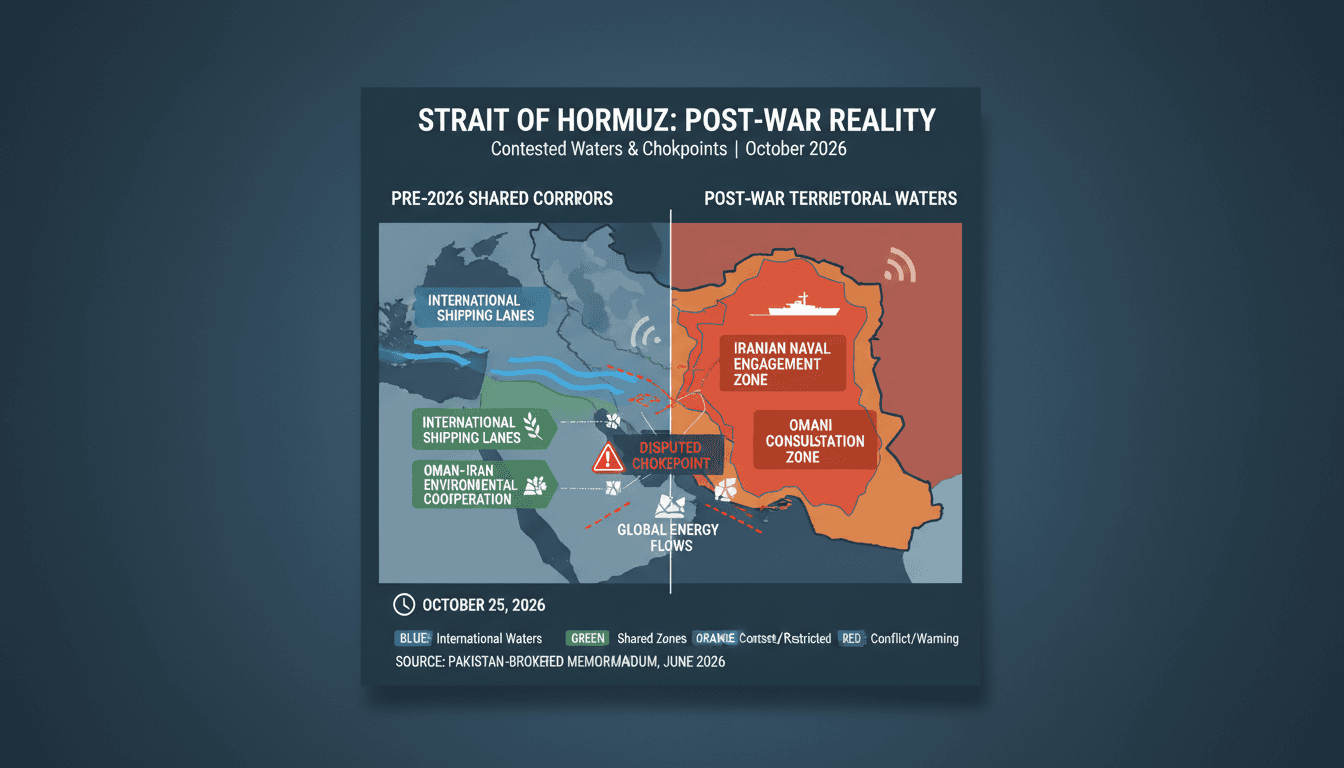
The formal shift away from pre-war maritime governance introduces structural friction into the transit passage carrying roughly a fifth of global petroleum liquids, converting what was once an open commercial corridor into a negotiated, conditional transit space.
What happened (in 30 seconds)
- A declared end to pre-war transit rules: On October 25, 2026, Iranian Foreign Minister Abbas Araghchi stated in Tehran that the Strait of Hormuz will not return to its pre-war operational status following the recent conflict.
- Review of bilateral maritime arrangements: Araghchi announced that longstanding shipping routes and corridor management protocols—historically coordinated between Iran and Oman—must undergo fundamental revision.
- Demands for an external-free framework: Tehran conditioned post-war maritime administration on comprehensive multi-front ceasefires and the total exclusion of non-regional naval forces from Gulf waters.
The context you actually need
- The 40-day conflict baseline: The diplomatic shift directly follows a 40-day war between Iran, the United States, and Israel that started in February 2026, which involved transit restrictions and a US naval blockade before reaching a June 2026 memorandum of understanding brokered by Pakistan.
- Decades of cooperative coordination disrupted: For decades prior to 2026, the Strait operated under practical functional coordination between Iran and Oman, focusing strictly on maritime safety, route separation, and environmental oversight rather than political leverage over commercial shipping.
- Cumulative regional structural transformation: Iranian leadership frames this operational revision not as an isolated tactical measure, but as an institutional adaptation to 18 months of regional conflicts that fundamentally reworked Gulf balance-of-power incentives.
What's really happening
The core mechanism behind Araghchi's announcement is the institutionalization of leverage. For decades, international maritime trade operated under the working assumption that the Strait of Hormuz, while legally complex under the United Nations Convention on the Law of the Sea, functioned as an open passage where commercial traffic remained insulated from regional geopolitical hostilities. The 40-day conflict shattered that assumption. By restricting transit during the war and enduring a reciprocal US naval blockade, Tehran established a precedent: physical access to the Persian Gulf can be directly tethered to sovereign security conditions.
Tehran’s post-war incentive structure is focused on preventing a return to an asymmetric status quo where foreign naval formations project power inside the Gulf while regional states absorb the risks. By formally stating that the administration of the Strait must be reworked, Iran is executing a strategy of maritime regionalization. The goal is to force neighboring states—most notably Oman and the broader Gulf Cooperation Council—into bilateral and multilateral security compacts that explicitly exclude external powers like the United States.
From an economic perspective, this shifts the maritime cost curve. When shipping lanes run under purely technical coordination, commercial freight carries predictable marine underwriting rates and scheduling reliability. Under a contested, regionalized administration, every commercial vessel becomes a data point in sovereign leverage. Iran’s call to review shipping lanes in coordination with Oman introduces bureaucratic, regulatory, and security checkpoints that could replace unimpeded transit with conditional navigation rights.
Furthermore, Tehran is linking transit stability to comprehensive ceasefires across all operational fronts. This bundling strategy means maritime access is no longer treated as an isolated domain of international commerce, but as a bargaining chip for regional diplomacy. Even though post-war negotiations mediated by regional partners remain active, the structural floor has reset. Iran has signaled that it will maintain this posture regardless of external pressure, institutionalizing a security umbrella where access to Gulf waters must be directly negotiated with littoral states.
Who feels it first (and how)
- Container and tanker fleet operators: Face shifting maritime routing declarations, heightened compliance reviews when entering Iranian or Omani territorial waters, and structural increases in vessel war-risk premiums.
- Dubai logistics and re-export hubs: Deal with sustained cost volatility in transshipment schedules and maritime freight overhead, testing the margin efficiency of Jebel Ali’s cargo throughput.
- Energy trading desks: Forced to permanently factor a sovereign transit premium into forward crude and LNG contracts, ending the discount previously applied during periods of diplomatic detente.
- Marine insurance underwriters: Required to reassess hull and cargo risk models for the Strait of Hormuz, transitioning from temporary war surcharges to structural operational risk adjustments.
What to watch next
- Muscat-Tehran bilateral maritime consultations: Watch for official joint communiqués between Iran and Oman regarding updated Traffic Separation Schemes (TSS) or inspection protocols within their respective territorial waters.
- Gulf Cooperation Council diplomatic responses: Monitor whether Gulf capitals accept, modify, or reject Iran’s overtures for an exclusive regional security pact that explicitly locks out foreign naval coalitions.
- Tanker tracking velocity and insurance benchmarks: Track average transit durations and Lloyd’s Joint War Committee listed area designations to see if regulatory uncertainty translates into tangible shipping delays.
The Strait of Hormuz’s pre-war operational status quo has been formally abandoned by Iranian foreign policy following the 40-day conflict, with shipping protocols targeted for overhaul alongside Oman.
Shipping companies will absorb structurally higher transit costs, including elevated war-risk insurance premiums and administrative overhead, as post-ceasefire security rules remain contested.
Whether Oman and other Gulf littoral states will formally consent to a regional-only management architecture that completely removes Western naval guarantees from Persian Gulf transit corridors.
Frequently Asked Questions
- Why it matters?
- The formal shift away from pre-war maritime governance introduces structural friction into the transit passage carrying roughly a fifth of global petroleum liquids, converting what was once an open commercial corridor into a negotiated, conditional transit space.
- What happened (in 30 seconds)?
- A declared end to pre-war transit rules: On October 25, 2026, Iranian Foreign Minister Abbas Araghchi stated in Tehran that the Strait of Hormuz will not return to its pre-war operational status following the recent conflict. Review of bilateral maritime arrangements: Araghchi announced that longstanding shipping routes and corridor management protocols—historically coordinated between Iran and Oman—must undergo fundamental revision. Demands for an external-free framework: Tehran conditioned pos
- What's really happening?
- The core mechanism behind Araghchi's announcement is the institutionalization of leverage. For decades, international maritime trade operated under the working assumption that the Strait of Hormuz, while legally complex under the United Nations Convention on the Law of the Sea, functioned as an open passage where commercial traffic remained insulated from regional geopolitical hostilities. The 40-day conflict shattered that assumption. By restricting transit during the war and enduring a recipro
- Who feels it first (and how)?
- Container and tanker fleet operators: Face shifting maritime routing declarations, heightened compliance reviews when entering Iranian or Omani territorial waters, and structural increases in vessel war-risk premiums. Dubai logistics and re-export hubs: Deal with sustained cost volatility in transshipment schedules and maritime freight overhead, testing the margin efficiency of Jebel Ali’s cargo throughput. Energy trading desks: Forced to permanently factor a sovereign transit premium into forwa
- What to watch next?
- Muscat-Tehran bilateral maritime consultations: Watch for official joint communiqués between Iran and Oman regarding updated Traffic Separation Schemes (TSS) or inspection protocols within their respective territorial waters. Gulf Cooperation Council diplomatic responses: Monitor whether Gulf capitals accept, modify, or reject Iran’s overtures for an exclusive regional security pact that explicitly locks out foreign naval coalitions. Tanker tracking velocity and insurance benchmarks: Track avera
Arabic-language coverage of international news and geopolitics.
"RT Arabic is a Russian state-funded outlet often criticized for promoting Kremlin-aligned narratives."
— A47 Editor
عراقجي: لن يعود هرمز لوضعه قبل الحرب
Iranian Foreign Minister Abbas Araghchi stated that the only path to regional stability is a ceasefire on all fronts, and said conditions will not return to their pre-war state, particularly in the Strait of Hormuz.
Jordanian news and regional updates.
"Roya News is a Jordanian outlet focused on breaking news and local affairs."
— A47 Editor
عراقجي: الوضع في مضيق هرمز لن يعود إلى ما كان عليه قبل الحرب
Iranian Foreign Minister Abbas Araghchi stated on Sunday that the situation in the Strait of Hormuz will not return to what it was before the war, according to a report published by Royanews, which is cited as the source of the story.
Pan-Arab political news and analysis.
"Al-Quds Al-Arabi is a London-based Arabic newspaper known for political coverage."
— A47 Editor
عراقجي: إدارة مضيق هرمز لن تعود إلى ما كانت عليه سابقا
Iranian Foreign Minister Abbas Araghchi said that the wars the region has witnessed have changed security conditions, and asserted that the management of the Strait of Hormuz will not return to what it was previously. He made the remarks in a speech ...