
China Fifth Plenum Convenes to Advance Party Self-Governance and Discipline Ahead of Xi Jinping's Fourth Term Bid
Why it matters
The meeting establishes the administrative and institutional incentives governing the world's second-largest economy ahead of the 2027 leadership transition.
What happened (in 30 seconds)
- High-level gathering opens in Beijing: The 20th Central Committee of the Chinese Communist Party convened on October 26, 2026, for a four-day closed-door fifth plenum centered on "full and rigorous party self-governance."
- Work report and draft decision introduced: General Secretary Xi Jinping presented a comprehensive work report outlining measures to heighten discipline, enhance loyalty, and counter official underperformance.
- Attendance reflects administrative enforcement: Approximately 300 Central Committee members gathered with notable vacancies following rolling disciplinary campaigns across civilian and defense administrative structures.
The context you actually need
- A multi-year anti-corruption framework: The anti-corruption effort launched in 2012 has steadily broadened beyond financial impropriety to target bureaucratic inaction, procedural formalism, and operational non-compliance among cadres.
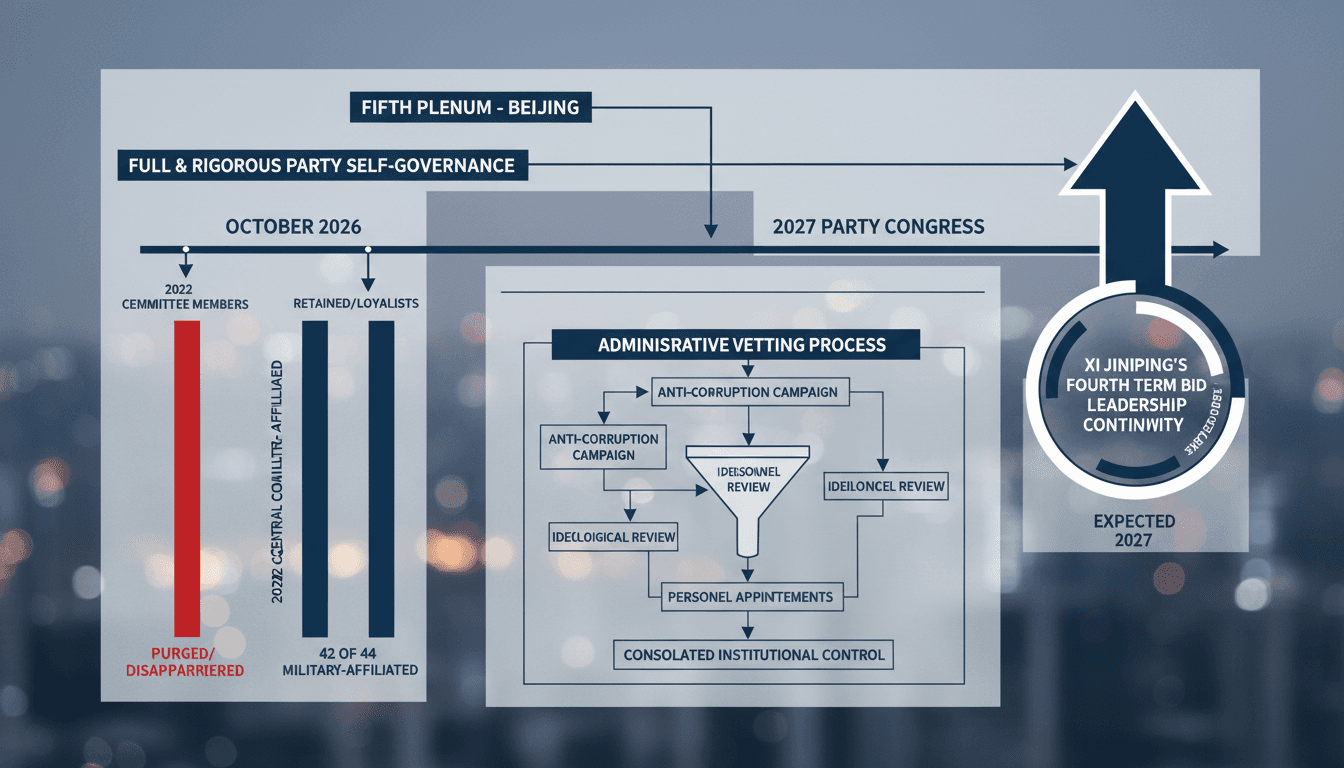
- Structural turnover in the military hierarchy: Disciplinary purges have impacted 42 out of 44 military-affiliated full Central Committee members who took office in 2022, creating substantial structural turnover in institutional bodies.
- Run-up to the 2027 party congress: Occurring approximately one year before the 2027 party congress, the plenum formalizes internal evaluations and vetting standards ahead of Xi Jinping's expected fourth term.
What's really happening
The Fifth Plenum operates as an institutional calibration mechanism, focusing on how internal party authority is structured, verified, and preserved. While third plenums traditionally set economic directions and fourth plenums address legal or administrative systems, fifth plenums historically evaluate mid-term governance execution and lay personnel groundwork for the upcoming political cycle. The central theme in Beijing—advancing "full and rigorous party self-governance"—represents a systematic tightening of oversight aimed at bureaucratic alignment and delivery speed.
For global decision-makers, the critical mechanism to observe is institutional incentive alignment. In large administrative systems, central mandates depend on local and regional cadres for implementation. When central authorities increase scrutiny on formalism and operational underperformance, local official behavior shifts toward strict compliance and risk minimization. Officials are evaluated not solely on aggregate economic outputs, but on absolute adherence to central directives, anti-corruption metrics, and institutional loyalty. This dynamic transforms decision-making across regulatory bodies, state-owned enterprises, and cross-border trade institutions.
The data underscores this operational shift. Disciplinary inspections have systematically removed officials who deviate from strategic mandates or display administrative inertia. The turnover among military-affiliated members of the 2022 Central Committee—where 42 of 44 individuals have been replaced, removed, or investigated—demonstrates that self-governance mechanisms are being applied to core administrative and security institutions alike. These empty seats in Beijing reflect an ongoing administrative realignment rather than a sudden shift in policy direction.
This consolidation directly shapes the operating environment through 2027. Rather than signaling immediate macroeconomic pivot points, the plenum signals absolute policy continuity. With central control reinforced and personnel appointments increasingly aligned around vetted loyalists, internal decision-making becomes more uniform. For international enterprises interacting with state-backed partners or navigating regional compliance regimes, understanding that Chinese counterparties are governed by heightened internal accountability is critical for accurately modeling contractual timelines, project execution speeds, and regulatory authorizations.
Who feels it first (and how)
- Central and regional administrative cadres: Government officials face heightened scrutiny regarding policy execution, compliance reporting, and personal performance metrics.
- State-owned enterprise executives: Corporate leadership within major public corporations must navigate intensified oversight regarding organizational governance and procurement protocols.
- Cross-border corporate strategists: Multinational executives experience longer project vetting cycles as domestic partners verify that all initiatives align with centrally mandated compliance rules.
- Regional commercial hubs, including Dubai: Trade and investment entities monitoring long-term capital flows observe predictable policy continuity from Beijing, facilitating multi-year bilateral planning.
What to watch next
- The concluding plenum communiqué on October 29: The language released at the meeting's conclusion will reveal official assessments of institutional progress and establish administrative benchmarks leading into 2027.
- Subsequent personnel appointments: Tracking replacements for vacated Central Committee positions will clarify which administrative factions and regional leaders hold organizational momentum.
- Regulatory enforcement pacing: Observing the speed and strictness of regulatory decisions by state agencies will reveal how regional cadres balance commercial activity against compliance requirements.
The Fifth Plenum runs from October 26 to October 29, 2026, in Beijing, with Xi Jinping leading discussions on party discipline and drafting self-governance guidelines.
Upcoming leadership appointments ahead of the 2027 party congress will favor officials with proven compliance records and personal alignment with the central leadership.
The exact regulatory tools that will be introduced to enforce anti-corruption standards without dampening local administrative initiative remain undefined in current statements.
Frequently Asked Questions
- Why it matters?
- The meeting establishes the administrative and institutional incentives governing the world's second-largest economy ahead of the 2027 leadership transition.
- What happened (in 30 seconds)?
- High-level gathering opens in Beijing: The 20th Central Committee of the Chinese Communist Party convened on October 26, 2026, for a four-day closed-door fifth plenum centered on "full and rigorous party self-governance." Work report and draft decision introduced: General Secretary Xi Jinping presented a comprehensive work report outlining measures to heighten discipline, enhance loyalty, and counter official underperformance. Attendance reflects administrative enforcement: Approximately 300 Cen
- What's really happening?
- The Fifth Plenum operates as an institutional calibration mechanism, focusing on how internal party authority is structured, verified, and preserved. While third plenums traditionally set economic directions and fourth plenums address legal or administrative systems, fifth plenums historically evaluate mid-term governance execution and lay personnel groundwork for the upcoming political cycle. The central theme in Beijing—advancing "full and rigorous party self-governance"—represents a systemati
- Who feels it first (and how)?
- Central and regional administrative cadres: Government officials face heightened scrutiny regarding policy execution, compliance reporting, and personal performance metrics. State-owned enterprise executives: Corporate leadership within major public corporations must navigate intensified oversight regarding organizational governance and procurement protocols. Cross-border corporate strategists: Multinational executives experience longer project vetting cycles as domestic partners verify that all
- What to watch next?
- The concluding plenum communiqué on October 29: The language released at the meeting's conclusion will reveal official assessments of institutional progress and establish administrative benchmarks leading into 2027. Subsequent personnel appointments: Tracking replacements for vacated Central Committee positions will clarify which administrative factions and regional leaders hold organizational momentum. Regulatory enforcement pacing: Observing the speed and strictness of regulatory decisions by
International stories from NPR’s global desk.
"NPR is an American public media organization known for thoughtful reporting and a slightly left-leaning editorial tone."
— A47 Editor
What to know about China's plenum as Xi seeks stronger party discipline
China's ruling Communist Party opened a closed-door plenum in Beijing on Monday, a four-day gathering of senior leaders at which President Xi Jinping is expected to call for tighter party discipline, about a year before he is expected to secure a fou...
International coverage of politics, culture, and current affairs.
"BBC News is widely regarded as a reputable international news organization, known for its impartial tone and public service mandate."
— A47 Editor
China's big political meeting could see Xi 'tighten discipline' in party
China's ruling Communist Party opened a highly secretive, closed-door four-day plenum in Beijing on Monday, a gathering of senior leaders at which President Xi Jinping is expected to call for tighter party discipline, according to BBC News reporting ...
Global news coverage with extensive reporting on Middle Eastern conflicts and geopolitics.
"Al Jazeera is a Qatar-based broadcaster known for wide regional coverage and alternative perspectives."
— A47 Editor
China’s political elite gather for talks on Communist Party discipline
China's political elite have gathered for a four-day meeting focused on Communist Party discipline, with observers closely watching for signals about the country's direction and future leadership. The talks come amid the ongoing anti-corruption campa...
Comprehensive coverage of Middle Eastern and global issues.
"Al Jazeera is a prominent voice from the Global South, especially the Middle East, with an emphasis on underreported stories."
— A47 Editor
China’s political elite gather for talks on Communist Party discipline
China's political elite have gathered for a four-day meeting focused on Communist Party discipline, with observers closely watching for signals about the country's direction and future leadership. The talks come amid the ongoing anti-corruption campa...
Top international stories selected by The Guardian editors.
"The Guardian is known for its progressive editorial stance and in-depth analysis."
— A47 Editor
Xi Jinping’s corruption crackdown in the spotlight as China prepares for meeting of top leaders
Xi Jinping's anti-corruption campaign remains intense as Chinese Communist Party officials prepare for the fifth plenum, a key meeting where discipline and party loyalty dominate discussions. Since Xi took power in 2012 he has pledged to root out gra...